Military operation in Culiacán hospital due to suspicion of armed men

The armed forces implement a total closure after an alert that no one seems to have seen confirmed, in a macabre déjà vu.

A Macabre Dejà Vu with the Flavor of Bullets and New Protocols

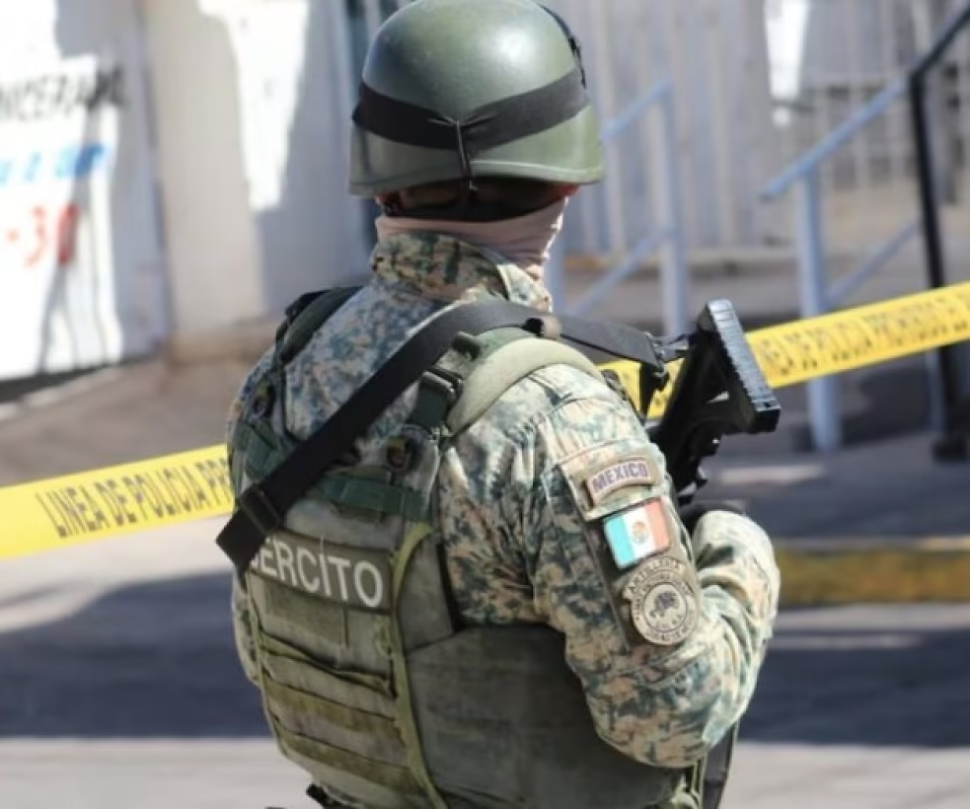
It seems that in Culiacán the phrase “going to the hospital” is acquiring a level of adrenaline that not even the most exaggerated action films would dare to propose. The brand new IMSS-Bienestar Hospital, the one that should smell like disinfectant and hope, today smells like gunpowder and newly released security protocols. The reason? A fun day of preventive confinement for all medical and administrative staff, while outside, visitors enjoyed a pleasant picnic in the parking lot, thanks to the lovely visit of the army and the National Guard.

It all started with an anonymous call to the emergency lines, reporting the presence of exemplary citizens carrying metal toys (meaning: armed men) in the Emergency Department. Immediately afterwards, the authorities, excited to be able to launch the new security protocols announced just 48 hours ago, decided that the best way to verify the rumor was… to lock all possible witnesses inside and leave the family members outside. A communication strategy, without a doubt.

RelatedPatients return to their beds after fire in Culiacán hospital

Reality: Between the Absurdity and Past Tragedy

The funniest thing about this whole comedy of misunderstandings is that the only ones who seem not to have found out about the supposed shooting or the presence of these individuals were, precisely, the people who were inside. The testimonies of the visitors agree on one thing: they did not see anyone armed, they did not hear explosions. Nothing. Zero. Zip. No action. Only the hum of the fluorescent lights and the tension of a military operation that, so far, has not yielded a single detainee. A resounding success.

And if the script were not good enough, the situation is a hilarious echo of the tragedy that bloodied Culiacán at the end of August. It turns out that this same hospital was the scene a few days ago of the “finishing” of a patient in Intensive Care who was recovering from a projectile wound. Almost at the same time, in a private clinic downtown, another poor individual suffered the same fate at the hands of two guys with tactical vests. So, of course, who can blame the authorities for being a bit paranoid? It’s as if after your house burns down, you develop an irrational phobia of matches. Understandable, although a bit theatrical.

The jewel in the crown in this media candle was provided by official statements. On the one hand, the State Public Security Secretariat admitted that a suspicious person had been detected and that, following the new and brilliant protocols, they were proceeding to identify him and assess the potential risk. Meanwhile, the Ministry of Health came out to say, with enviable calm, that they had no evidence of said suspicious presence, but that, oh well, just in case, they still closed everything and checked every last closet. Because better safe than sorry, especially when the headlines are staring at you.

So there you have it. A closed hospital, a search operation in progress, contradictory versions from the authorities and citizens who wonder if, the next time their tooth hurts, it won’t be safer to go to the dentist with a helmet and bulletproof vest. The violence in medical institutions in Sinaloa is no longer news, it is a genre in itself, a tragicomedy that is repeated with a rotating cast of armed characters and officials trying to decipher a security manual that clearly needs a second edition.

The final result? Zero arrests, zero weapons confiscated, and a exhaustive review that, as far as we know, only disrupted medical care and created more chaos. A normal day in the fight for security, where the only certainty is that absurdity continues to win by a landslide.

The moral? If you plan to visit a hospital in Culiacán, bring a book, a bottle of water and a lot, a lot of patience. And maybe pray that your medical emergency does not coincide with the next armed civilian alarm which, hopefully, will be another exercise in coordination between institutions. Have fun!

Does this security reality show seem incredible to you? Don’t stay intrigued. Share this current gem on your social networks and help us make the absurd viral. And if you’re thirsty for more informative surrealism, explore our related content for more episodes of “Mexico: Land of Incongruencies.”
Fuel smuggling grew in militarized customs

Imports of additives have skyrocketed in Matamoros since the Army took control of customs.

Smuggling in Matamoros: growth under military control

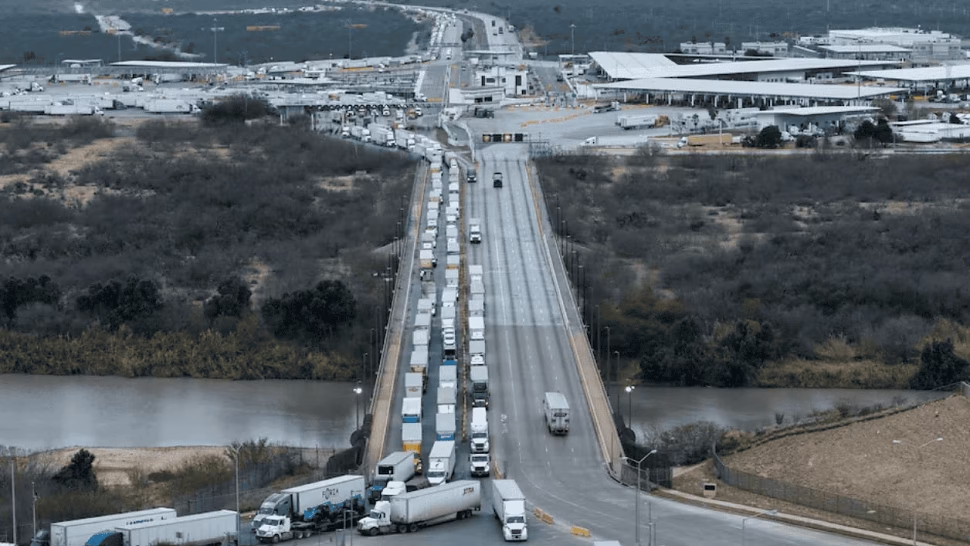
Fuel smuggling from the United States to Mexico, a practice that intensified during the six-year term of Andrés Manuel López Obrador, now involves three high-ranking soldiers from the Secretariat of National Defense (Sedena). The Attorney General’s Office (FGR) accuses them of facilitating the illegal entry of gasoline into the customs office in Matamoros, Tamaulipas, between June 1, 2024 and July 15, 2025.

An investigation by EL PAÍS, based on confidential documents and foreign trade databases, reveals that crime has multiplied in that border area since Sedena assumed control in mid-2020. The militarization of customs, justified by the former president as a measure to guarantee honesty and efficiency, did not prevent the fiscal huachicol – as hydrocarbon smuggling is known – from finding new ways of operating.

Ghost companies and figures that explode

Records show that in 2019 and 2020, suspicious imports of additives and lubricating oils did not exceed 2 million liters. Starting in 2021, with customs in military hands, the volume skyrocketed. That year, the company Nafta Aditivos Orgánicos, indicated in military documents as linked to illegal trade, imported 80 million liters of additives supplied by the American Hevi Logistics.

In 2022, Hevi Logistics shipped another 80 million liters. But the biggest jump occurred in 2023, when imports reached 690 million liters. Most of it came from Hevi Logistics and the rest from Ikon Midstream, another export firm under investigation by US authorities. The importers were old acquaintances, such as Sensive Solutions, which shares management with companies linked to the network of the Ministry of the Navy, or JSC Servicios Aduanales, which received millions of pesos from Ahavat Logistics Solution, identified as an intermediary for the Jalisco New Generation Cartel.

By 2024 and 2025, the numbers fell to pre-2021 levels. However, the FGR discovered a new method: using calcium chloride solution as a disguise. The JR Customs Services company would have smuggled 144 million liters of fuel between June 2024 and July 2025 with the complicity of the three fugitive soldiers.

Official response and previous evidence

Sedena responded to EL PAÍS that operational control of customs corresponds to the National Customs Agency of Mexico, although it reiterated its willingness to collaborate with the FGR. The prosecution described the case as “one of the largest smuggling schemes detected in the country.”

Internal documents leaked by Guacamaya Leaks indicate that the Government had information since January 2020 about the unusual increase in lubricant imports without economic support. In recent weeks, the United States Department of the Treasury sanctioned companies and individuals complicit in a tax huachicol network linked to the Jalisco Nueva Generación Cartel, with 160 reports of suspicious activities worth $7 billion from Texas and Florida.

Continue reading

Semar cancels tsunami warning after earthquake in Chiapas

Semar cancels tsunami warning after reviewing sea levels in the Pacific.

Alert cancellation

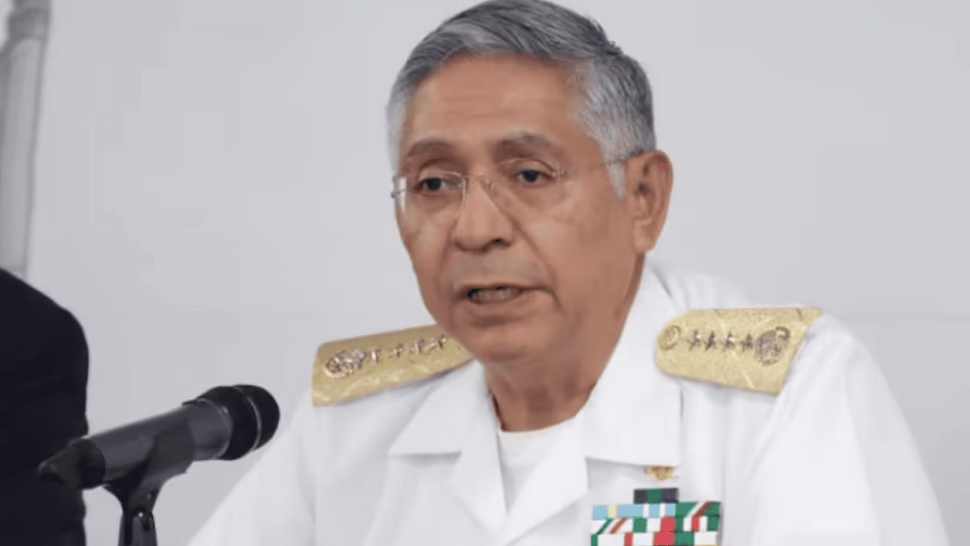
The Secretary of the Navy (Semar) reported the cancellation of the Tsunami Alert for the Mexican Pacific. The measure was taken after the 7.4 magnitude earthquake recorded 135 kilometers southwest of Ciudad Hidalgo, Chiapas.

According to the department in charge of Raymundo Pérez Morales, the decision was based on the analysis of sea level observations. On the coasts near the epicenter, no significant variations are expected.

Semar maintains permanent monitoring of sea conditions to inform the population of any changes. “Prevention, surveillance and timely information are part of our commitment #ParaServirAMéxico,” he posted on his X account.

Security recommendations

After the earthquake, President Claudia Sheinbaum Pardo activated security protocols. On his social networks he asked not to go near the beaches in the next few hours due to the risk of tsunami. “The Secretary of the Navy recommends not approaching those beaches in the next six hours due to the risk of tsunami. It is important to follow the recommendations of Civil Protection,” he wrote around 10:00 a.m.

Semar continues to monitor the sea to guarantee the safety of the population and avoid incidents.

Continue reading

Texas buoys break off and close border bridges

One hundred Texas buoys were dislodged by the rising Rio Grande and closed bridges.

Loose buoys in the Rio Grande

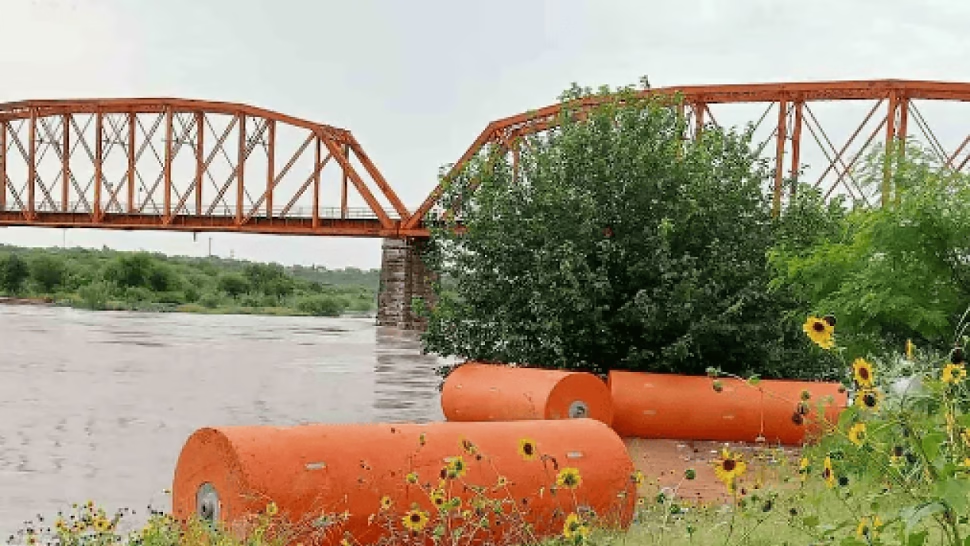
Around 100 buoys and floating walls placed by the Texas government on the border between Eagle Pass and Piedras Negras, Coahuila, dislodged due to recent rains and the increased flow of the Rio Grande. State Civil Protection images show how the structures are carried away by the current; some are already stuck in Mexican territory.

International bridges were immediately closed due to the risk of impact. Eagle Pass Mayor Aaron Valdez reported on social media that they would remain closed until the buoys passed. His counterpart from Piedras Negras, Jacobo Rodríguez, confirmed the situation in a video: “There are 100 coming that were brought by the current and they are loose; let’s hope they get stuck somewhere.”

Each floating wall weighs about a ton. Given the possibility of hitting the bridge structure, it was decided to close the border crossing.

No risk of overflow for now

The buoys, installed to deter unauthorized migrant crossings, were placed on the US shore. Francisco Contreras Obregón, regional coordinator of State Civil Protection, explained that between 5 and 6 in the afternoon the flow would reach its maximum point: 2,183 cubic meters per second, with a depth of 7.5 meters. He assured that there is no risk of overflow, but urged the population not to approach the area.

Continue reading