Heat wave in France leaves 2,000 additional deaths

At least 2,000 additional deaths in a week due to record temperatures in France.

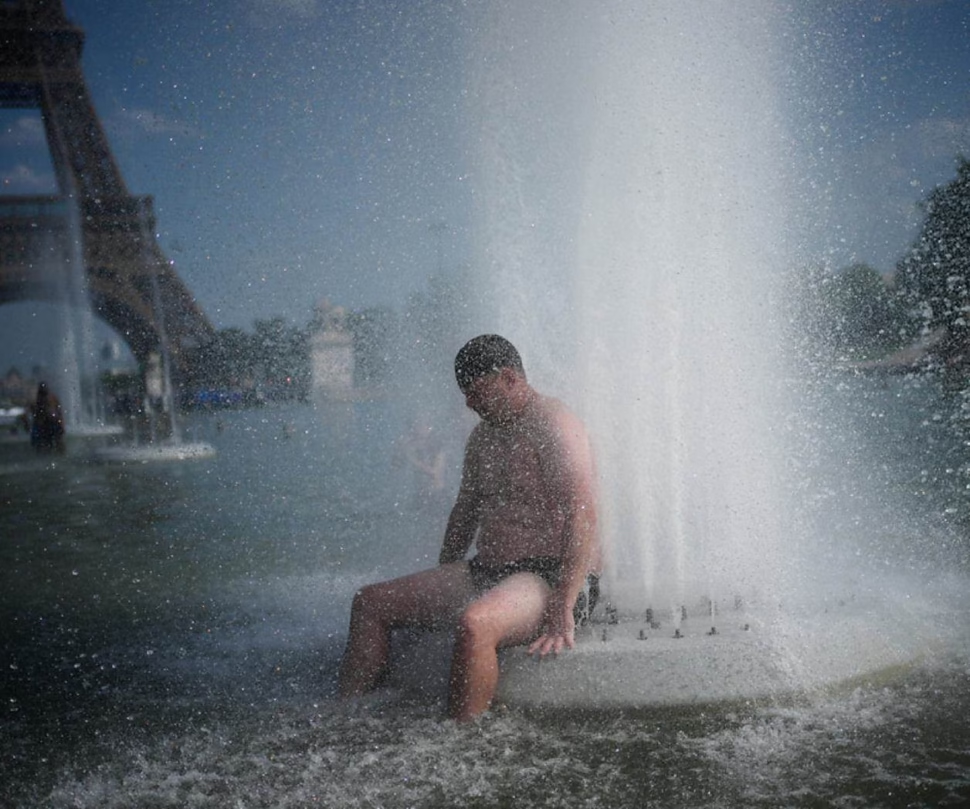
The heat wave that hit France at the end of June left a tragic toll. According to Public Health France, deaths increased by almost a third during the hottest week, with at least 2,000 more deaths than the previous week.

Preliminary and revised figures

The agency reported 8,973 deaths between June 22 and 28, 29% more than the 6,948 recorded between June 15 and 21. The difference of 2,025 deaths is attributed to extreme heat. This figure doubles the initial estimate of 1,000 additional deaths.

RelatedSweltering Europe: France on red alert due to extreme heat

Public Health France warned that the numbers are partial and that the real mortality will be higher.

Impact on hospitals and communities

Dr. Nicolás Gonzales, head of emergencies at Paris-Saclay Hospital, told The Associated Press:

“Patients with heat exposure began arriving on June 20. We treated cases of heart attacks, dehydration and kidney failure, from children to elderly people who lived alone.”

Deaths in private homes shot up 91% compared to the previous week. In nursing homes they increased by 37%, and in hospitals by almost 20%. The Paris region was the most affected, with an increase of 63%.

Overload in funeral services

In Paris, funeral directors reported difficulties storing bodies before burial or cremation. Several morgues were at their limit and rejected bodies.

France recorded its hottest days in history between June 22 and 28, with day and night records in multiple locations. The wave also affected other European countries.

Health authorities continue to monitor the situation while awaiting definitive data.
Women fishermen in Kenya: from the sea to ecotourism due to the climate crisis

Kenyan women transform their relationship with the sea in the face of the fishing crisis.

Women fishermen in Kenya: from the sea to ecotourism due to the climate crisis

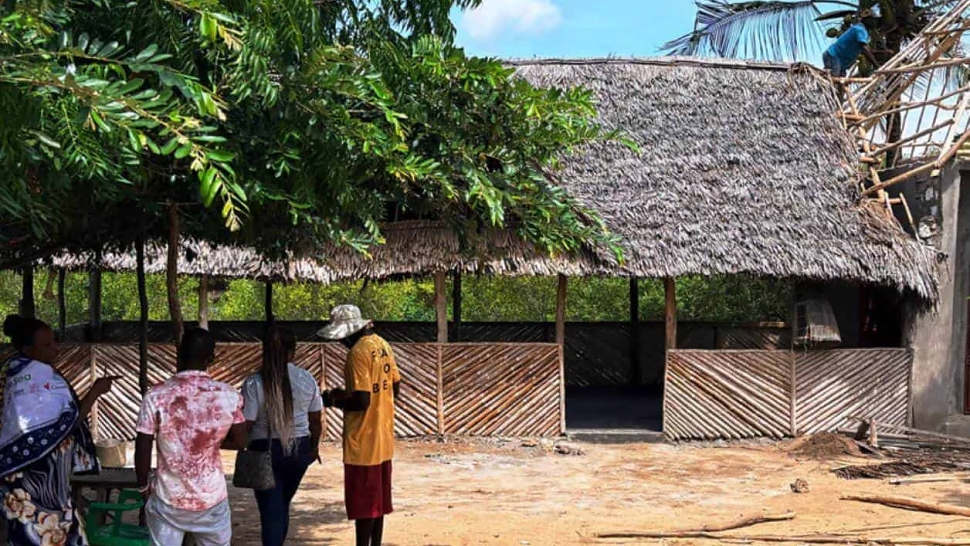
Nuru Mohammed, 54, leads a group of women hanging fishing nets as decorations at her new restaurant in Malindi, northeast of Mombasa. In a few days it will open its doors. “For us women, this is hope,” she says. “It will help support many families who have depended on the ocean for decades.”

Along the East African coast, fishermen are reinventing themselves. Climate change, overfishing and ocean deterioration threaten their livelihoods. In Kenya, women transform restored mangroves into sources of income through beekeeping and ecotourism. In Zanzibar, communities protect reefs with locally managed closures. In Mozambique, seagrass restoration creates jobs.

“Communities that depend on the ocean are also its best guardians,” says Andréanne Martel, project director of the ReSea conservation program. “When local people, especially women, lead in conservation, they protect biodiversity and create more resilient livelihoods.”

Mohammed says that his boats have been stolen and that it is difficult for him to compete with industrial trawlers. A nearby Chinese processing plant reflects the changes. “I can’t compete with that power,” he says. “It’s been hard. I fought to stay a fisherman, but I think it’s a battle I can’t win anymore.”

10 kilometers away, Beatrice Mwanyiro oversees a mangrove nursery and restaurant for Samahco, a self-help group of 30 women supported by the Canadian government. “We have to adapt. The number of fish decreases every year. Without another source of income we will not be able to feed our families,” he explains.

Mohamed Somo, a fishing leader in Lamu, says that they used to catch up to 100 kilos of fish per boat; now less than 30. Kenyan law prohibits trawling within 9 kilometers of the coast, but some vessels operate closer. Illegal, unreported and unregulated fishing costs $23 billion annually, according to the FAO.

“The trawlers fish on the high seas during the day, but at night they enter the shallow waters where we artisanal workers work. There is very little left in the morning,” adds Somo.

Jerry Mang’ena of Action for Ocean in Tanzania says: “Coastal communities are on the front lines of climate change, but they are also drivers of resilience. If we want to protect the ocean, we must invest in those who have cared for it.”

At the recent Our Ocean Conference in Mombasa, organizations called for ratifying the BBNJ (high seas) treaty, which came into force in January and has been signed by 145 countries and ratified by 81. Aliou Ba of Greenpeace Africa says: “The agreement offers a historic opportunity to protect the high seas and tackle illegal fishing that deprives communities of food and income. Governments cannot delay.”

Continue reading

Fujimori announces intention to resume ties with Mexico

The elected president of Peru seeks to reestablish dialogue with Mexico after statements by Sheinbaum.

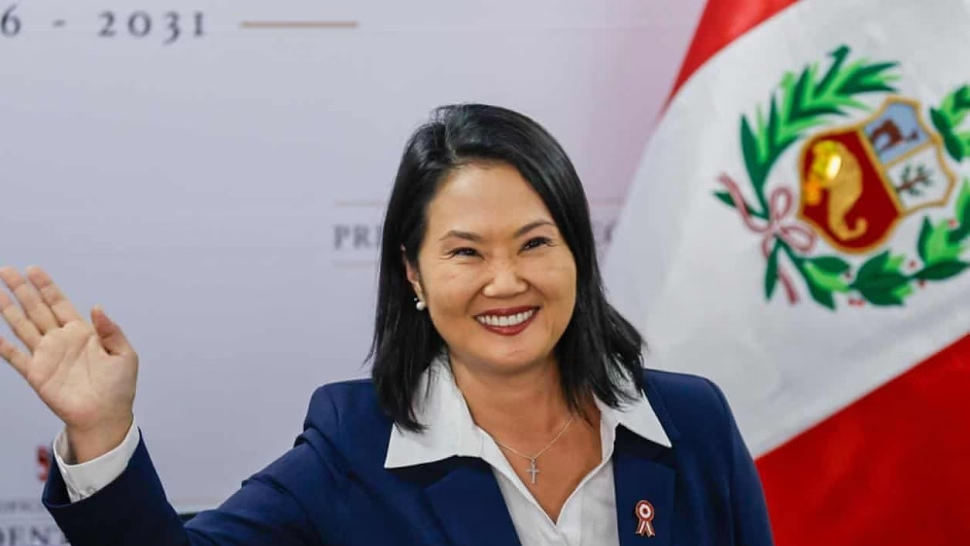
The elected president of Peru, Keiko Fujimori, stated on Thursday that she has “every intention” of resuming diplomatic relations with Mexico. The statement came a day after the Mexican president, Claudia Sheinbaum, indicated that she had not yet contacted Fujimori to congratulate her on her electoral victory.

“On my side there will be every intention to be able to resume relations between Peru and Mexico,” Fujimori briefly told the press during a public event in Lima.

Background of distancing

Sheinbaum had declared in his morning conference: “We are going to wait, remember that they broke off relations with us.” The break occurred in 2025, when Peru decided to break ties after the diplomatic asylum granted by Mexico to former Prime Minister Betssy Chávez, who took refuge in the Mexican embassy in Lima. Chávez is still waiting for safe passage to travel to Mexico, which Peru has not granted.

The conflict originated in December 2022, when the Peruvian Congress dismissed then-president Pedro Castillo, who was imprisoned after trying to dissolve the Legislature. In this context, Castillo’s wife and two minor children received asylum at the Mexican embassy and then moved to Mexico. Since then, both Andrés Manuel López Obrador and Sheinbaum requested Castillo’s release.

Castillo’s arrest sparked protests that left 50 dead during the repression by security forces under the government of Dina Boluarte. Later, Castillo and Chávez were sentenced to 11 years in prison for conspiracy to rebel. Castillo has appealed the sentence and faces other corruption investigations.

Asked if she considers Castillo’s detention illegal, as Sheinbaum claims, Fujimori responded: “I am very respectful of the institutions of my country.” However, before being proclaimed the winner, she had already pointed out that Peru and Mexico share the Pacific Alliance bloc and that there are “ties of friendship that must be prioritized beyond differences.”

Continue reading

IMF and Venezuela: call for emergency funds after earthquakes

IMF confirms call with Venezuela to release $350 million in humanitarian aid after earthquakes.

Key call between Georgieva and Rodríguez

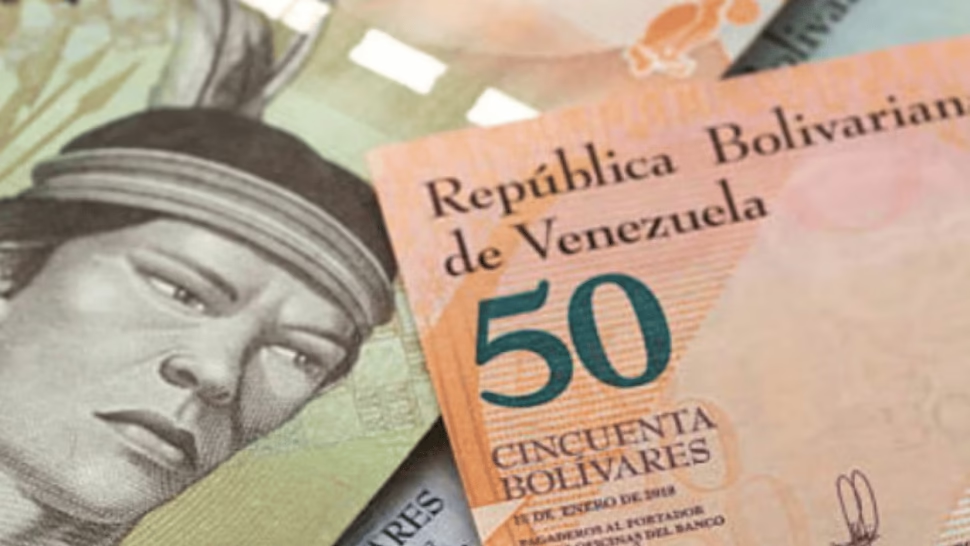
The International Monetary Fund (IMF) confirmed this Thursday that its managing director, Kristalina Georgieva, spoke by phone with the interim president of Venezuela, Delcy Rodríguez. The central issue was access to the country’s reserve tranche in the organization, an immediate liquidity mechanism valued at approximately $350 million, intended to cover urgent humanitarian needs.

IMF spokesperson Julie Kozack explained that both officials analyzed the economic impact and humanitarian needs caused by the twin earthquakes of June 24. So far, the earthquakes have caused more than 3,800 deaths, nearly 17,000 injuries and have left almost 18,000 people homeless in the north of the country.

“It is an important and easily available source of liquidity that can be mobilized quickly to help meet urgent humanitarian needs arising from the disaster,” Kozack explained.

Available resources and political context

This reserve tranche is independent of the Special Drawing Rights (SDR) retained by the IMF, which amount to about $4.5 billion. In total, Venezuela’s assets in the organization add up to nearly $5 billion. The IMF indicated that it has worked with counterparts to facilitate access to the country’s own resources.

The conversation occurs as emergency response efforts and damage assessment continue in several regions. Days before the earthquakes, Venezuela fully reestablished its membership in the IMF, after years of distancing during the governments of Hugo Chávez and Nicolás Maduro. This approach occurs in the new political context after the capture of Maduro by US forces on January 3.

Continue reading