


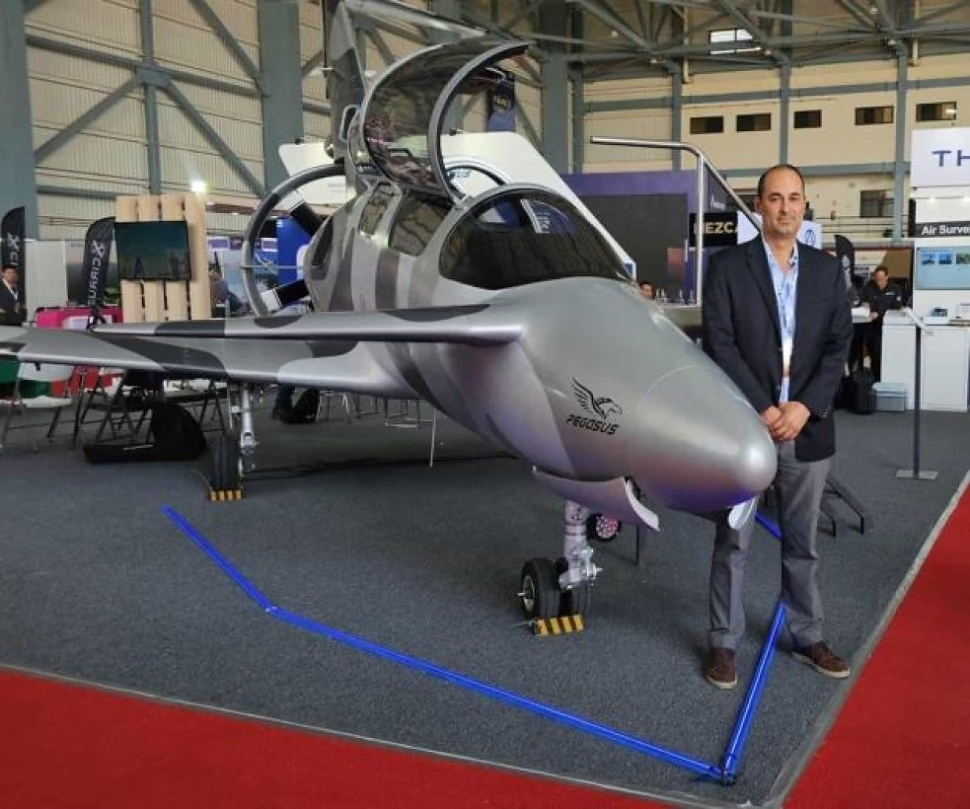
Oaxaca Aerospace promotes Mexican aviation with tactical aircraft
The company Oaxaca Aerospace, led by founder Raúl Fernández López, announced during the Mexican Aerospace Fair 2025 (FAMEX) that it will begin production of the Pegasus PE-210A aircraft in 2026. This project, developed entirely in Mexico, represents a milestone for the national aerospace industry, with a focus on applications tactics, training and surveillance.
Technical characteristics and competitiveness
The PE-210A is a two-seat model with a tandem cabin, designed for versatile operations. It has a range of 1,600 kilometers, autonomy of 5 hours, maximum speed of 210 knots (389 km/h) and payload capacity of 350 kilograms. Its estimated price of 1 million dollars positions it as a competitive alternative, with a cost 30% lower than similar aircraft in the global market.
The company projects an annual production of 52 units (one per week) at its plant located in Oaxaca, where the prototype has already been developed. Fernández López highlighted that the design, started in 2011, integrates adaptive technology, allowing future updates such as electric or hydrogen engines.
Expansion of the Pegasus line
In addition to the PE-210A, Oaxaca Aerospace presented the Pegasus P-400T, an advanced model valued at 3 million dollars. This prototype, aimed at reconnaissance missions, high-speed general aviation and light attack, offers a range of 1,800 kilometers and speed of 240 knots (444 km/h). Both aircraft are designed to meet both military and civil demands, with special emphasis on emerging markets in Latin America.
Institutional support and industrial perspective
Manuel Pérez Cárdenas, executive advisor of the Business Coordinating Council, stressed the need for public policies that promote strategic sectors such as aerospace. “These projects require tax incentives, academia-industry collaboration and access to financing,” he noted. The Oaxaca Aerospace initiative not only reduces technological dependence on foreign countries, but also positions Mexico as a relevant player in the global aviation value chain.
With an estimated investment of 50 million dollars for the initial phase, the company is seeking alliances with governments and commercial partners. Its focus on sustainability and technological adaptability responds to global trends, such as the decarbonization of air transport.
Are you interested in the future of aviation in Latin America? Share this note and discover more about aerospace innovation in our specialized section.


