


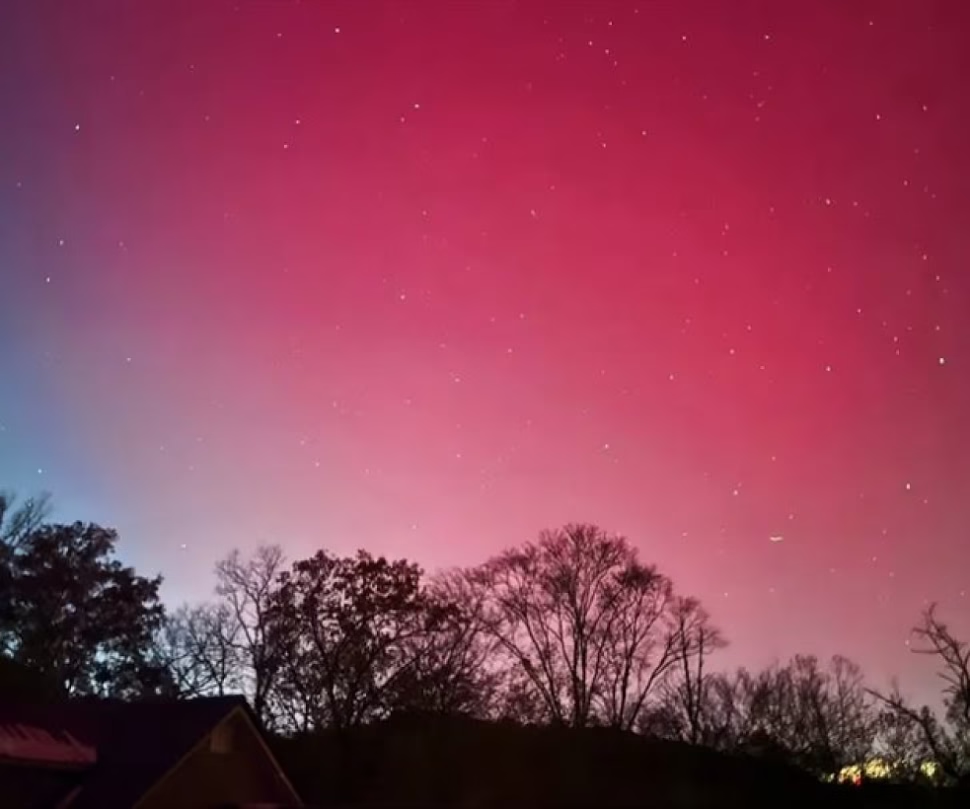
Northern Lights Forecast for Mexico After New Geomagnetic Storm
Researcher Juan Américo González Esparza, attached to the Institute of Geophysics of the National Autonomous University of Mexico (UNAM), has reported that sightings of the northern lights in Mexican territory could intensify. This phenomenon is anticipated due to the arrival of a second geomagnetic storm during the evening of Wednesday, November 12, driven by a new cloud of solar material that is heading towards our planet.
In exclusive statements for the Maximum House of Studies, the scientist highlighted that the solar event recorded the previous Tuesday already allowed the observation of polar lights in several regions of the country. This unusual astronomical event in mid-latitudes is directly linked to the exceptional intensity of the solar wind generated by the recent activity of our star.
Mechanism of Formation of Polar Auroras
The expert meticulously detailed the physical process that gives rise to these light shows. The northern lights occur in the upper layers of the Earth’s atmosphere when charged particles from the Sun interact with the planet’s magnetic field and collide with atmospheric molecules, mainly oxygen and nitrogen. These collisions excite the atoms, which upon returning to their ground state emit photons of light, creating the characteristic curtains of dancing colors.
González Esparza explained that these light phenomena are frequent in high latitude regions such as Finland, Sweden, Norway or northern Russia, where the Earth’s magnetic field naturally channels solar particles towards the poles. However, its appearance in low-latitude nations such as Mexico constitutes an extraordinary event that requires solar winds of severe intensity, such as that recorded during the preceding event.
Scientific Surveillance and Assessment of Technological Risks
The specialist emphasized that the Mexican Space Weather Service (SCIESMEX) of the UNAM maintains continuous monitoring of solar activity and its effects on the terrestrial environment, with special attention to the national territory. This specialized body systematically evaluates the potential risks of high solar activity on critical technological systems through state-of-the-art instrumentation networks.
“We function as the official source of strategic information regarding these natural phenomena and provide fundamental technical data to the National Civil Protection System,” stated the researcher. This surveillance work is crucial to implement mitigation protocols in the event of possible impacts on sensitive infrastructure.
The UNAM has forcefully clarified that there are no risks to human health derived from the observation of northern lights or exposure to geomagnetic storms. However, the effects of these space weather events can impact strategic technological systems such as satellite constellations, telecommunications networks, global positioning systems (GPS), aerial navigation and electric power distribution networks.
It is essential to highlight that these astrophysical phenomena have no causal relationship with geological events such as earthquakes, meteorological events such as hurricanes, nor with the patterns associated with anthropogenic climate change. This conceptual precision is essential to avoid misinformation and pseudoscientific speculation.
Are you fascinated by the spectacle of the auroras in Mexican skies? Share this information on your social networks and help us spread the science of space weather. To delve deeper into these astronomical topics, explore more specialized content on our website.


