New species of firefly discovered in the Chapultepec Forest

A citizen vote will decide the name of this endemic species, honoring the legacy of five pioneering women. Participate in this milestone of science and culture.

Finding of a New Species in the Heart of Mexico City

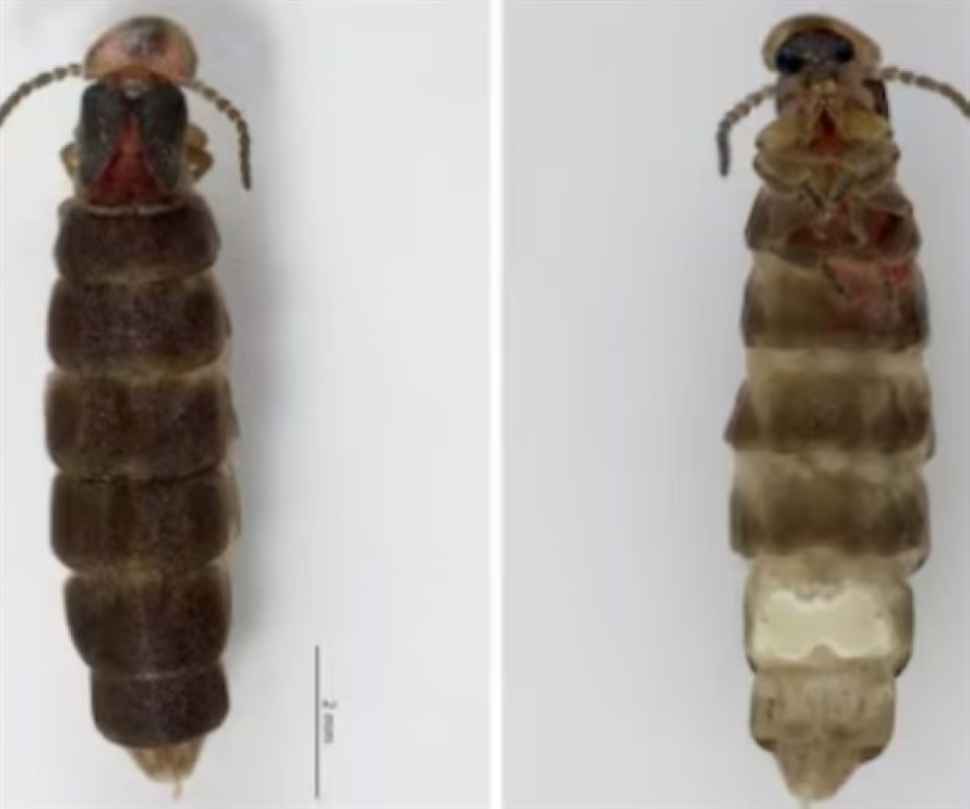
The Ministry of the Environment (Sedema), in an inter-institutional collaboration with the General Directorate of Coordination of Environmental Policies and Culture, the Digital Agency for Public Innovation (ADIP) and the National Autonomous University of Mexico (UNAM), has officially announced the discovery of a new species of firefly (Lampyridae) within the ecosystem of the Chapultepec Forest. This significant finding underlines the biological richness that persists in urban areas and reinforces the importance of environmental conservation.

The discovery occurred by chance on September 2, 2024, within the framework of a BioBlitz, an intensive biodiversity observation and recording event. During this activity in the first section of the forest, UNAM researchers detected a light flash pattern that did not coincide with those of known species. The subsequent laboratory analysis, which included the examination of morphological and probably ethological characteristics, confirmed that it was a taxon not described by science, belonging to the genus Photinus.

RelatedA firefly is named after Julieta Fierro

The public announcement was made at a press conference titled “Mexican women who illuminate us: let’s name a new species of firefly,” held at the Museum of Natural History and Environmental Culture. This approach not only highlights the discovery itself, but frames it in a context of historical and cultural recognition.

A Participatory and Inclusive Naming Process

In an unprecedented exercise of citizen participation and scientific dissemination, the authorities have decided that the scientific name of this new firefly will be chosen through a public vote. The initiative seeks for citizens to take ownership of the discovery and, at the same time, pay tribute to the legacy of Mexican women whose work has been fundamental in various fields of knowledge and culture.

The participation mechanism is accessible and available on the digital platform plazapublica.cdmx.gob.mx/luciernaga. The process requires simple registration to ensure voting transparency. Participants can consult the detailed profiles of the five proposed candidates before casting their vote. The voting period will be valid from September 26 to October 5, 2025.

Profiles of the Candidates for Scientific Immortality

The proposed scientific nomenclature for each of the candidates follows the standard protocol, adding a Latin suffix to the genus Photinus. The options represent a diversity of contributions to the history of Mexico:

Irene Elena Motts Beal (Photinus irenemottsae): Biologist, teacher and author of French origin who settled in Mexico since 1896. She is recognized as one of the pioneers in the pedagogy of biology in the country, contributing decisively to the creation of natural science textbooks for all educational levels, laying the foundations of modern scientific education in Mexico.

Magdalena Cervantes Castañeda (Photinus cervantesae): Tepehuana educator from Huajicori, Nayarit, distinguished for implementing an innovative teaching methodology. Their work empowers their students, encouraging them to become tutors and delve deeper into their areas of interest. In addition, it actively promotes pride in the Tepehuana language and culture among new generations, strengthening community identity.

Malinalli Tenepal (Photinus malinalliae): Known historically as La Malinche, she was a crucial figure in the period of the Conquest. Equipped with an exceptional command of languages, she acted as translator, interpreter and diplomatic strategist. Her role as a mediator between cultures was decisive in the configuration of the alliances that defined the course of Mesoamerican history, representing the complexity of the encounter between two worlds.

Maria Sabina (Photinus mariasabinae):
Renowned Mazatec healer and wise woman from Huautla de Jiménez, Oaxaca. Her deep knowledge of traditional medicine and the ceremonial use of sacred mushrooms made her a global icon. His legacy has inspired numerous research in ethnomycology and psychotherapy, facilitating a unique dialogue between indigenous ancestral knowledge and contemporary science.

Rosario Castellanos (Photinus rosariocastellanosae): One of the most influential literary voices of the 20th century in Mexico. Poet, narrator, essayist and diplomat, her work acutely addresses topics such as identity, the oppression of indigenous peoples and the condition of women. His work constitutes a profound social criticism and a fundamental pillar of Mexican literature.

Implications of the Discovery and the Initiative

The discovery of this new species of beetle in a space as emblematic and busy as Chapultepec is a powerful reminder that urban biodiversity still holds secrets to be revealed. Fireflies, in addition to their aesthetic value, are bioindicators of the health of an ecosystem; Its presence indicates favorable environmental conditions, with low light and soil pollution. This finding validates the conservation and ecological restoration efforts carried out in the forest.

The strategy of involving the public in choosing the name is a success in terms of science communication. It transforms a technical act, such as the description of a new species, into a collective cultural experience. By linking the name to female historical figures, the underrepresentation of women in scientific nomenclature is partially corrected and the public is educated about their contributions, generating an emotional and intellectual link between the community, its natural heritage and its historical heritage.

This process sets a precedent for future discoveries, demonstrating that science can be participatory, inclusive and a vehicle for gender equality and cultural recognition. The final name will not only identify this firefly in scientific literature forever, but will perpetuate the legacy of an exceptional woman, symbolically lighting the way for future generations.

Would you like one of these pioneering women to name this scientific discovery?Share this news on your social networks so that more people know about this unique initiative and participate in the vote. Explore more content on Mexican biodiversity and conservation projects in our environment section.


Buscan nombre para especie de luciérnaga descubierta en Chapultepec

How artificial intelligence transforms global security

Motorola Solutions is committed to hybrid models and agentic AI in the transformation of the sector.

Security industry: cloud migration and artificial intelligence

Security is undergoing a profound transformation. The cloud, generative artificial intelligence and video surveillance systems as decision tools are redefining the sector. This was stated by Pedro Simoes, global vice president of video security and analytics at Motorola Solutions.

“The cloud is a very strong trend, but it is not a solution for all sectors,” he explained. Prison facilities, airports and nuclear plants require hybrid models that combine local infrastructure with cloud services. Motorola Solutions is committed to unified platforms.

One of the key advances is agentic artificial intelligence. The company introduced Operator, a platform that integrates video, access controls and sensors in a single interface. The objective: reduce the time between detection and response. “It’s not just identifying. It’s being collaborative in decisions,” said Simoes.

The role of sensors in smart cities

Cameras no longer just record: they are sensors. “Today a camera produces data that can be used to optimize logistics, mobility or business decisions,” he added. Security information extends to multiple applications.

However, the growth of AI poses privacy challenges. Motorola Solutions developed “AI nutrition labels,” documents that detail capabilities and limitations of its models. “We are the first company in the sector to create and use this type of labels,” said Simoes.

Mexico and the 2026 World Cup

Mexico is experiencing a key moment for the 2026 FIFA World Cup. The arrival of millions of visitors is driving investments in technological infrastructure and security in airports, hotels and stadiums. Simoes confirmed collaboration with governments, without revealing details. “Safety is a priority; our responsibility is to develop technology that protects people and infrastructure.”

He recommended organizations think long term: “The decision should not be based only on current problems, but on the challenges of three or five years.” The combination of cloud, generative AI and unified platforms will define the next stage of the sector.

Continue reading

Strawberry Moon: the June full moon will arrive on the 29th

The Strawberry Moon will light up the night sky on June 29. Know its origin and other names.

The night sky will offer a notable astronomical event at the end of June. That month’s Full Moon, known as the Strawberry Moon, will reach its maximum splendor on Monday, June 29, according to the specialized portal Star Walk.

When and how to see it?

The full moon will occur exactly at 5:57 in the afternoon, central Mexico time. It will be the first full Moon after the summer solstice, which according to the same source will happen on Sunday, May 21. The satellite will be fully illuminated from June 28 to 30.

The origin of the name

Despite what its nickname suggests, the Moon does not take on a pinkish or reddish hue. The name “Strawberry Moon” comes from the native North American peoples, who named it that way because it coincided with the harvest season for this fruit in various regions of the continent.

In other cultures, this same full moon receives names such as:

  • Moon of Moras
  • Honeymoon
  • Rose Moon
  • Moon of Ripening Berries
  • Garden Moon
  • Green Corn Moon
  • Windy Moon
  • Birth Moon
  • Moon When the Buffalo Bellows

All of these nicknames are linked to natural phenomena typical of the same time of year.

Continue reading

The oldest plague: remains from 5,500 years ago in Siberia

Traces of plague from 5,500 years ago found in teeth of Siberian hunter-gatherers.

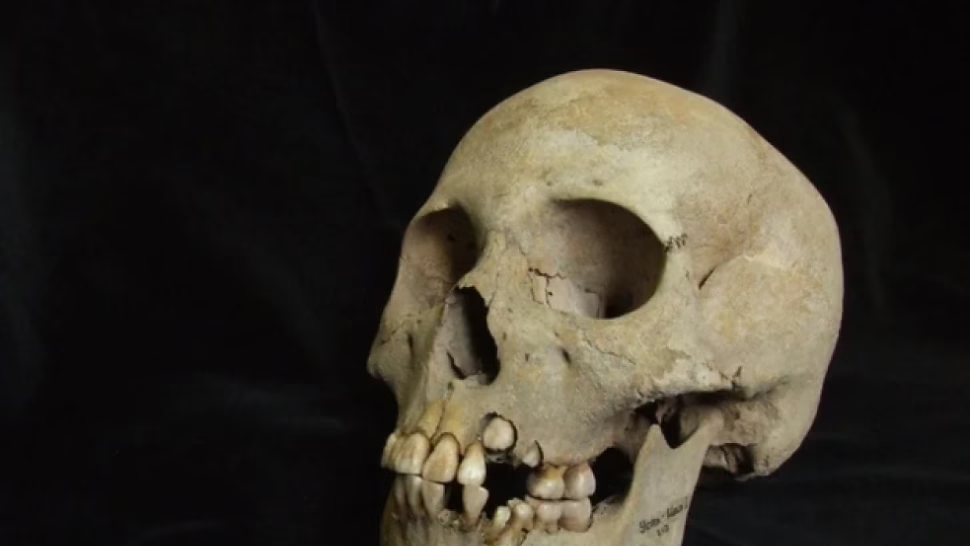
Scientists have identified the earliest evidence of plague known so far: traces of bacterial DNA in the teeth of hunter-gatherers buried near Lake Baikal in Siberia. Carbon dating indicates that the disease caused outbreaks about 5,500 years ago, about 200 years earlier than previously thought.

Finding in Siberia

A team led by geneticist Eske Willerslev of the University of Copenhagen analyzed remains from four cemeteries. They found traces of Yersinia pestis in the teeth of 18 individuals. The dating revealed two episodes of infection.

“To understand our own history, understanding the history of the plague is extremely important,” Willerslev said.

The prehistoric plague spread in stages. According to the authors, it was probably transmitted from marmots—native rodents—when people consumed their raw organs or handled infected skins. It also spread from person to person through coughing or sneezing.

Many of the deceased were children between 8 and 11 years old. Three girls were buried together; two were cousins. An aunt and her nephew were found in another mass grave. “There were people who buried the dead and who knew who they were. It’s a very human element,” said co-author Ruairidh Macleod, an expert in ancient DNA at the University of Oxford.

Implications of the study

The researchers note that children may be at greater risk due to still developing immune systems. The presence of multiple victims suggests that the prehistoric plague caused both isolated cases and outbreaks, said geneticist Aida Andrades Valtueña, from the Max Planck Institute for Evolutionary Anthropology, who was not involved in the study.

This ancient strain evolved long before the bubonic plague responsible for the medieval Black Death. However, there is evidence that earlier plagues were just as serious. The disease not only affected populous cities, but also small nomadic groups.

“Understanding the steps the bacteria took to become the deadly pathogen we know today can provide clues about how pathogens could emerge in the future,” wrote Andrades Valtueña.

The study was published Wednesday in the journal Nature.

Continue reading