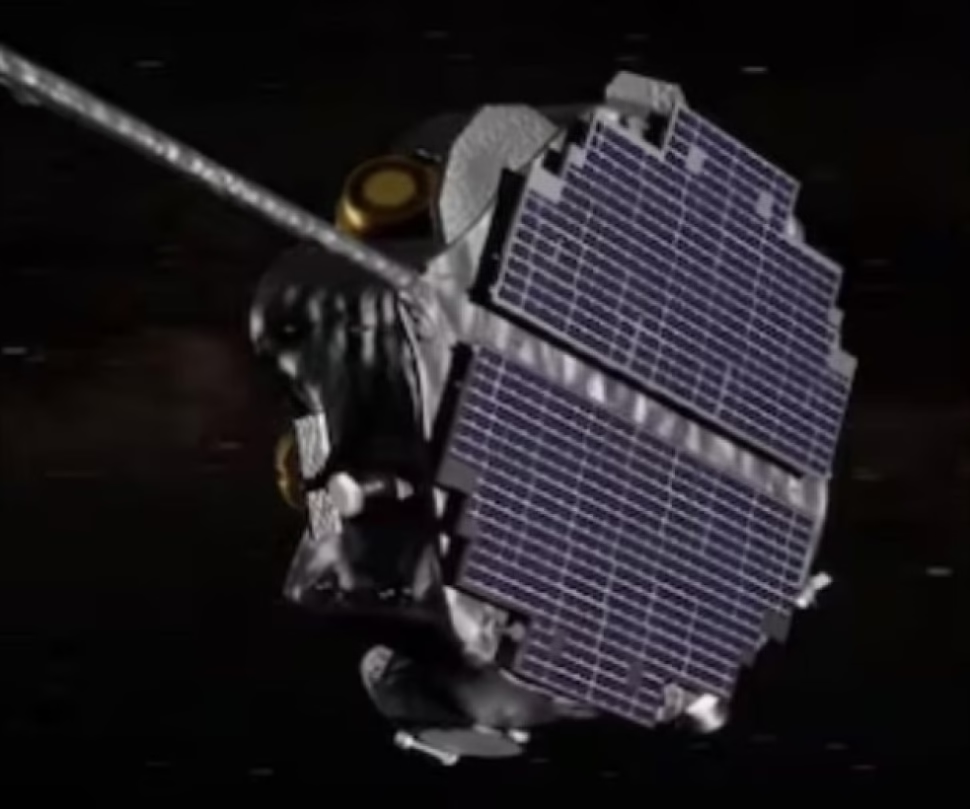
NASA, in its eternal quest to understand the neighborhood, launches another device into the void
It seems that the National Aeronautics and Space Administration (NASA, for friends who save ink) has thought that, instead of solving earthly problems like the price of avocado, it is more fun to launch very expensive toys into space. Last Wednesday, with the solemnity that characterizes these events, the IMAP mission took off from the Kennedy Space Center in Florida. His objective, not at all modest, is to go for a walk to study the heliosphere, because of course, what is better than understanding a giant bubble when on Earth we have economic bubbles that we don’t understand even a little?
But NASA, in a fit of cosmic efficiency (or perhaps to justify the budget), decided that a single satellite was too lonely. So IMAP was joined by two colleagues, SWFO-L1 and Carruthers, in what could well be the most expensive interplanetary carpooling in history. Together, these ships will be installed at a strategic point in space, the Lagrange point 1, at a comfortable distance of one million miles from Earth. A perfect place to observe the Sun without the smoke from terrestrial barbecues spoiling the view.
What exactly does this luxury spacewalk consist of?
The IMAP probe (or Interstellar Mapping and Acceleration Probe, for those who prefer the long and pompous name) aspires to be the modern celestial cartographer par excellence. Your job will be to trace the limits of the heliosphere, that protective bubble created by the Sun that envelops our solar system like cosmic bubble wrap. Imagine it: a satellite doing the job of a surveyor, but on a scale where a miscalculation means getting lost in the immensity forever. Doesn’t that seem adorably ambitious?
The spacecraft will be dedicated to analyzing in great detail how the Sun, in its stellar outbursts, launches charged particles and how this energy interacts with the galactic environment. That is, basically, spying on the disputes in the interstellar neighborhood. According to scientists, this will help understand two minor things: the energization of particles and the interaction of the solar wind on its border with interstellar space. Nothing fancy, just the fundamental physics that keeps deadly radiation at bay. But hey, who needs to worry about that when we have social media?
To carry out this titanic task, IMAP is equipped with 10 scientific instruments of the latest technology. Ten. Because with nine it would fall short and with eleven it would be a waste. These instruments will detect everything from high-energy particles to magnetic fields to the remains of exploded stars. Basically, it’s the cosmic equivalent of bringing a camera, thermometer, anemometer, and metal detector on a hike, just in case.
The heliosphere: the bubble that we all depend on (and are unaware of)
And what is this famous heliosphere that NASA people like to study so much? Well, in simple terms, it is a giant bubble created by the Sun that protects us from the inclemencies of interstellar space, like a cosmic umbrella of epic proportions. It is formed thanks to the solar wind, a constant flow of particles that leaves the Sun and travels through all the planets until, three times beyond Pluto, it encounters the interstellar medium and says “this is as far as I’ve come.”
Studying it is crucial to… well, to stay alive, basically. Understanding their dynamics gives us clues about the habitability of planets and the physics of space. Or, in other words, to know exactly what protects us from becoming cosmic popcorn. An investigation undoubtedly more useful than the last season of your favorite series, although probably less entertaining.
IMAP spacecraft separation confirmed! One down, two to go! SWFO-L1 is up next! – @NASAKennedy
So you already know. As you read this, probably worried about your electric bill or traffic, there is a satellite traveling a million miles away to map the boundaries of our solar bubble. A reminder that, in the midst of our daily problems, humanity continues to launch engineering wonders into the cosmos to satisfy its insatiable curiosity. Is it an extravagance? Maybe. Is it fascinating? Absolutely.
Did you like this ironic look at space exploration? Share this article with other science and satire lovers. And be sure to explore more content about the mysteries of the universe in our science section.