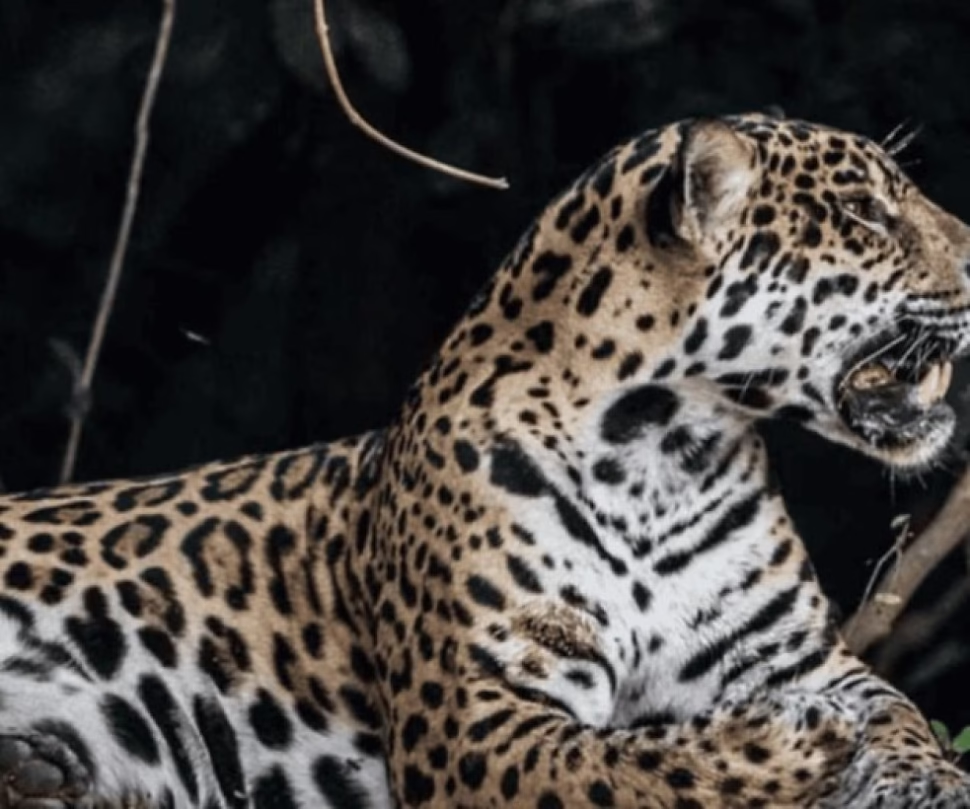
The rescue and rehabilitation of Xamã, an Amazonian jaguar
The case of Xamã, a male jaguar (Panthera onca) from the Brazilian Amazon, constitutes a meticulously documented example of contemporary efforts to conserve threatened species. This individual was located at approximately two months of age on a rural property in the Sinop region, state of Mato Grosso, an area located within the critical Deforestation Arc of the Amazon, recurrently devastated by forest fires. The most solid hypothesis suggests that its mother was probably a victim of the flames or was forced to abandon her calf during the escape.
After its rescue, the puppy was transferred to the Veterinary Hospital of the Federal University of Mato Grosso (UFMT). Upon admission, he weighed just over 10 kilograms, accompanied by symptoms of malnutrition and dehydration. Initial clinical evaluations confirmed that, despite its weakened state, the specimen was in general health and, crucially, exhibited extreme reluctance to human contact. This last factor, far from being negative, was essential, since it indicated the preservation of their natural instincts, a fundamental prerequisite for a potential reintroduction into the wild.
This rescue caught the attention of World Animal Protection, an organization that identified in the history of Xamã an opportunity to demonstrate the impact of agricultural expansion on wildlife. Biologist Júlia Trevisan, the organization’s wildlife coordinator, explained that, as it is an animal with minimal anthropogenic contact, it was emerging as an ideal candidate for reintroduction. The rehabilitation task was entrusted to Onçafari, an organization with international recognition in the reintroduction of jaguars, pioneer in the first successful release worldwide in 2016.
A meticulous process towards freedom
After five months of intensive care in Sinop, where he managed to almost triple his weight to 27.5 kilograms, Xamã undertook a transfer of more than 700 kilometers to a huge rehabilitation facility in the state of Pará. This space, measuring 15,000 square meters and built in the middle of the forest, had previously been used in reintroduction experiences. However, the challenge with Xamã was significantly greater due to his young age. Leonardo Sartorello, coordinator of the Onçafari Reintroduction Program, admitted the high initial risk, since the animal became practically invisible in an enclosure of such magnitude, generating uncertainty about its survival.
The initial period after entering the facility was critical; Xamã fasted for almost six days, worrying behavior for a puppy. Gradually, he began to eat pieces of chicken and beef again. Monitoring using surveillance cameras allowed the team to evaluate their adaptation and exploration of the territory. Two factors were decisive in supporting its release: the development of its hunting ability, perfected to the point of killing live prey in less than two minutes with a precise bite on the neck technique, and the evolution of its interaction with other jaguars, going from submissive behavior to a defiant attitude towards potential rivals.
In October 2024, after almost 24 months of preparation, the release was carried out using the soft release technique. It took Xamã more than 12 hours to voluntarily leave the premises, embarking on a completely free life. The GPS collar that he wears has allowed him to track his movement through more than 43,000 hectares of Amazon rainforest, recently showing stabilization in an area with a high food supply and low territorial dispute.
A success in an overall persistent threat landscape
While the story of Xamã stands as a conservation success, it illustrates an exception within a national context of growing threats. Brazil is home to the largest population of jaguars in the world, estimated at around 10,000 individuals distributed mainly in the Amazon, the Pantanal, the Atlantic Forest and the Caatinga. In all of these biomes, the species faces critical pressures. The fires, intensified by climate change and deforestation, have had a devastating impact on the Pantanal, claiming the lives of specimens monitored for years, such as the female Gaia, and condemning others, like Amanaci, to permanent captivity due to irreversible injuries.
Threats vary by region. In the Atlantic Forest, the reduction of habitat and the loss of forest connectivity are the main risks, leading to the genetic isolation of populations and increasing conflicts with farmers. Biologist Yara Barros, from Onças do Iguaçu, emphasizes that these conflicts are a direct consequence of loss of habitat, which forces greater interaction between humans and felines. Roberto Cabral, environmental analyst at IBAMA, adds that this conflict begins a perverse cycle: man’s hunting of the jaguar’s natural prey leads the feline to prey on livestock, which in turn unleashes retaliation and hunting.
In the Amazon, the threats become more complex with hunting and international trafficking driven by Chinese demand. The scarcity of Asian tigers has led the illegal market to replace them with the so-called “American tigers”, increasing poaching to extract skins, heads, teeth and claws. Brazilian legislation is perceived as excessively lenient, with ridiculous fines and minimal prison sentences that do not act as effective deterrents. Sartorello criticizes that an offender who killed four jaguars in 2023 merely paid a fine and faces trial in freedom.
The reintroduction process itself is a monumentally expensive and bureaucratic undertaking. Daniela Gianni of NEX No Extinction, an institution that currently houses 27 unrecoverable jaguars, details that the cost of releasing a single individual ranges between 800,000 and 1 million reais (140,000 to 180,000 dollars). This process, which requires at least three years, involves perfect health of the animal, exhaustive mapping of the area and the submission of a detailed report for approval by environmental agencies, without any government funding.
The story of Xamã, documented in the film “Xamã – No Rastro da Onça”, transcends the individual anecdote. It serves as a stark reminder of the direct connection between agribusiness, deforestation, fires, and the biodiversity crisis. As Júlia Trevisan concludes, the impact is not limited to the death or captivity of individuals, but alters vital ecological functions such as seed dispersal and prey control, thus having a cascading effect on the health of forests and the global climate. Xamã’s return to freedom is a scientific and ethical triumph, but also an urgent wake-up call about the need for more robust and effective conservation policies.
Were you moved by the story of Xamã? Share this article to help raise awareness of the challenges of jaguar conservation and explore more content on biodiversity and rewilding efforts in our specialized section.