State of Mexico recognizes environmental defenders in 16 categories

For the first time, the state administration recognizes the work of 18 anonymous heroes on the front line of ecological defense.

A Milestone in the Recognition of Ecological Work in the State of Mexico

The Governor of the State of Mexico, Delfina Gómez Álvarez, has presided over an event of great institutional and symbolic relevance: the first delivery in the history of the entity of recognitions to environmental defenders. In total, eighteen people and a civil association were honored in an event that sets a fundamental precedent in the official assessment of the fight for conservation. This ceremony constitutes the materialization of an unprecedented public call, designed specifically to praise the work, effort, commitment and achievements of those citizens whose exemplary actions contribute directly to the protection, conservation and restoration of Mexican ecosystems.

The recognition program was structured into sixteen different categories, a strategic decision that demonstrates a deep understanding of the multidimensionality of environmental defense. This segmentation made it possible to make visible and nominate a broad and representative spectrum of society, including men, women, young people, girls and boys, older adults, indigenous people, scientists, academics, civil society organizations and forest rangers. This inclusive approach recognizes that the protection of natural heritage is a collective task that transcends ages, genders, professions and cultural origins.

RelatedJulión Álvarez conquers Reynosa with a historic concert

Government Commitment and Environmental Legal Framework

During her intervention, the state president contextualized this recognition within the broader framework of her administration’s public policies. He recalled that, from its beginning, the environment was established as a transversal priority. This commitment has been translated into concrete actions of great significance, the most significant being the elevation of the rights of nature to constitutional status. This legal reform is pioneering and transformative, as it recognizes nature and biodiversity as subjects of law, a paradigm that radically changes the legal relationship between society and its environment.

In parallel, an ambitious reforestation plan has been promoted aimed at the conservation and restoration of forests and green areas, crucial for the mitigation of climate change and the preservation of biodiversity. In the field of animal protection, the implementation of the Decalogue Against Animal Abuse has been reinforced with concrete initiatives for the safeguarding of species and an aggressive strategy to reduce the incidence of forest fires, phenomena that represent one of the greatest threats to regional ecosystems.

The Laureates: Profiles of Exemplary Dedication

The eighteen awardees represent the embodiment of these principles. Behind every name are stories of resilience and dedication, often anonymous, that have involved years, and even decades, of continuous effort. They are individuals who have dedicated their existence to the protection of a specific forest, to the defense of a river threatened by pollution, to the conservation of a species in critical danger of extinction, or simply to the noble task of educating their communities in respect and symbiosis with the natural environment. As Governor Gómez Álvarez stated, “for us you are true heroes and heroines of our time.”

The list of awarded people is a mosaic of this commitment: Lourdes Vargas Ramírez, José Luis Bailón Becerril, Adolfo Pineda Valdés, Erika Adriana Reyes Velázquez, Nayelli Rodríguez Bruno, Luis Enrique Pacheco Carlos, Alejandra Sánchez García, Edna Fabiola Valdés Hernández, the civil association Grupo Ecologista Guardianes del Ehécatl y Sierra de Guadalupe, Florencio López Arriaga, Alfredo Ocampo Hernández, Elizabeth Teresita Romero Guzmán, Francisco Javier Perea Alonso, Javier Lizardi Hernández, José Mejía Cirilo, Emily Gisselle Quintero Sánchez and Ángel Eduardo Valdés Rangel. Each of them is an essential node in the state’s environmental protection network.

This act of recognition, therefore, transcends the mere ceremonial. It stands as a powerful political signal that institutionalizes the value of active citizenship in ecological matters. It sets a standard for future administrations and, most importantly, inspires a new generation to get involved in defending the planet, demonstrating that this effort, although sometimes silent, is seen, valued and essential for building a sustainable future.

Were you inspired by the work of these environmental defenders? Explore more stories about conservation and share this news to help make visible the crucial work for our planet.
Sheinbaum reinforces security and housing in Cuautla

The president presented a package of social and security actions in Cuautla, Morelos.

President Claudia Sheinbaum visited Cuautla, Morelos, to announce a set of social and security measures. Among them, the construction of 10 new schools of the “Margarita Maza” National High School, house-to-house visits, more jobs through Young People Building the Future and a greater presence of the National Guard.

“We are going to build together, because this is a job for everyone, for families to care for their children, for the state government and for the federal government,” the president highlighted.

The visit occurred after the arrest of the mayor of Cuautla. Sheinbaum instructed strengthening the federal presence with attention to the causes, as part of the National Security Strategy. Next week they will begin house-to-house tours and outreach to merchants. He promised to return in three months to monitor progress.

Housing for Wellbeing

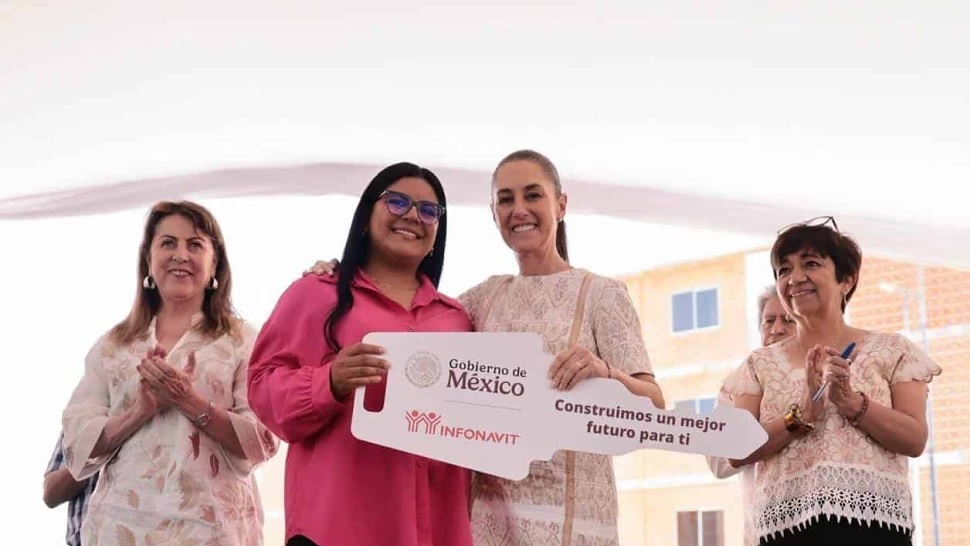
At the event, 128 Infonavit homes and 207 Insus deeds were also delivered. Sheinbaum recalled the four components of the program: build 1.8 million new houses for people with incomes of one to two minimum wages; deliver the same number of credits for improvement; grant a million deeds; and restructure unpayable loans for 5 million families.

Octavio Romero Oropeza, director of Infonavit, reported that of the goal of 1.2 million homes, there are already 440 approved complexes that total 514 thousand houses (43% progress). In Morelos, the goal is 13 thousand new homes with an investment of 8,150 million pesos.

Edna Elena Vega Rangel, head of Sedatu, explained that 128 homes and 207 deeds were delivered. Governor Margarita González Saravia thanked the expansion of the state goal to 24 thousand houses in the six-year term, in addition to other works such as modernization of the countryside, a Convention Center in Cuernavaca and the “Circuito Tierra y Libertad” highway program.

The beneficiary Kendra Ramírez Orozco expressed her gratitude for access to housing. Sheinbaum reiterated his commitment to return in three months to follow up.

Continue reading

They demand justice for a journalist in Oaxaca; colleague receives threats

Threats against journalist in Oaxaca after the murder of Alejandro Leyva; protest in the Guelaguetza.

Threats against correspondent

After the murder of Francisco Alejandro Leyva Aguilar, Proceso‘s correspondent in Oaxaca, Pedro Matías Arrazola, was intimidated through social networks. They warned him that he would be next.

Organizations such as Reporters Without Borders and the UN demanded that the threats be investigated and security guarantees granted. The Oaxaca Prosecutor’s Office deployed two agents to protect him, and the state police carry out patrols near his home.

“I didn’t find out until they told me about Reporters Without Borders and then the UN, but I didn’t pay much attention to it (…). Better to keep a low profile,” declared Matías.

The journalist explained that he avoided spreading the threats so as not to divert attention from Leyva’s case. However, colleagues advised him not to minimize the risk, in a context of growing attacks against the press.

Two years ago, individuals threw Molotov cocktails with nails at his home, without causing any injuries. That attack forced him to leave the country for six months. Sixteen years earlier he was kidnapped and tortured.

“I am not afraid. I am a believer. I have a mission in this life and it will be until God decides,” he stated.

Matías filed a complaint for threats with the State Prosecutor’s Office. Its incorporation into the federal protection mechanism began.

“If we remain silent, they will have achieved their purpose. In recognition of Alejandro Leyva, I will continue along the same critical line,” he said.

Protest in Guelaguetza

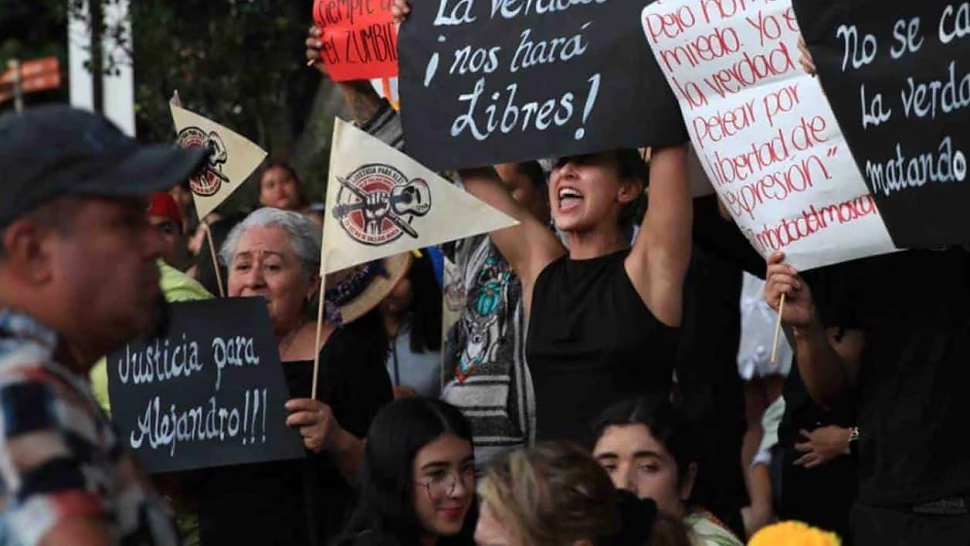
Relatives and friends of Alejandro Leyva protested during the Guelaguetza delegation parade. With tarps, banners on the roof of a house and dressed in black, they demanded justice.

“We are Alejandro’s family and we ask for justice for my uncle. We know the situation in the country. It is not just Oaxaca, it is the entire country. Please join our cause,” expressed the protesters.

Continue reading

Sheinbaum announces border reopening for Mexican cattle

Gradual reopening of the US border to Mexican cattle at the end of August.

New stage for national livestock farming

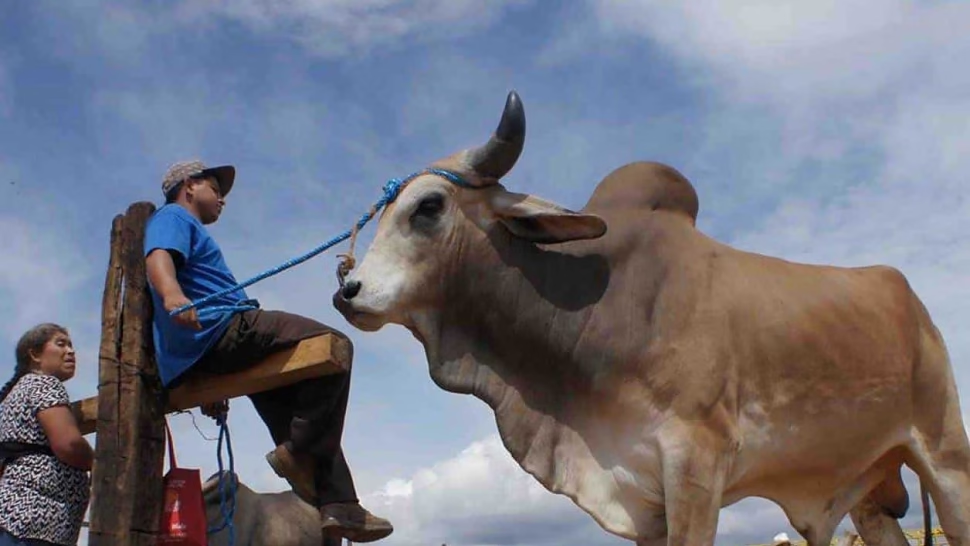
President Claudia Sheinbaum confirmed that the United States border will gradually reopen at the end of August for the export of Mexican livestock. The measure represents economic relief for the country and for thousands of families dedicated to livestock farming.

Both nations suffered losses during the shutdown, caused by the presence of the screwworm. Sheinbaum acknowledged that the coordinated work between governments and producers for more than a year made it possible to contain the pest.

“You know that we have been working on the issue, both with all the livestock organizations and with the governors, to contain the screwworm,” said the president from Cuautla, Morelos.

As part of the strategy, a plant to produce sterile flies is already operating in Chiapas. In addition, Cofepris is analyzing a new strain that would make the process more efficient.

Sheinbaum explained that the effort is carried out in conjunction with the governments of Mexico, the United States and Panama. This articulation created the conditions for the US authority to authorize the opening of the border.

Continue reading