Navy of Mexico and the US agree on new maritime security strategies

Mexico and the US reinforce maritime security with new operational and technological agreements.

High-level meeting between naval commanders

Admiral Raymundo Pedro Morales Ángeles, head of the Secretary of the Navy (Semar), met with commanders of the United States Navy and Coast Guard from June 3 to 5. The objective was to design maritime security strategies, strengthen search and rescue efforts, and reaffirm the binational commitment against transnational organized crime.

The agreements were formalized with Admirals James W. Kilby and Kevin E. Lunday, deputy chief of naval operations and commandant of the Coast Guard, respectively. In the working groups, coordination mechanisms were reviewed under principles of mutual trust and respect for sovereignty. The maritime space is consolidated as one of the most dynamic axes of the bilateral agenda.

RelatedThe Navy faces investigations for internal corruption

Technological and environmental cooperation

The US authorities recognized the operational capacity of the Mexican Navy, highlighting the naval trinomial model—ships, helicopters and interceptor patrols—and the incorporation of unmanned systems for surveillance and target tracking.

Secretary Morales Ángeles underscored the urgency of strengthening the North American Maritime Security and Safety Initiative (NAMSI). This trilateral mechanism, in force since 2008, allows the exchange of information and coincident operations to stop illicit activities, maintaining the sovereign control of each country. In the environmental field, Mexico ratified its commitment against illegal fishing, with emphasis on the Gulf of California and the Gulf of Mexico.

Both parties agreed to reactivate the binational SAREX exercises to improve emergency training. Semar will implement the SAROPS 4.5 system, developed with the US Coast Guard, which optimizes resources and reduces locating times for people or vessels. The comprehensive plan includes port protection, cybersecurity and academic interoperability.
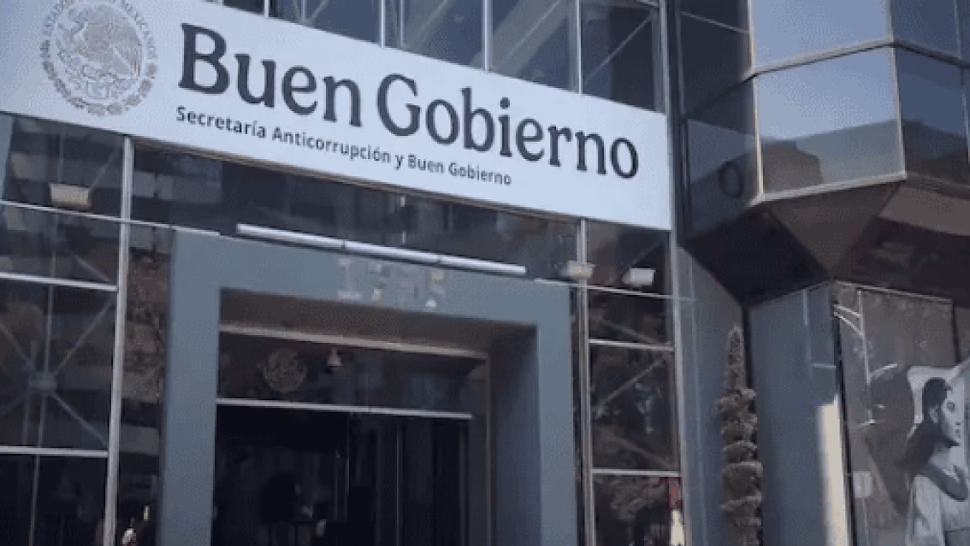

They sanction 13 public servants in nine agencies

13 officials from 9 agencies were sanctioned for non-serious administrative offenses.

The Anti-Corruption and Good Government Secretariat reported that it applied sanctions to 13 public servants from 9 agencies for non-serious offenses. Disqualifications range from 15 days to 3 months.

Details of sanctions

The investigations were carried out through the responsibilities units at Pemex and CFE, as well as the internal control bodies at IMSS, Defense, SNDIF, ANAM, INDEP, ASIPONA Manzanillo and Salud.

  • In Pemex, suspension for 30 days of Marlyn C and María F for not following up on the payment of post-mortem benefits of a worker between 2022 and 2025.
  • In CFE, 15 days of suspension to Josué S for registering requests for electricity supply without powers in 2024.
  • In IMSS, Víctor C was disqualified for 3 months for omitting medical treatment for a patient, which deteriorated his health until his death in 2022.
  • In Defense, private reprimand to Luis C for not integrating a clinical file in accordance with official standards in 2023.
  • In SNDIF, Ornela G is suspended for 15 days for abuse of a minor in 2025.
  • In ANAM, Tomas M, Brenda P and Hernán M are suspended for 15 days for failing to check the luggage of three passengers in 2023.
  • In INDEP, 15 days of suspension to José A and Omar G for signing an agreement that exceeded 20% of the contractual amount in 2023.
  • In ASIPONA Manzanillo, two suspensions of 10 and 12 days to Edmundo C for not managing budget adjustments in 2023.
  • In Health, public reprimand to Ana G for providing documentation with confidential information in 2023.

Reaction of the Secretariat

The agency explained that the sanctions were imposed in accordance with the law, considering proportionality and severity. Sanctioned people can challenge.

“The Anti-Corruption and Good Government Secretariat reaffirms its commitment to eradicate corruption in public life and promote ethics, honesty, integrity and good governance,” he said.

He invited people to report conduct contrary to legality at denuncias.gob.mx.

Continue reading

Sheinbaum in Acapulco: Women’s Pension and goodbye to La Parota

President delivers cards to 70,000 Guerrero residents and cancels dam project.

President Claudia Sheinbaum visited Acapulco, Guerrero, to lead the delivery of cards from the Pensión Mujeres Bienestar program. This scheme grants 3,100 pesos every two months to Mexican women between 60 and 64 years old.

Support for women and new works

During the event, the president stressed that the benefit recognizes the care work that women have historically carried out. Currently, almost 70 thousand people of Guerrero receive support, of which around 18 thousand reside in the port.

“When women walk together, there is nothing that stops us, we are the center of the Transformation, we are the history and future of Mexico,” stated Sheinbaum.

In terms of infrastructure, the president announced the definitive cancellation of the La Parota Dam project due to its effects on communities. Instead, wells and high tanks will be built to guarantee the supply of drinking water. Rehabilitation work will also be carried out after hurricanes Otis and John.

Sheinbaum reiterated his administration’s commitment to women and the sustainable development of Guerrero, prioritizing solutions that do not harm the social or natural environment.

Continue reading

They urge SEP to strengthen actions against bullying

28.5% of adolescents suffered bullying; They urge SEP to reinforce protection protocols.

The Second Commission of the Permanent Congress approved an opinion that urges the Ministry of Public Education (SEP) and the educational authorities of the 32 entities to reinforce strategies for preventing bullying and school violence. The request is part of the “Safe School Environments” program.

According to the National Discrimination Survey (ENADIS) 2022, carried out by Inegi, Conapred and the CNDH, around 28.5% of people between 12 and 17 years old have experienced some form of harassment or mistreatment at their school. The National Educational System serves more than 34 million students in 258 thousand basic, upper secondary and higher education schools.

The “Safe School Environments” strategy promotes co-responsibility between authorities, families and school communities to prevent risks and promote a culture of peace. The opinion highlights that this mechanism articulates guidelines, protocols and actions to guarantee safe, healthy and inclusive spaces, without restricting fundamental rights.

The legislators considered it necessary to maintain permanent prevention and care actions. The exhortation seeks to ensure that educational centers are environments free of harassment, with full respect for human rights and the best interests of children.

Continue reading