Venezuelan migrants seek justice after historic court ruling

A court ruling in Washington marks a crucial milestone for a group of men who allege serious abuses during their detention in Central America.

A Cry for Justice that Crosses Borders

Imagine having the courage to raise your voice, to demand what is right, even when the circumstances seem to be against you. That’s exactly what a group of Venezuelan men are doing today. His story is a powerful reminder that human dignity and the pursuit of justice know no geographical limits. After a road full of challenges, a recent decision by a federal court in Washington has lit a spark of hope, ordering the U.S. government to guarantee them due process, a fundamental right that illuminates the path to the truth.

These brave individuals, initially transferred to a penitentiary center in El Salvador, have found in legal defense organizations and the support of their nation of origin, crucial allies to push their claims. His press conference was not just an informative event; It was an act of empowerment, a demonstration that, united, we can make the world listen. It is proof that every step, no matter how small, brings us closer to equity and reparation.

RelatedTrump Government asks Supreme Court to withdraw TPS from Venezuelans

The Power of a Sentence that Changes Lives

The court order is not just a legal document; It is a ray of light. It rules that these 252 Venezuelan citizens must be granted the opportunity for a judicial hearing or, alternatively, their return to US territory. This ruling dismantles labels and accusations, such as belonging to a criminal organization, opening a legal door to defend their innocence and question measures based on old legislation. It is a monumental triumph for legal activism and for anyone who believes in the protection of migrants.

However, the path has been marked by a deep mark of pain. The stories of cruel treatment and psychological suffering during his stay in the Salvadoran prison are an urgent call to reflect on our systems. The fear of the authorities and the anxiety that many carry today are consequences of a trauma that justice must recognize and heal. As Nolberto Aguilar shares with us, distrust of a system is a wound that requires more than words; requires restorative actions.

Transforming Pain into a Global Call to Action

His return to Venezuela within the framework of a detainee exchange closed one chapter, but began another: the tireless search for responsibility and recognition of his rights. This court ruling is, without a doubt, a significant advance, a guiding light toward accountability. It teaches us that even in the face of seemingly insurmountable adversity, perseverance and faith in the law can generate profound changes. Every fight for immigration justice is a brick in the construction of a more compassionate and equitable world.

This story goes beyond a legal case; It is a lesson in human resilience. It invites us not to remain indifferent, to inform ourselves and to understand the complex realities that millions of people live on the move. His victory in the courts is a victory for the collective conscience, reminding us that defending fundamental rights is defending our own humanity. The journey continues, and every voice that joins this call makes a difference.

Are you inspired by this display of resilience and fight for justice?Share this story on your social networks to amplify this message of hope and rights. Explore more content related to human rights and self-improvement on our site, and be part of the conversation that transforms realities.
The United States and Iran intensify attacks; oil rises

New attacks between Washington and Tehran raise tension and affect energy markets.

Escalation between the United States and Iran

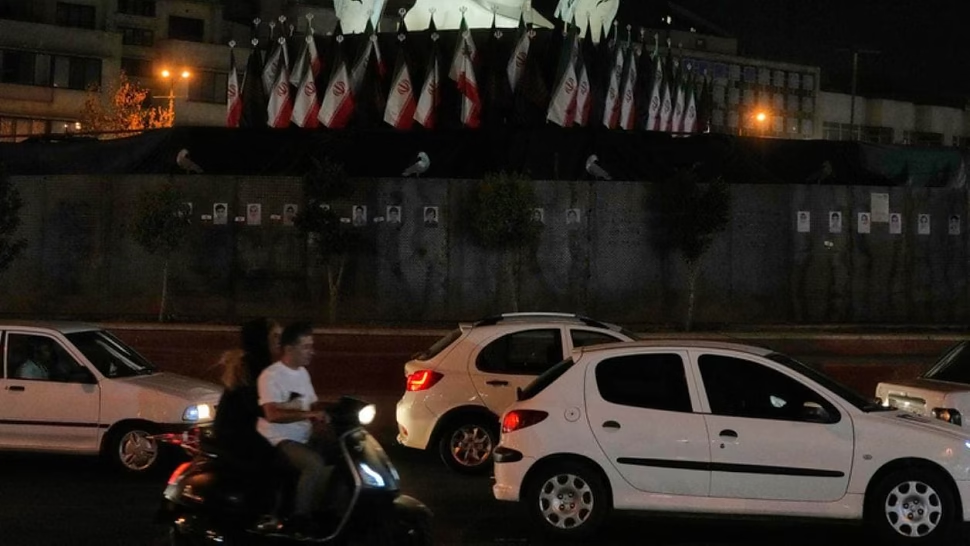
The United States launched a new round of airstrikes against Iran at the beginning of the week, hours after confirming the death of another American soldier. Iran responded with offensives against Kuwait, Jordan and Bahrain, where the US Navy’s Fifth Fleet is located.

The provisional ceasefire agreement signed last month has fallen apart. Maritime traffic in the Strait of Hormuz, a vital route for global energy, is practically paralyzed. Both sides have attacked civilian infrastructure on which millions of people depend.

Impact on energy markets

The violence sent oil prices soaring. Brent crude oil surpassed $88 per barrel, and regular gasoline in the US rose to $1.05 per liter, putting pressure on consumers ahead of the November legislative elections.

The US Central Command said its ninth consecutive night of strikes targeted Iranian command centers, anti-aircraft batteries and surveillance facilities. The IRNA agency reported at least one death near Tabriz. Other locations were also reached.

The British Maritime Trade Operations Center reported a second ship attacked in the Strait of Hormuz, which was left adrift and on fire. The Iranian Revolutionary Guard claimed responsibility for attacks on oil tankers in the area.

Tehran also attacked countries allied with the US. Kuwait said its anti-aircraft defenses fired against an incoming barrage. Jordan reported that it shot down three Iranian missiles without damage. Bahrain condemned Iranian drones against its air traffic system.

Yemen’s Houthis, backed by Iran, announced a maritime embargo against Saudi Arabia in the Red Sea, an alternative route for crude oil exports.

Diplomatic efforts

Pakistan intensified efforts to revive the truce. Iran’s Interior Minister Eskandar Momeni arrived in Islamabad for talks with Prime Minister Shehbaz Sharif. His Pakistani counterpart, Mohsin Naqvi, expressed optimism: “God willing, we will have good news.”

Secretary of State Marco Rubio said the US remains open to negotiating with Iran, but “it has to be real.” He noted that the door to diplomacy would be if those who want something productive for Iran take control.

Iranian authorities reported at least 50 deaths and 517 injuries in recent rounds of US attacks. Since the conflict began on February 28, 17 US service members have died.

Continue reading

Hamas elects Khalil al-Hayya as new political leader

The Palestinian movement appoints Sinwar's dolphin in an internal vote.

The new leadership of Hamas

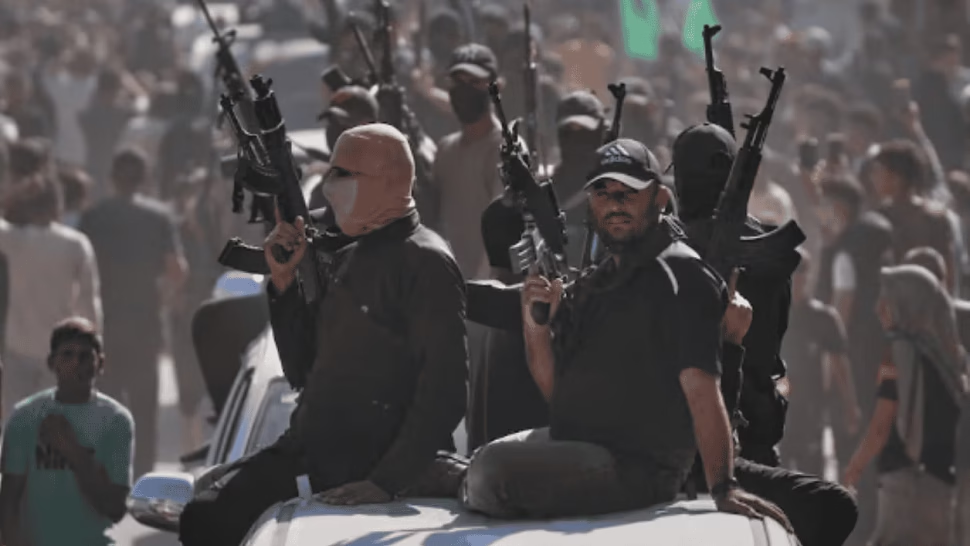
The Palestinian organization Hamas announced the election of Khalil al-Hayya as head of its political office. The position had been vacant since October 2024, when Yahya Sinwar was killed in an Israeli operation in Rafah.

Al-Hayya prevailed over Khaled Mashal in an internal vote that the organization described as “highly complex and secret for security reasons.” Representatives of Palestinians detained in Israeli prisons also participated.

According to internal sources cited by agencies, Al-Hayya won “by an overwhelming majority.” However, the Qatari newspaper Al-Araby reported that the difference was “barely one vote,” citing another movement source.

Continuity in the political line

The appointment of Al-Hayya implies continuity with the strategy of Sinwar and the previous leader, Ismail Haniyeh, who also died in an Israeli operation in Tehran in July 2024. Both maintained alignment with the so-called “axis of resistance” led by Iran, despite the fact that Hamas has a Sunni majority.

His arrival reinforces Gaza as the central axis of the Palestinian cause, in contrast to the current of Mashal, born in the West Bank and considered closer to Qatar and Turkey. During his leadership until 2017, Mashal broke with Syrian President Bashar al Assad, distancing the movement from the Iranian axis.

At the same time, Hamas has reinforced its presence in its headquarters in Istanbul, to the detriment of its center in Doha.

Impact on negotiations with Israel

Al-Hayya, 64, is a founder of Hamas and was Sinwar’s top deputy in Gaza. Before October 7, he left the Strip on instructions from Sinwar to direct affairs from abroad. According to The New York Times, in July 2023 he discussed attack plans with a general in the Iranian Revolutionary Guard.

He has survived several attacks attributed to Israel, including one in Doha in September 2025 where his son Hamman died. Three other children also died in Israeli attacks.

Currently, Al-Hayya is Hamas’ main negotiator in indirect contacts with Israel, which last October led to a ceasefire agreement and the release of hostages. He has met personally with US envoys Steve Witkoff and Jared Kushner.

In the talks that continue in Cairo, Al-Hayya maintains an inflexible position and rejects the disarmament of Hamas. According to various assessments, the stalemate could lead to a new Israeli offensive on the Strip.

Continue reading

The US accuses Cuba of historical infiltration and espionage

The US accuses Cuba of decades-long infiltration of its government. Havana denies it.

Washington’s accusations against Havana

The United States Department of State has denounced that Cuba carried out an espionage campaign for decades. According to the official report, Havana managed to infiltrate the highest levels of the US government.

“Cuba infiltrated the highest levels of the US government, recruited and trained generations of activists, and supported an unprecedented wave of left-wing political violence on US soil,” the document states.

The report calls the operation “one of the most protracted and damaging foreign intelligence infiltrations in U.S. history.” He adds that the Cubans developed a model of attrition based on espionage, sabotage and networks of allies.

Secretary of State Marco Rubio reiterated these accusations in a meeting with officials from more than 60 countries. “The intelligence and ideological networks of the Cuban regime helped build the extreme left in our country and in the hemisphere,” he stated.

Context of political pressure

The accusations are part of the growing pressure from Donald Trump’s administration against Cuba. In May, President Trump issued an executive order calling the island an “unusual and extraordinary threat” to US national security, expanding sanctions.

Cuba faces its worst economic crisis in decades and has vigorously rejected the accusations. Cuban authorities insist that the country does not represent a threat to the United States.

Tensions between both countries date back to the triumph of the Castro revolution in 1959. Since then, Washington imposed sanctions, there were attempts to attack Fidel Castro and Havana supported guerrilla movements in Latin America and the Caribbean. The current report revives that history of confrontation.

Continue reading