Mexico restores ancestral lands to the Ódami and Rarámuri peoples

A historic step returns what was stolen: land, dignity and future to indigenous communities.

Justice comes (with selfie included) to the Sierra Tarahumara

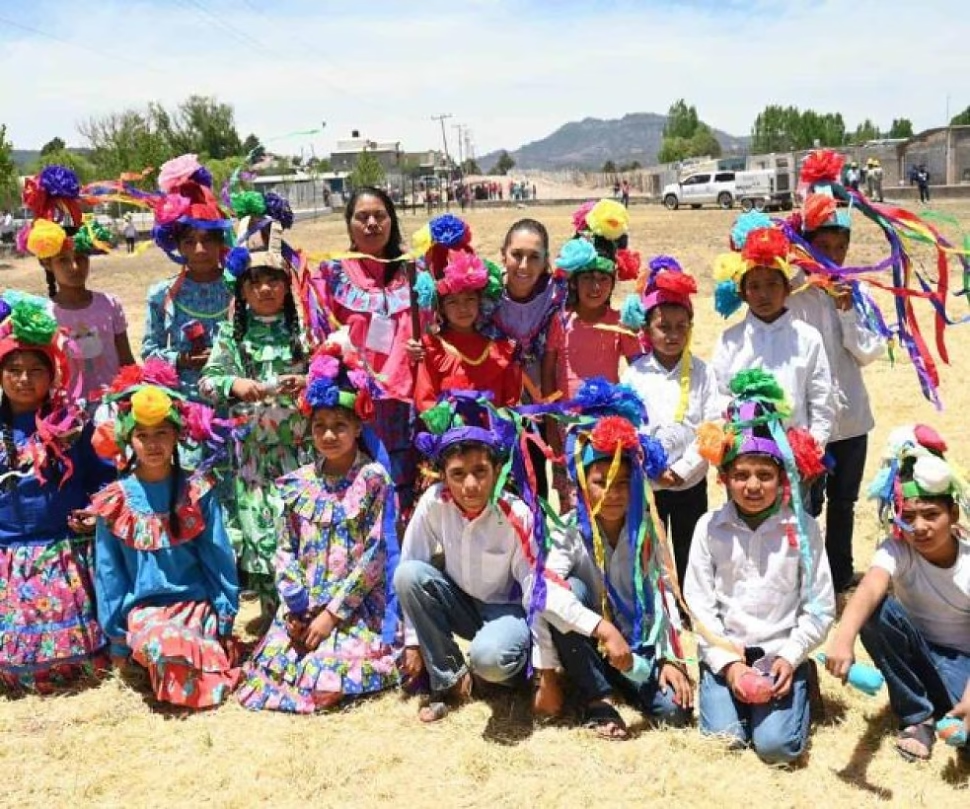
In an act that mixes historical vindication and political marketing, President Claudia Sheinbaum signed two decrees to return 820 hectares to the Ódami and Rarámuri peoples. Yes, you read it correctly: give back, not give away, because the land was always yours (even if the system insisted on forgetting it). The scene, with Rarámuri children in the background and speeches about “humanism”, seemed taken from a Netflix script… but with less drama and more legal papers.

Gone with the wind (and governments)

Among phrases like “Fourth Transformation” and promises of ancestral justice, Sheinbaum recalled that this plan was initiated by AMLO. Because in Mexico, even historical reparation has six-year continuity. The communities of Mesa Colorada (Ódami) and Mogótavo (Rarámuri) thus recover land where their grandparents prayed, planted crops and, probably, cursed the invaders. No minor detail: the federal government has already restored 2,998.9 hectares in the area. Something is something, even if it sounds like a drop in the desert.

RelatedClaudia Sheinbaum restores 820 hectares to communities in the Sierra Tarahumara

“You deserve everything,” the president said, while distributing land as if they were likes on Instagram. The combo includes: 16 artisanal paths (349.83 million pesos), monthly medical brigades and nursing schools. Because nothing says “we compensate you for centuries of neglect” like a health center and fresh asphalt.

The repair budget (or how to put a price on dignity)

Here are the numbers that hurt more than a mother-in-law’s comment:

  • 5,441 million pesos invested in the Justice Plan (yes, with that money you buy 1,000 Tesla, but here it is about paying off colonial debts).
  • 102,000 supports from Sembrando Vida (591.8 million pesos), because even ecology is reparation.
  • 3,636 homes with electrification this year, so that the 21st century reaches the mountains.

And attention to millennial detail: the Tarahumara Technological University will become Intercultural Indigenous University. Change of name and paradigm, because education must also be decolonized.

What is not seen in the official photo

While officials pose with community leaders (did someone say tokenism?), in Guadalupe and Calvo 3,000 hectares are still pending in Mala Noche (a name that sounds like a meme, but it is reality). And although it sounds nice to talk about “environmental justice”, the forests of the mountains are still waiting for the 30.4 million pesos promised for 2025. Spoiler: without trees, there is no future.

What has been said: between government selfies and checks with many zeros, something is moving in the Sierra Tarahumara. Will it be enough? The communities have been waiting 500 years… which is a couple more six-year terms.

Are you outraged or inspired by this news? Share it and join the conversation about indigenous rights. #JustTierra#SierraTarahumara
They will invest 20 thousand million pesos to clean the most polluted rivers in Mexico

The federal plan seeks to restore the most polluted rivers with long-term works.

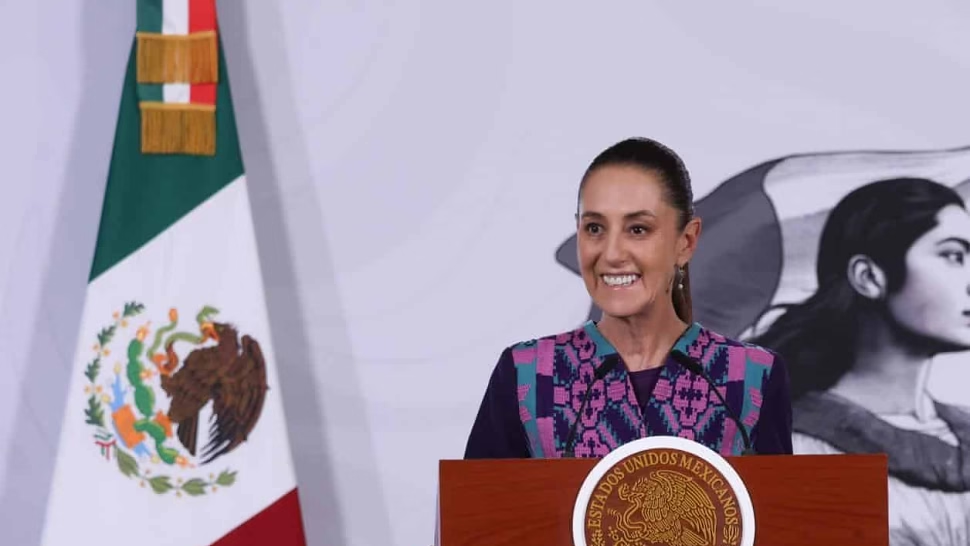
President Claudia Sheinbaum announced an investment of 20 billion pesos to clean up and restore the Atoyac, Lerma-Santiago and Tula rivers. The goal is to keep them permanently clean.

“We chose these three rivers because, according to Conagua, historically they are the most polluted,” Sheinbaum said in the morning conference. “We have invested close to 2,500 million pesos between 2025 and 2026, but in total there are 20 billion.”

The plan will benefit 25 million people in 10 states. The actions include marginal drainage, wetland treatment plants, desilting, reforestation and elimination of landfills.

Details by river

The Secretary of the Environment, Alicia Bárcena, reported that the Lerma-Santiago river covers 1,360 km and benefits 21.4 million inhabitants. Tula has 191 km for 0.8 million, and Atoyac 162 km for 3.7 million.

More than 340 km have been walked, 322 sites have been sampled and 3,202 polluting discharges have been detected. 479 clandestine dumping sites and 460 priority industries were also identified.

Four goals

  1. Improve water quality: 10 new treatment plants, rehabilitation of 23 more, 94 km of collectors and 280 inspections.
  2. Ecosystem restoration: 24 km revegetated, 4,639 hectares reforested and 8,243 hectares intervened in natural areas.
  3. Prevent flooding: 41 km of clearing, slope stabilization and 28 monitoring stations.
  4. Reconnect the population: 9 parks and more than 40 thousand people in cleaning days that collected 4 thousand 667 tons of garbage.

Progress by basin

The director of Conagua, Efraín Morales, specified that on the Atoyac River the first stage of 63 km is 85% complete. In Tula, 74 km with 62% progress. In Lerma-Santiago, 65 km with 90% progress.

Additionally, work is carried out in the Tijuana, Acapulco, Nogales and Sonora rivers.

Continue reading

CNTE marches again, but without the force of Section 22

The absence of Section 22 reduced the impact of the new teacher protest in CDMX.

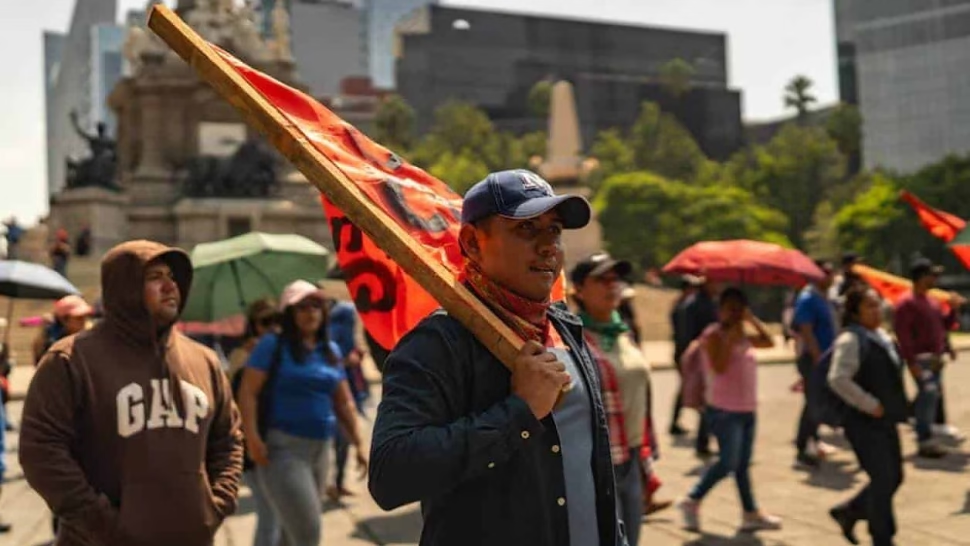
The National Coordinator of Education Workers (CNTE) returned this Thursday to the streets of the Historic Center of Mexico City to demand compliance with previous agreements. However, the mobilization was limited in scope.

Lower call

The protest was led by sections 9, 10, 11 and 60. The absence of Section 22 of Oaxaca, one of the most active in the union, reduced the pressure capacity. The teachers blocked some roads and held a rally. Initially they had planned a march, but it was suspended.

During the day there were moments of tension when a group tried to enter the offices of the General Coordination of Human Resources of the Ministry of Public Education (SEP) without authorization. No injuries were reported. A commission was received by authorities to review their proposals.

Government Response

The leaders accused Claudia Sheinbaum’s administration of failing to fulfill the commitments agreed upon after the June sit-in. Among the demands, the lack of monitoring tables with the SEP and the ISSSTE on social security and working conditions stands out.

Sheinbaum reiterated that the dialogue will continue, but emphasized that consultations will be held directly with teachers in schools, not only with union leaders. He announced that starting in August a national process will begin to discuss changes in the teacher promotion system. The CNTE analyzes new actions given the lack of progress.

Continue reading

Ernesto Ruffo arrested for alleged prosecutor huachicol

Former PAN governor arrested in Ensenada for alleged fuel smuggling. The FGR links him to the Ingemar company.

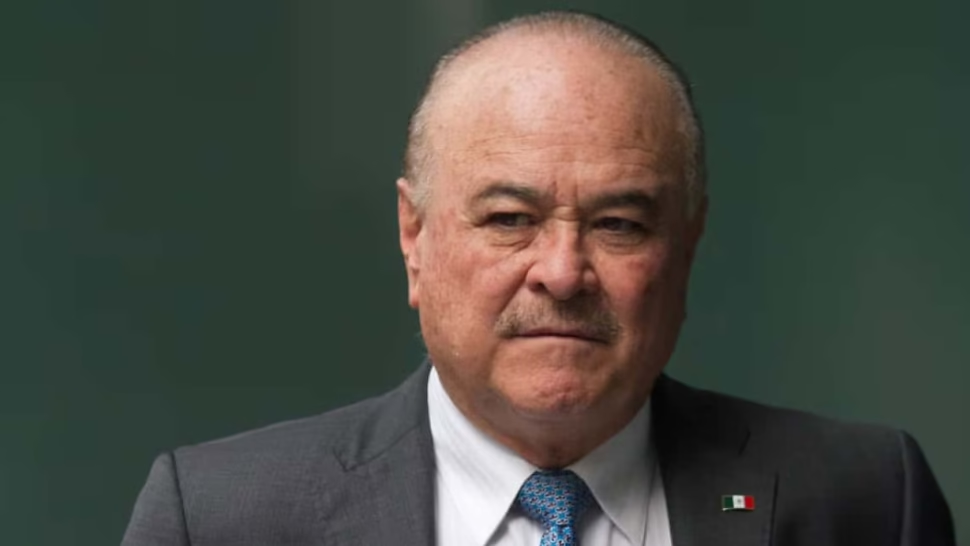
The Attorney General’s Office of the Republic (FGR) arrested the former PAN governor Ernesto Ruffo Appel, 74, this Thursday in Ensenada, Baja California. He is accused of crimes related to organized crime and fuel smuggling, a modality known as huachicol fiscal. The arrest stems from a “highly complex” investigation against the company Ingemar, founded by Ruffo and dedicated to customs procedures.

Charges and background

The case dates back to July of last year, when authorities seized nearly 15.5 million liters of fuel and 129 tanker trucks in Coahuila. It was the largest hydrocarbon seizure during Claudia Sheinbaum’s government. After that operation, the Secretary of Federal Security, Omar García Harfuch, identified Ingemar as one of the companies under investigation for its possible link with the transfer of fuel.

Ruffo acknowledged being a shareholder in Ingemar, although he said he did not have a majority stake. In interviews, he stated that the company only carried out imports and reported irregularities at customs. “We imported some of the volumes,” he declared, rejecting direct responsibility for smuggling.

Research and reactions

According to the FGR, the arrest warrant was obtained after gathering investigative elements. The case also includes Ricardo Thompson, one of the founders of Ingemar, who asked to investigate his partners and accused that in 2021 Ruffo and José Merino Valdés stripped him and his son of shares and administrative positions.

The National Action Party (PAN) expressed support for the former governor and trusted that he will clarify the allegations. The PAN leadership questioned the arrest and asked for justice without partisan distinctions. Ruffo, a historic member of the PAN, was the first state governor in opposition to the PRI in 1989, and then a senator and federal representative. His case adds to the investigations into hydrocarbon smuggling networks in border areas, especially Tamaulipas.

Continue reading