Mexico promotes health transformation with 51 new hospitals

An ambitious hospital expansion plan is revolutionizing access to health in Mexico with million-dollar investments.

A Revolution in Public Health is Underway!

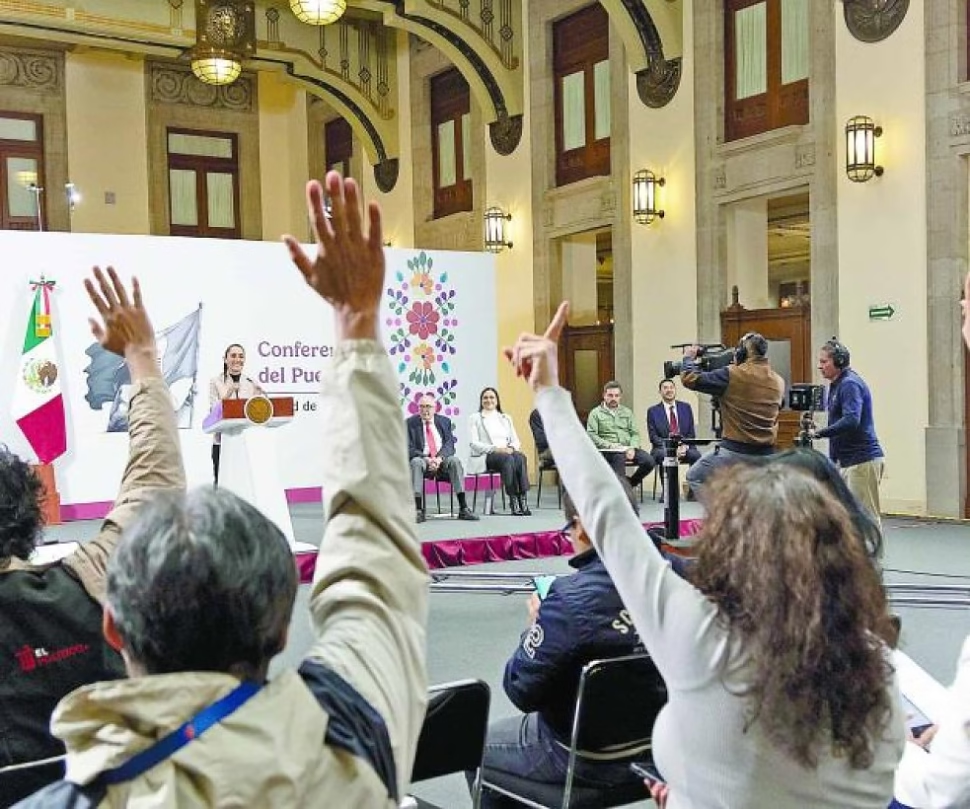
Get ready to celebrate a historical milestone in the Mexican health system. The Government of Mexico, with the unwavering commitment of the Ministry of Health, is taking a quantum leap in medical care: 31 hospitals, 12 clinics and 256 new operating rooms will come into operation before 2026! And this is just the beginning, because between 2025 and 2027, 20 more hospitals will be added to this network of hope.

Investment that Transforms Lives

Imagine the impact of 50 billion pesos destined to save lives. Every penny of this monumental investment translates into state-of-the-art operating rooms, family medical units, and hospitals ready to serve the communities most in need. President Claudia Sheinbaum says it with pride: “We are building the future of health in Mexico”, inheriting and expanding the legacy of the Fourth Transformation.

RelatedSinaloa reinforces security protocols in hospitals after incidents

Did you know that 13 of these hospitals are already operating? Progress is tangible! And before the end of this year, 18 more medical centers will open their doors. This is not just infrastructure; They are smiles recovered, families reunited and dreams renewed.

Innovation that Breaks Barriers

The ISSSTE and IMSS are revolutionizing their services with programs like 2-30-100: 831,328 surgeries performed in just seven months! And that’s not all: 13.9 million specialized consultations and 57 million primary care services demonstrate that Mexico moves with purpose. In addition, traveling doctors will bring surgical care to remote areas, because in this transformation no one is left behind.

Martí Batres from ISSSTE and Zoé Robledo from IMSS are leading by example: 36 operating rooms renovated this month, equipped with cutting-edge technology and trained personnel. Every detail counts in this crusade for medical excellence.

You are also part of this change! Share this incredible news and let’s celebrate together how Mexico is writing a new chapter in public health. Do you want to know more about these transformative initiatives? Explore our impact stories and join the conversation with #HealthForAll.

Remember: Health is the foundation of a great nation, and today, Mexico is building that future with concrete actions. Let’s continue inspiring the world!

Ready to witness this evolution? Share this article and let’s make optimism viral. Together we multiply the positive impact!

Haaland’s footprint: 559 Peruvian babies bear her name

559 Peruvians registered their children with the name of the Norwegian forward after the 2026 World Cup.

The Haaland phenomenon in Peruvian civil registries

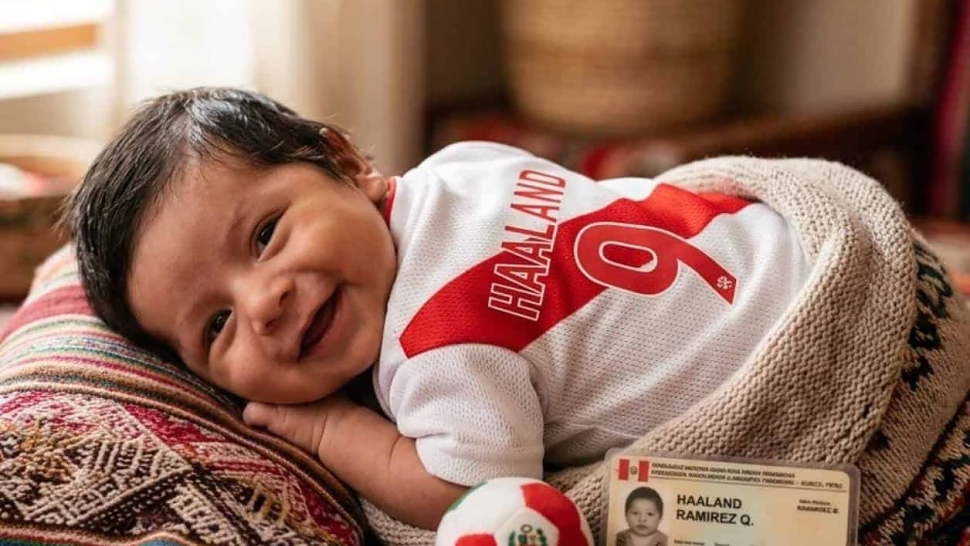
The impact of the 2026 World Cup is not only measured in goals. In Peru, at least 559 babies were registered with a name inspired by Norwegian striker Erling Haaland. This was reported by the National Registry of Identification and Civil Status (Reniec).

Of that total, 468 infantrymen were simply given “Haaland” as a name, while another 91 were registered as “Erling Haaland.” The figure could increase, since birth records are still open.

According to Reniec, the phenomenon gained strength after Haaland’s double in the round of 16 against Brazil. That 2-1 allowed Norway’s historic qualification to the quarterfinals of the tournament.

But Haaland is not the only footballer who inspires Peruvian parents. Reniec explained that in the country there are already 3,402 people named Messi, 1,185 with the name Cristiano Ronaldo and 1,241 registered as Yamal, in reference to the Argentine star, the Portuguese and the Spanish attacker.

The absolute record, however, is held by the Brazilian Neymar: almost 34 thousand Peruvians have that name on their identity document.

Continue reading

France approves aid-in-dying law with strict conditions

The National Assembly approved the measure with 291 votes in favor and 241 against.

A historic step at the end of life

France’s National Assembly gave the final green light to a bill that allows adults with incurable diseases to receive medication to end their life. The vote was 291 in favor and 241 against, after a long parliamentary process initiated more than three years ago by President Emmanuel Macron.

“I made a commitment to the French people to open this path. With seriousness, humility and respect for our democracy, that commitment has been fulfilled,” Macron wrote in X.

Rigorous conditions

The law focuses on self-administration of lethal medication. Only patients over 18 years of age, citizens or legal residents, with a serious, incurable disease and in an advanced or terminal phase can request it. The pain must be unbearable and uncontrollable, and the request voluntary.

Psychological suffering alone does not qualify. People with serious psychiatric disorders or neurodegenerative diseases such as Alzheimer’s are also not eligible. The process includes an application reviewed in 15 days and a reflection period of at least two days.

The patient will be able to choose the time and place, even at home, accompanied by loved ones. A doctor or nurse will verify your wish moments before and will remain nearby in case complications arise. Health insurance will cover all costs.

Divided reactions

The Association for the Right to Die with Dignity celebrated the law: it allows “choosing to end unbearable suffering, freely and with full awareness.” Its president, Jonathan Denis, stressed that “a law that creates a new right never forces anyone to exercise it.”

In contrast, the anti-euthanasia group Alliance Vita warned that “presenting death as a desirable solution can never be an acceptable response to suffering” and called for strengthening palliative care. They fear pressure on elderly or disabled people.

Constitutional review pending

The Senate, with a conservative majority, rejected the project. However, the National Assembly has the final say. Prime Minister Sébastien Lecornu and the president of the Senate will refer the law to the Constitutional Council, which must rule within a month. Only after that approval will it come into force.

France thus joins the countries that regulate medical assistance in dying. In the United Kingdom, a similar project is advancing with new amendments, while in Germany the Bundestag rejected two proposals in 2023.

Continue reading

Mexico joins the neutrality protocol of the Panama Canal

Sheinbaum and Mulino agree to strengthen cooperation and support the interoceanic waterway.

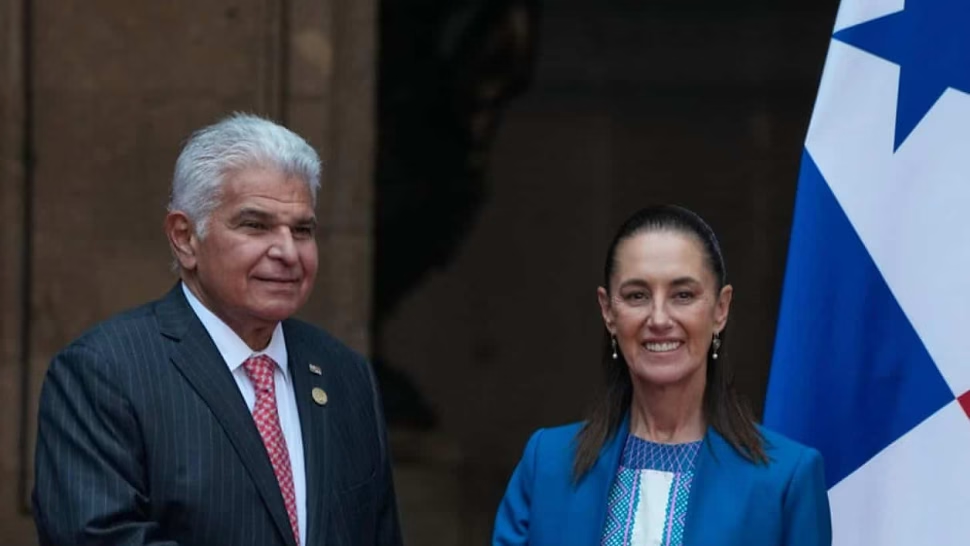
Mexico formalized its support for the neutrality protocol of the Panama Canal, an interoceanic waterway that the Panamanian government seeks to shield against global tensions. President Claudia Sheinbaum announced the decision after meeting with her counterpart José Raúl Mulino at the headquarters of the Panamanian Executive.

Support for Panamanian sovereignty

Sheinbaum stated that he shares with Mulino the conviction that current challenges are faced with collaboration and strengthening the sovereignties and institutions of each country. The neutrality protocol is part of the treaties signed in 1977 by Jimmy Carter and Omar Torrijos. There, the transfer of the canal to Panama was agreed in December 1999, after more than 80 years of US control.

At least 40 countries have joined the protocol. This establishes that the canal will remain safe and open for the peaceful transit of ships of all nations, both in peace and war, and that it will not be the target of reprisals in any armed conflict.

Wider cooperation

In addition to supporting the channel, Sheinbaum and Mulino agreed to strengthen cooperation in trade, agribusiness, security, tourism, investments and infrastructure. Mulino thanked the support for Panamanian sovereignty and described the canal as a “neutral tool of world trade.” He also urged other countries in the region to join the protocol.

Last April, Mulino expressed concern about the increase in detentions of Panamanian ships in Chinese ports, and noted that Panama was left in the middle of tensions between the United States and China.

Strategic importance

The 82-kilometer Panama Canal connects the Atlantic with the Pacific. Approximately 14,000 ships transit through it a year, making it a vital infrastructure for international trade. In light of the conflict in the Middle East and the temporary closure of the Strait of Hormuz, the canal has gained greater relevance as a safe route for global maritime cargo.

Continue reading