Mexico increases water delivery to the US due to pressure over binational treaty

Mexico accelerates water deliveries to the US, but drought and low storage in dams complicate compliance with the treaty.

Context of the Binational Water Treaty

The Binational Water Treaty of 1994 establishes the obligations of Mexico and the United States regarding the distribution of shared water resources, particularly in the Rio Grande basin. This agreement, in effect in five-year cycles, requires Mexico to annually deliver a specific volume of water to its northern neighbor. However, compliance with these quotas has generated recurrent diplomatic tensions, especially in periods of extreme drought.

Progress and challenges in the current cycle

With 104 days left until the current deadline expires (cycle 36, started in October 2020), Mexico has significantly increased its deliveries, reaching 840 million cubic meters as of July 8. However, this figure represents only 38.9% of the 2,158 million committed. The recent rainfall, associated with tropical cyclones and the “Mexican monsoon”, allowed the fifth highest monthly delivery of the cycle (49 million m³ in 8 days), more than doubling the volume of June.

RelatedMexico delivers water to the US under the 1944 Treaty

Despite this, the persistent drought in the Bravo basin complicates the scenario: as of June 30, 45% of the region registered a rainfall deficit, while 24.8% suffered from extreme or exceptional drought. The 11 key dams for compliance with the treaty maintain only 27.2% storage on average, with critical cases such as La Boquilla (Chihuahua), which operates at 18% of its capacity.

Geopolitical implications and recent agreements

The partial non-compliance with the treaty has escalated into diplomatic controversies. In April 2024, then-US President Donald Trump threatened to impose trade tariffs, accusing Mexico of “stealing water from Texas.” In response, both countries signed an agreement to transfer water from the La Amistad (Coahuila) and Falcón (Tamaulipas) international dams, in addition to intensifying extractions from the six tributaries of the Bravo. These measures allowed April to close with 93.2 million m³ delivered.

Distribution by sources and future perspectives

Until May 2024, 55% of the water sent to the US came from the Conchos River, followed by the San Diego (14%) and the Salado (10%). Experts warn that, although recent rains provide respite, the overexploitation of aquifers and climate variability require a structural review of the treaty. The International Boundary and Water Commission (IBWC) monitors progress, but highlights the need for binational strategies for sustainable management.

Are you interested in cross-border resource management? Share this analysis on your social networks and discover more content on environmental diplomacy in our dedicated section.

Explore more: Subscribe to receive updates on water policies and international relations.
They capture the Bengal tiger that escaped in Edomex

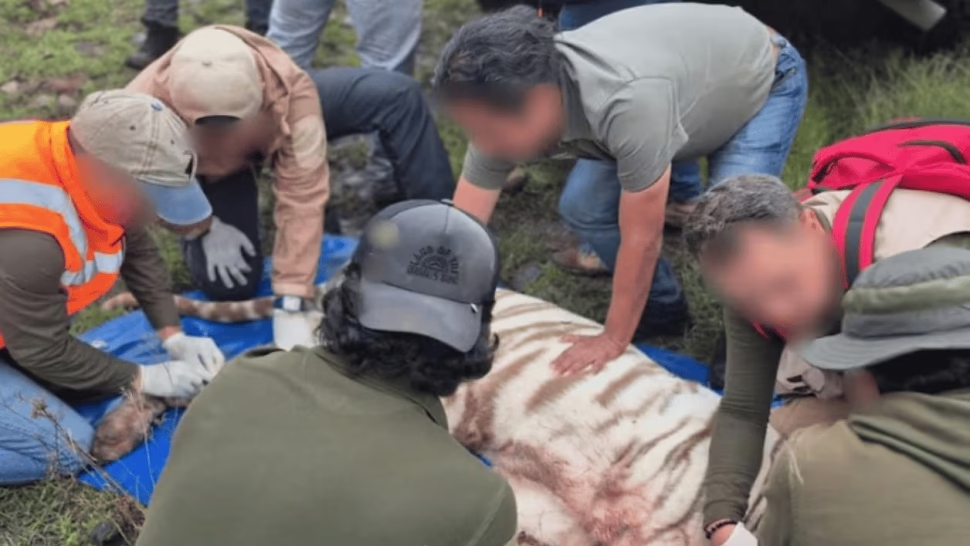
After four days of operation, the tiger Kenzo was secured without incident.

Four-day operation concludes successfully

The municipal president of Tepetlaoxtoc, Diana Morales, confirmed this morning the capture of the Bengal tiger that escaped last Saturday from a wildlife center. The animal, identified as Kenzo, had caused the mobilization of federal and local authorities.

The escape occurred on the Property or Facility that Manages Wildlife outside of its Natural Habitat (PIMVS) called Animal Experience México. The Federal Environmental Protection Agency (Profepa) reported that the feline is already receiving medical attention.

Capture details

According to the official report, the operation lasted four days until the specimen was contained without any violent events or damage to people being recorded. Authorities did not detail the exact capture method, but noted that the safety of the community and the animal was prioritized.

Kenzo is under veterinary observation. Profepa will evaluate the conditions of the PIMVS and determine possible sanctions. The case revives the debate on the regulation of centers that house exotic species in areas close to residential areas.

Continue reading

Sheinbaum defends security in Mexico in response to the United Kingdom alert

President responds to British alert and announces new measures after deaths.

The United Kingdom government issued a travel alert for its citizens due to risks of crowds and robberies during the celebrations of the next Mexico vs England match. President Claudia Sheinbaum responded: “It is safe to visit the country, there is no problem.”

Measures after incidents in El Ángel

Last Tuesday, four people died during the celebrations for Mexico’s victory over Ecuador at the Angel of Independence. Sheinbaum explained that, in coordination with the capital government, actions will be implemented to avoid new mass concentrations.

“Based on what happened, the City government is taking measures to put up more screens throughout Reforma. This way people disperse and do not congregate in a single point,” he said at a conference.

Call to responsibility

Sheinbaum made a direct call to the fans: “Act responsibly, avoid excess alcohol. We appeal to the responsibility of everyone, both Mexicans and visitors.”

The president reported that she maintains contact with the head of government, Clara Brugada. “I personally spoke with her. They have done their job well and now take precautions to avoid dangerous crowds.”

Response to the British alert

Asked if her cabinet had already coordinated with the CDMX government before the next game, Sheinbaum responded: “We are in contact. It is difficult to contain a million people with police. The idea is to guide and prevent.”

He reiterated that traveling to Mexico is safe: “We have seen it throughout the World Cup. There is no problem.” The strategy focuses on dispersion of attendees and surveillance without repression.

Continue reading

INEHRM becomes a research and teaching center

The INEHRM is transformed into a research and teaching center under the new secretariat.

Transformation of the INEHRM

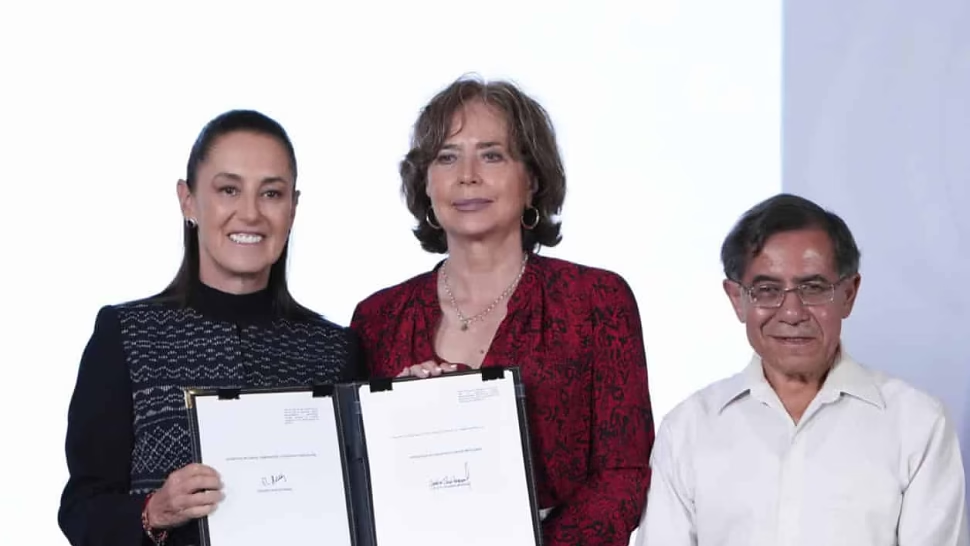
President Claudia Sheinbaum signed the decree that transfers the National Institute of Historical Studies of the Revolutions of Mexico (INEHRM) to the Secretariat of Science, Humanities, Technology and Innovation (SECIHTI). The institute becomes a decentralized public body with an academic focus.

Rosaura Ruiz Gutiérrez, head of SECIHTI, explained that the new scheme will train specialists in history to strengthen national capacities in social sciences and humanities.

Felipe Arturo Ávila Espinosa, director of the INEHRM, explained that the study plans will link historical knowledge with social, economic, political and cultural problems of the country, and will address the needs of the Federal Public Administration.

Hybrid educational offer

The offer will include bachelor’s degrees in History, Social Sciences and Humanities, and Public Administration and Good Government. In postgraduate studies, master’s degrees will be added in Mexican Humanism, Gender and Feminism Studies, and Social Movements and Rescue of Historical Memory. There will also be specialties in Political Communication and History Teaching.

Graduates will cover topics such as agrarianism, health, migration, artificial intelligence, violence and human rights.

Headquarters and call

The new headquarters will be at 80 Guatemala Street, Historic Center of Mexico City. The first admission call will be launched in July, and classes will begin in September.

Continue reading