Mexico gives a symbolic knockout to violence with massive boxing classes

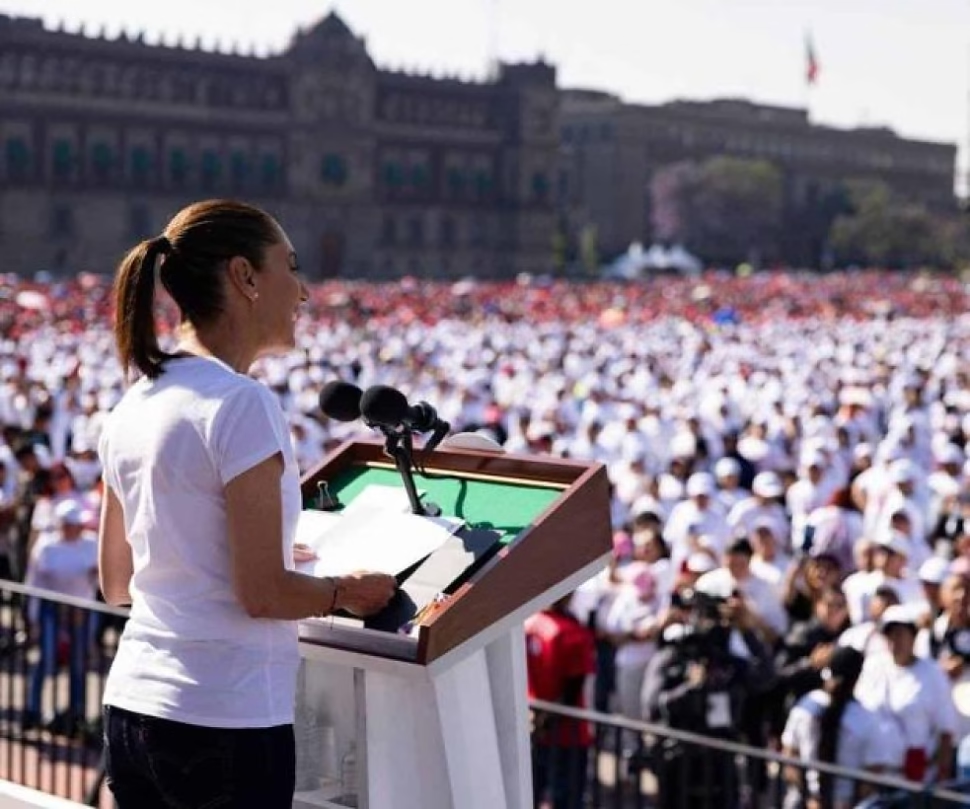
Boxing, peace and a Zócalo that seems like a living meme There she was, President Claudia Sheinbaum, breaking stereotypes and the Twitter algorithm at the same time: 42 thousand people doing jab-cross in the capital's Zócalo. Because…

Boxing, peace and a Zócalo that looks like a living meme

There she was, President Claudia Sheinbaum, breaking stereotypes and the Twitter algorithm at the same time: 42 thousand people doing jab-cross in the capital’s Zócalo. Because nothing says “we build peace” like a National Boxing Class broadcast live to the entire country. The message? Mexico prefers gloves to low blows (literally and metaphorically).

Speech that sounds like a viral anthem

Among phrases that could be run-down lyrics, Sheinbaum dropped gems like: “We are a people that leaves no one behind (except maybe on the morning jog)”. And he finished off with that sport makes us “freer, healthier and happier” (confirmed: even step training counts as therapy).

RelatedClaudia Sheinbaum turns boxing into the new national subject

The combo of champions present – from Julio César Chávez to “Pitbull” Cruz – gave the event an Avengers feel but in a ring version. Even Óscar de la Hoya appeared, because in Mexico even anti-violence events have legendary cameos.

Sports as a national trending topic

Clara Brugada, head of the CDMX government, summed it up perfectly: “This is a knockout of violence”. And yes, seeing thousands moving their feet in unison gives more hope than any political speech. Bonus track: the UN was present, because if something unites the world it is seeing Mexicans sweating their shirts (pun intended).

Moral? Mexico shows that it can viralize something more than memes: social causes with style. Now, if this doesn’t deserve your shares, what will? #BoxeoPorLaPaz is already on everyone’s lips (and on trending topics).

Did you miss it? Share this sports-social hit and continue exploring how Mexico reinvents activism (with style and sweat included).
Mexico files criminal complaints against the US for migrant deaths

The SRE announces criminal and civil legal actions for compatriots who died in immigration custody.

The Mexican government hardens its stance towards the United States. The Ministry of Foreign Affairs (SRE) instructed the Attorney General’s Office to file criminal complaints against those responsible for the deaths of Mexicans during immigration operations and in the custody of the Immigration and Customs Enforcement Service (ICE). In addition, it will promote civil actions against companies that manage detention centers.

Mexico’s legal actions

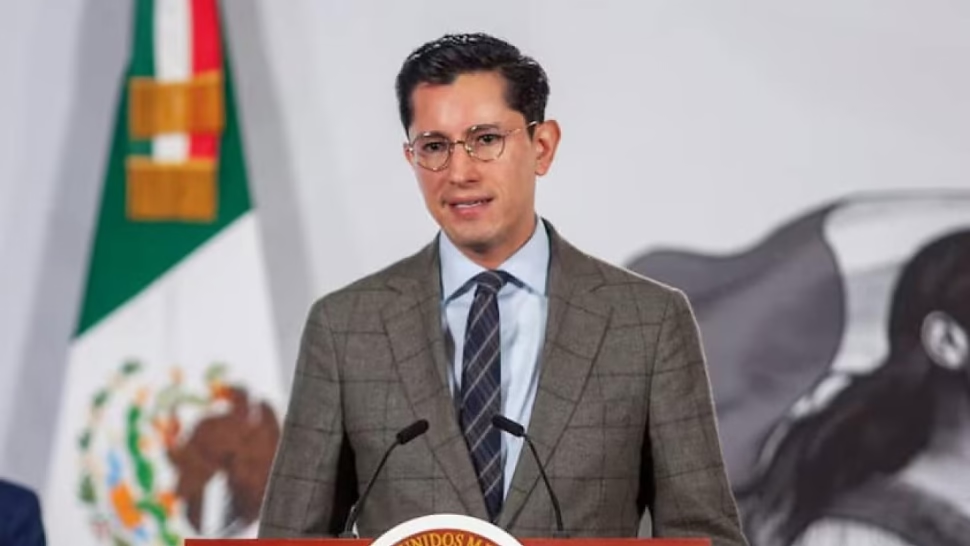
Foreign Minister Roberto Velasco explained that the complaints will be directed to state prosecutors and the United States Department of Justice. The objective is to carry out criminal investigations into the deaths that Mexico considers still unclarified. This decision marks a shift in Mexican strategy, which previously privileged diplomatic efforts.

Claudia Sheinbaum’s administration had sent 11 letters of diplomatic protest. In them he requested investigations into 17 deceased Mexicans: 14 in immigration detention centers and three during capture operations. Without obtaining answers considered satisfactory, Mexico raised the claim to judicial authorities.

One of the emblematic cases is that of Lorenzo Salgado Araujo. He died after being shot by ICE agents during an operation in Houston, Texas. US authorities indicated that the man tried to ram the agents with his vehicle. His family and the Mexican government questioned that version and called for an independent investigation.

Mexico will also sue private companies that operate immigration detention centers. It points out alleged irregularities in accommodation and medical care conditions. The center of Adelanto, California, is one of the main ones highlighted. Several Mexicans have died there and complaints have been filed for deficiencies in basic services.

At the same time, the SRE will request intervention from international organizations. It will appeal to the Inter-American Commission on Human Rights and the UN High Commissioner for Human Rights, demanding better conditions and guarantees for migrants.

Continue reading

Trans people demand dialogue after cancellation of meeting in Segob

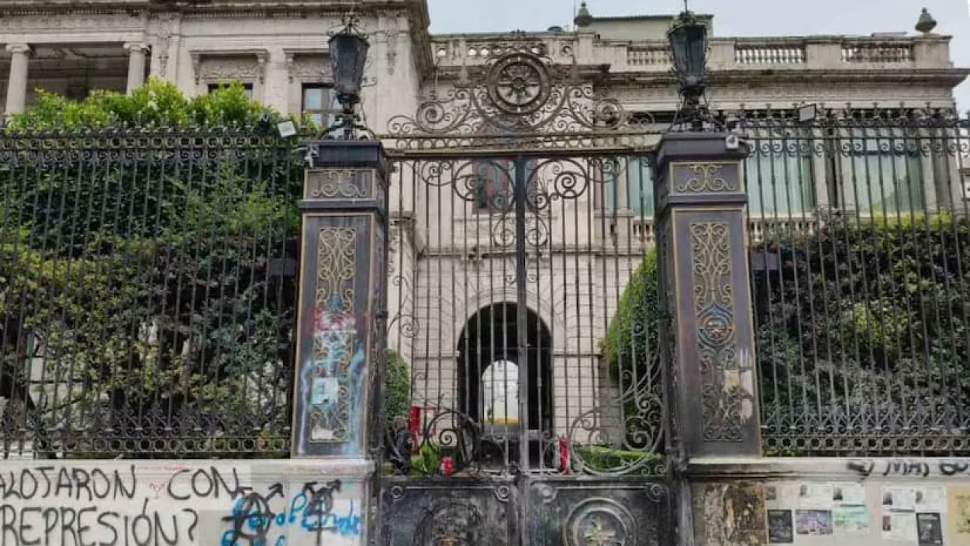
Trans groups denounce cancellation of meeting in Segob and carry out graffiti in Reforma.

Protest in Segob

Trans and non-binary people demonstrated this Thursday outside the Ministry of the Interior (Segob) in Mexico City. They denounced the cancellation of a meeting where they would address demands for health, housing, education and human rights. During the mobilization, they painted and caused damage to street furniture, set fire to objects and broke pedestrian traffic lights in front of the Senate.

Elements of the National Guard tried to disperse the protesters with fire extinguishers and a water hose. According to the participants, the water also wet journalists who were covering the events. The groups advanced towards Paseo de la Reforma and Insurgentes, where they damaged advertisements and glass, as well as the Bienestar Tower.

The protesters demand that the Secretary of Government of Mexico City, César Cravioto, sign a minute to set a new meeting date. They assure that with this they would break up the sit-in and resume the dialogue.

This protest joins other recent actions, such as the occupation of a Segob hall in June and road blockades. Until now, Segob and its head, Rosa Icela Rodríguez, have not issued a position on the alleged cancellation.

Continue reading

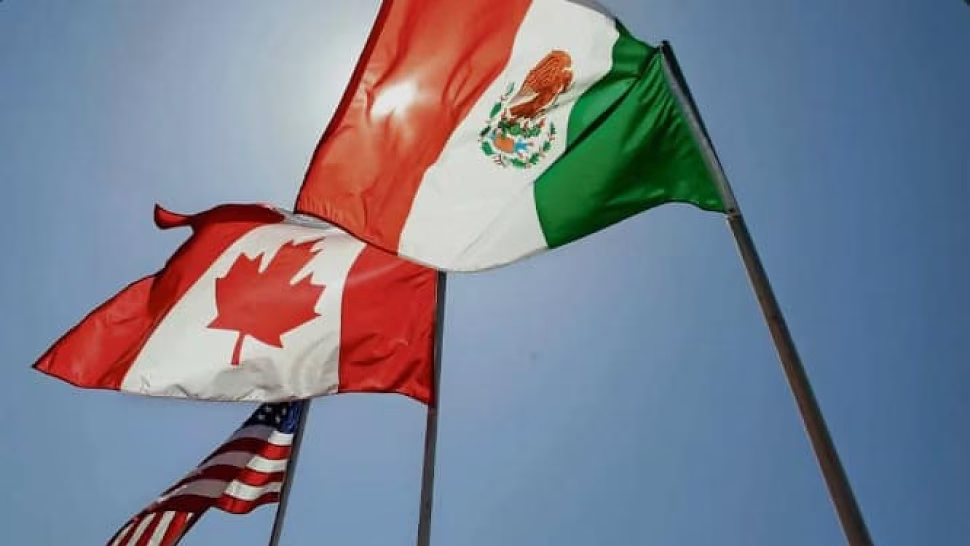
Modifications to the T-MEC require approval from the US Congress

Comce specialists warn that profound changes to the T-MEC require approval from the US Congress.

Possible modifications to the Treaty between Mexico, the United States and Canada (T-MEC) could not imply substantive changes without the authorization of the US Congress. This was pointed out by specialists from the Mexican Business Council for Foreign Trade, Investment and Technology (Comce).

Implications of the changes

Kenneth Smith Ramos, president of the Mexico-United States Bilateral Technical Committee of COMCE, indicated that the White House proposals on rules of origin and other chapters of the treaty could face resistance among Democratic legislators. For this reason, he asked not to advance concessions during the negotiation until he had guarantees regarding the reduction of tariffs.

The specialist highlighted that the T-MEC is still in force and represents certainty for companies in the region. He considered it necessary for the US economic sectors to express their rejection of any measure that structurally affects the agreement.

Comce Actions

Smith Ramos stated that, although the United States maintains pressure through trade threats, the chances of it abandoning the treaty are practically zero. However, he acknowledged that annual reviews generate uncertainty for investors and companies that depend on stable rules.

Comce representatives pointed out that the continuity of the T-MEC until 2036 should be seen as a positive aspect. They warned that Mexico and Canada share dependence on the US market, so it will be necessary to strengthen the trade relationship and maintain a negotiation strategy that protects the economic integration of North America.

The annual reviews of the T-MEC generate uncertainty, but the extended validity until 2036 offers a horizon of stability if managed with a strategic approach.

Continue reading