Mexico contains the screwworm after a year of battle

The most epic health battle of the year shows results, but the microscopic enemy does not give up easily.

One year later and the worm is still in its forced quarantine

It turns out that just a year ago, Mexico detected an unwanted guest in its livestock: the screwworm (GBG). And no, it is not the name of an indie rock band, but of a plague that sounds like a bizarre horror movie. But don’t worry, because according to Senasica (the anti-pigeon squad of the Ministry of Agriculture), the situation is… contained. Basically, 99.9% of active cases are on vacation in the south-southeast of the country. It’s as if the worm has decided that Cancun and the Riviera Maya are its favorite destination, and the north of the country doesn’t even look at it.

Currently, there are 941 cases being followed up. Sounds like a lot, right? Well, in reality it is only 0.003% of the national livestock herd. It’s the equivalent of three people wearing an ugly shirt at a Bad Bunny concert: statistically insignificant, but you still have to keep an eye on them. And all this thanks to a health operation that seems to come out of a mission impossible protocol, but with fewer masks and more rubber boots.

RelatedCattle screwworm reduces active cases by 57 percent

The most epic operation (and that no one saw on Netflix)

To control this pest, the largest zoosanitary operation in recent decades was deployed. Imagine an army of 1,195 people – technicians, inspectors, the ‘soldiers’ of the field – doing everything from inspections to treatments, and restricting the movement of animals as if they were influencers at an airport. As part of border control, 2.2 million animals have been checked and treated. Yes, millions. Basically, they have put up a sanitary fence that makes the ‘Game of Thrones’ wall look like a garden fence.

But collaboration does not stay at home. In a plot twist that no one expected, Mexico and the United States teamed up to launch the most peculiar counterattack: the release of more than 4 billion sterile flies. No, it’s not the latest TikTok trend; It is an insect suppression technique. It’s like a fly dating reality show where all the dates go wrong and the population dwindles. This measure is part of the Senasica-APHIS Joint Action Plan, signed in August 2025, which sounds like an interstellar treaty but is pure applied science.

The future is now (and it comes with more sterile flies)

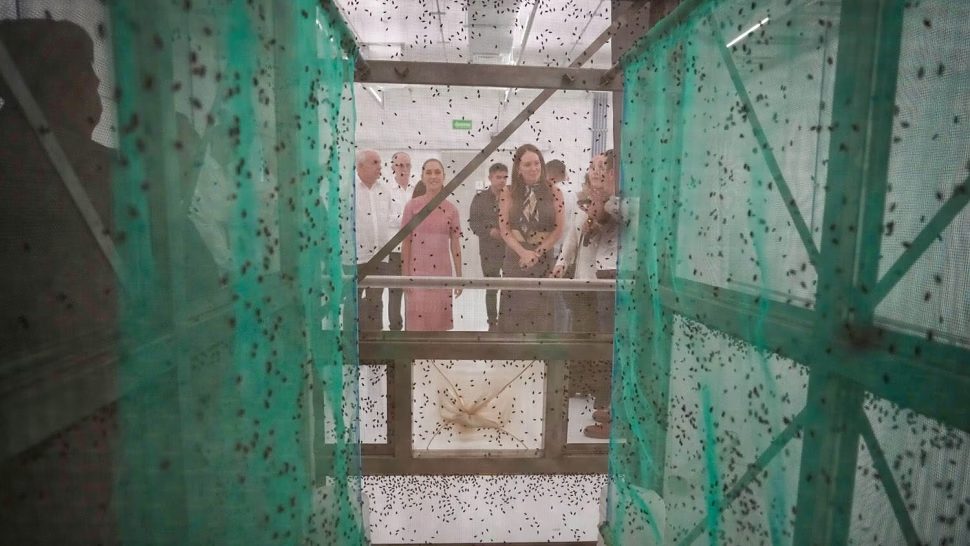
And in case anyone thought this was over, the start-up of the Sterile Fly Production Plant in Metapa de Domínguez, Chiapas is scheduled for 2026. This single insect factory will have the capacity to produce 100 million sterile flies per week. Basically, it will be the most effective and massive Tinder for flies, where all matches are a dead end. This will strengthen containment and eradication actions, taking the battle to a new level.

The country is moving from the containment phase to preparing for the total eradication of the screwworm. But, as in any good drama, challenges persist: the climatic conditions favorable to the insect (because the worm loves warmth), the operational complexity of field deployment (coordinating so many people is not a meme) and the need to maintain the training and collaboration of producers and technicians in the territory. In short, the fight continues, but at least we are winning for now.

Does this scientific battle against a worm seem incredible to you? Share it on your social networks and make your timeline aware of this biological war! And don’t miss more stories about innovation and sustainability in our related content section.
Sterile fly plant inaugurated in Chiapas; key binational cooperation

New binational plant will produce 100 million sterile insects per week to protect livestock.

Strategic plant against livestock pest

President Claudia Sheinbaum inaugurated the Production Plant for Sterile Livestock Screwworm Flies (GBG) in Metapa de Domínguez, Chiapas. The project is binational between Mexico and the United States.

The facility will produce 100 million sterile insects each week. The objective: control the pest and strengthen animal health in both countries.

Sheinbaum highlighted that international cooperation generates results in the face of phytosanitary challenges that do not recognize borders. He thanked President Donald Trump and the US authorities for their financial and technical contribution.

Investment and results

The US ambassador to Mexico, Ronald D. Johnson, announced an additional investment of 83.8 million dollars. The resources will be used to intensify the fight against the pest, increase the production of sterile flies and strengthen preventive strategies.

The US Secretary of Agriculture, Brooke L. Rollins, described the achievement as an example of the success of coordinated work.

For her part, the Secretary of Agriculture and Rural Development, Columba Jazmín López Gutiérrez, explained that the plant was built in 12 months. As part of the containment actions, 5.3 million heads of cattle have been inspected, more than 84 thousand commercial shipments have been verified and 7 billion sterile flies have been released with the support of specialists.

The bilateral relationship, Sheinbaum stressed, must continue on mutual respect, constant dialogue and sovereignty.

Continue reading

Former Pemex director investigated for alleged assault on his wife

The Morelos Prosecutor's Office is investigating Víctor Rodríguez Padilla for alleged assault on his wife.

Investigation in progress

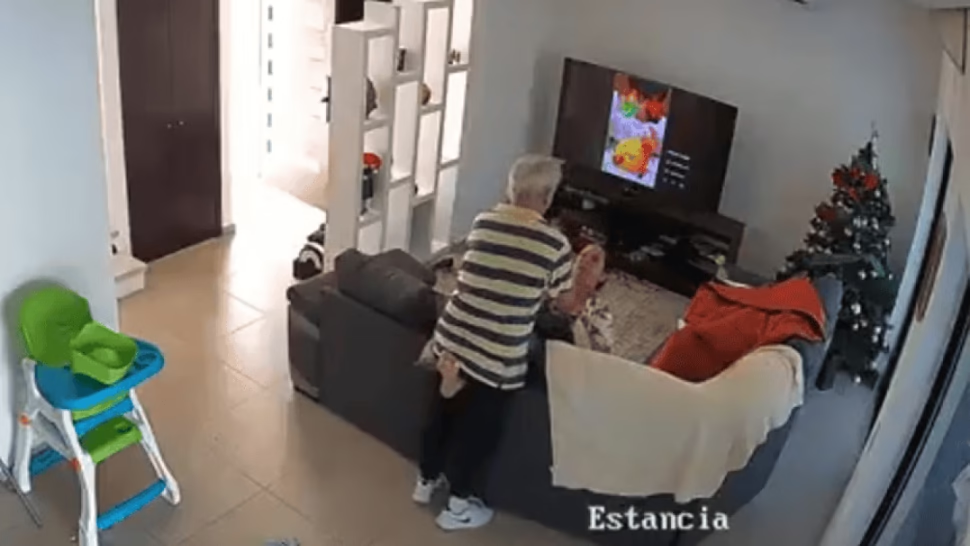
The Attorney General’s Office of the State of Morelos initiated an investigation file against Víctor Rodríguez Padilla, former director of Petróleos Mexicanos, after the dissemination of a video in which he is seen allegedly attacking his wife, María Felicia Jiménez. The recording, which circulates on social networks, shows Rodríguez Padilla repeatedly hitting the victim inside a home in the municipality of Emiliano Zapata, adjacent to Cuernavaca. According to the metadata of the video, the attack occurred on March 15.

The state agency reported that since Friday it has been exchanging information with the Women’s Secretariat of the Government of Mexico to guarantee the protection of the victim.

“The Attorney General’s Office of the State of Morelos initiated an investigation folder for the probable criminal acts derived from the dissemination of a public complaint through a video, where an act of violence against a woman is seen,” cited the FGE.

Protection actions

The Morelos Prosecutor’s Office specified that the investigation was opened in full respect for the rights of women, girls, boys and adolescents. The statement indicates that the events probably occurred on March 15 inside a home in Emiliano Zapata, with the alleged participation of a former federal official.

The institution assumed the commitment to exhaust all measures to determine responsibilities and guarantee a life free of violence for the victim. So far, no precautionary measures have been reported against Rodríguez Padilla, and the investigation is still ongoing.

Continue reading

Sheinbaum supervises progress of IMSS-Wellbeing with governors

Sheinbaum leads meeting with 23 governors to evaluate progress in the health system.

Advances in public health

At the National Palace, President Claudia Sheinbaum led a follow-up meeting on the IMSS-Wellbeing model. Governors of the 23 entities integrated into the program participated.

“The objective is to guarantee quality, universal and free medical care for the people of Mexico.”

The federal cabinet was attended by Rosa Icela Rodríguez (Government), David Kershenobich (Health), Luisa María Alcalde (Legal Department), Eduardo Clark (Undersecretariat of Health), and the directors of IMSS-Bienestar (Alejandro Svarch), IMSS (Zoé Robledo) and Issste (Martí Batres).

The state leaders present were: Marina del Pilar Ávila (Baja California), Víctor Castro (Baja California Sur), Layda Sansores (Campeche), Eduardo Ramírez (Chiapas), Clara Brugada (CDMX), Indira Vizcaíno (Colima), Delfina Gómez (State of Mexico), Evelyn Salgado (Guerrero), Julio Menchaca (Hidalgo), Alfredo Ramírez (Michoacán), Margarita González (Morelos), Miguel Navarro (Nayarit), Salomón Jara (Oaxaca), Alejandro Armenta (Puebla), Mara Lezama (Quintana Roo), Ricardo Gallardo (San Luis Potosí), Yeraldine Bonilla (Sinaloa), Alfonso Durazo (Sonora), Javier May (Tabasco), Américo Villarreal (Tamaulipas), Lorena Cuéllar (Tlaxcala), Rocío Nahle (Veracruz), Joaquín Díaz (Yucatán) and David Monreal (Zacatecas).

The meeting is part of the periodic supervision to consolidate free coverage of health services in the country.

Continue reading