Mexico and the United States build the future with dialogue and cooperation

A bond that overcomes disagreements, building a joint future in security and trade after two centuries of shared history.

An Alliance that Transforms Challenges into Opportunities

Hello, bridge building community! Today is a day to celebrate with a heart full of optimism. Mexico and the United States commemorate 203 years of a vibrant diplomatic relationship, a shared history that, even in its most complex chapters, demonstrates the transformative power of permanent dialogue and strategic collaboration. In this new era, with the administrations of Claudia Sheinbaum and Donald Trump, we don’t just see differences; We see a golden opportunity to reaffirm that bilateral cooperation, based on mutual respect and sovereignty, always triumphs! The Secretariat of Foreign Relations (SRE) has reaffirmed this unbreakable commitment: to move forward, always for the benefit of our people.

It is true that the path has had its tests, from discussions about trade tariffs to immigration policies. But you know what? Each disagreement has been a lesson that has strengthened the foundations of this bond. Even the tensions around the Water Treaty or the shadow over the future of the T-MEC are calls to action, invitations to sit down, talk and create more solid agreements. Because when we focus on the common goal, obstacles become stepping stones. And today, progress is undeniable: security cooperation, the frontal combat against trafficking in drugs, firearms and people, is stronger than ever. That’s evolving together!

RelatedMexico and the United States establish security cooperation program

Concrete Actions That Inspire a Safe Future

Energy is transformed into action, and the proof is in every meeting, in every initiative. The recent Second Meeting of the United States-Mexico Security Implementation Group, led by the person in charge of the Chancellery, Roberto Velasco, is a beacon of what can be achieved. Under inalienable principles such as shared responsibility and collaboration without subordination, a border cooperation program that is already protecting communities is followed up. Together with ambassador Ronald Johnson, not only are progress reviewed, the synergy is deepened for the good of all!

And the initiatives are as powerful as they are inspiring. The “Firewall Mission: United Initiative against Firearms Trafficking” is a perfect example of joint ingenuity. With clear goals such as expanding the use of the eTrace tool and deploying ballistics technology throughout Mexico, they are cutting the flow of violence at the root. Every weapon stopped, every network dismantled, is a life saved, a family protected. Furthermore, the creation of a group against cross-border illicit finances attacks the heart of organized crime: its money. That’s thinking big and acting precisely!

Enthusiasm extends to training and coaching. Imagine the impact: 163 Sonora state police officers and 44 elements of the Border Operations Division receiving advanced training, equipped with specialized tools thanks to programs such as that of the Office of International Narcotics and Law Enforcement Affairs (INL). It’s not just about techniques; It’s about empowering those who protect us every day. As the U.S. Embassy said: “When we work together, our communities on both sides of the border are more protected. Safe Together”. That phrase is more than a motto, it is a reality that is built day by day!

So, let’s celebrate this anniversary not only by looking to the past, but with our gaze fixed on the horizon of possibilities. This binational relationship demonstrates that with respectful dialogue, political will and a shared vision, any panorama can be transformed. Challenges don’t go away, but our ability to overcome them, together, grows exponentially.

Are you inspired to see how cooperation builds a better future? Share this message of unity and progress on your social networks and explore more stories about how alliances transform our world!
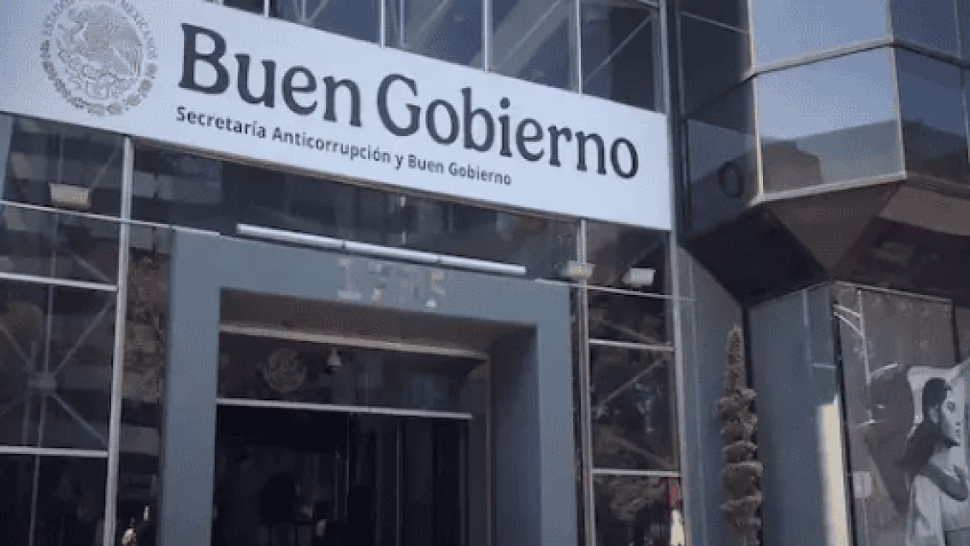
They sanction 13 public servants in nine agencies

13 officials from 9 agencies were sanctioned for non-serious administrative offenses.

The Anti-Corruption and Good Government Secretariat reported that it applied sanctions to 13 public servants from 9 agencies for non-serious offenses. Disqualifications range from 15 days to 3 months.

Details of sanctions

The investigations were carried out through the responsibilities units at Pemex and CFE, as well as the internal control bodies at IMSS, Defense, SNDIF, ANAM, INDEP, ASIPONA Manzanillo and Salud.

  • In Pemex, suspension for 30 days of Marlyn C and María F for not following up on the payment of post-mortem benefits of a worker between 2022 and 2025.
  • In CFE, 15 days of suspension to Josué S for registering requests for electricity supply without powers in 2024.
  • In IMSS, Víctor C was disqualified for 3 months for omitting medical treatment for a patient, which deteriorated his health until his death in 2022.
  • In Defense, private reprimand to Luis C for not integrating a clinical file in accordance with official standards in 2023.
  • In SNDIF, Ornela G is suspended for 15 days for abuse of a minor in 2025.
  • In ANAM, Tomas M, Brenda P and Hernán M are suspended for 15 days for failing to check the luggage of three passengers in 2023.
  • In INDEP, 15 days of suspension to José A and Omar G for signing an agreement that exceeded 20% of the contractual amount in 2023.
  • In ASIPONA Manzanillo, two suspensions of 10 and 12 days to Edmundo C for not managing budget adjustments in 2023.
  • In Health, public reprimand to Ana G for providing documentation with confidential information in 2023.

Reaction of the Secretariat

The agency explained that the sanctions were imposed in accordance with the law, considering proportionality and severity. Sanctioned people can challenge.

“The Anti-Corruption and Good Government Secretariat reaffirms its commitment to eradicate corruption in public life and promote ethics, honesty, integrity and good governance,” he said.

He invited people to report conduct contrary to legality at denuncias.gob.mx.

Continue reading

Sheinbaum in Acapulco: Women’s Pension and goodbye to La Parota

President delivers cards to 70,000 Guerrero residents and cancels dam project.

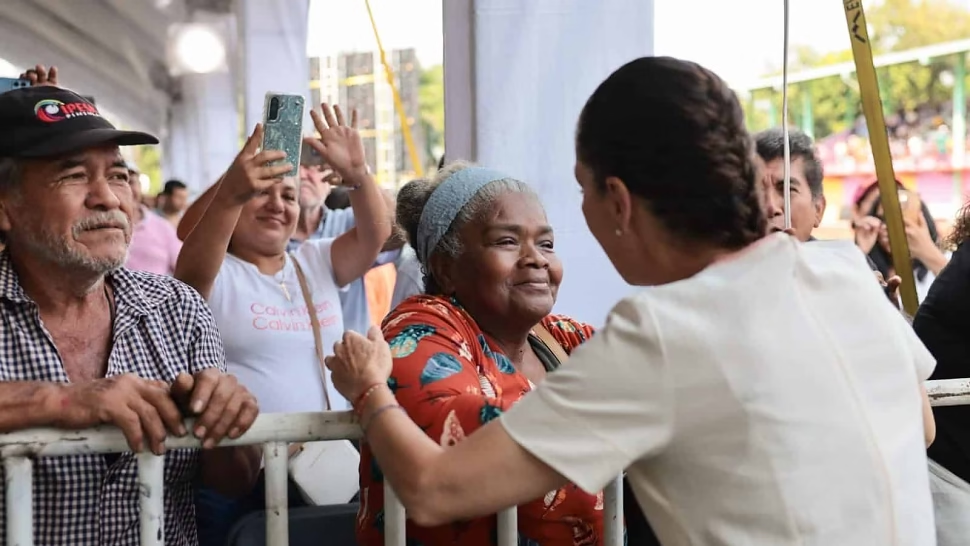
President Claudia Sheinbaum visited Acapulco, Guerrero, to lead the delivery of cards from the Pensión Mujeres Bienestar program. This scheme grants 3,100 pesos every two months to Mexican women between 60 and 64 years old.

Support for women and new works

During the event, the president stressed that the benefit recognizes the care work that women have historically carried out. Currently, almost 70 thousand people of Guerrero receive support, of which around 18 thousand reside in the port.

“When women walk together, there is nothing that stops us, we are the center of the Transformation, we are the history and future of Mexico,” stated Sheinbaum.

In terms of infrastructure, the president announced the definitive cancellation of the La Parota Dam project due to its effects on communities. Instead, wells and high tanks will be built to guarantee the supply of drinking water. Rehabilitation work will also be carried out after hurricanes Otis and John.

Sheinbaum reiterated his administration’s commitment to women and the sustainable development of Guerrero, prioritizing solutions that do not harm the social or natural environment.

Continue reading

They urge SEP to strengthen actions against bullying

28.5% of adolescents suffered bullying; They urge SEP to reinforce protection protocols.

The Second Commission of the Permanent Congress approved an opinion that urges the Ministry of Public Education (SEP) and the educational authorities of the 32 entities to reinforce strategies for preventing bullying and school violence. The request is part of the “Safe School Environments” program.

According to the National Discrimination Survey (ENADIS) 2022, carried out by Inegi, Conapred and the CNDH, around 28.5% of people between 12 and 17 years old have experienced some form of harassment or mistreatment at their school. The National Educational System serves more than 34 million students in 258 thousand basic, upper secondary and higher education schools.

The “Safe School Environments” strategy promotes co-responsibility between authorities, families and school communities to prevent risks and promote a culture of peace. The opinion highlights that this mechanism articulates guidelines, protocols and actions to guarantee safe, healthy and inclusive spaces, without restricting fundamental rights.

The legislators considered it necessary to maintain permanent prevention and care actions. The exhortation seeks to ensure that educational centers are environments free of harassment, with full respect for human rights and the best interests of children.

Continue reading