Mexico on the brink of recession due to US tariffs

Experts paint a discouraging picture: more tariffs could plunge the Mexican economy into a deep crisis.

Because nothing says “commercial friendship” like sinking your neighbor with taxes

The Mexican Institute of Finance Executives (IMEF), those soothsayers of the economy that never fail (except when they do), released their latest prediction: if the United States continues playing “tariff punishment” with Mexico, the economic slowdown will become a recession worthy of a soap opera. And no, it is not an episode of “La Rosa de Guadalupe”, this is real.

The trigger? Tariffs, that brilliant strategy that makes everyone lose, especially when applied to products like tomatoes. Because, of course, what better way to demonstrate power than to charge more for guacamole ingredients?

RelatedThe SAT wants full access to your apps and it’s chaos

From bad to worse: the IMEF adjusts its figures (downwards, obviously)

The institute, in an act of inverse optimism, cut its GDP growth projection for 2025 from the already pathetic 0.6% to a desolate 0.2%. Come on, not even a bureaucrat’s salary increase is enough to compensate for that blow.

According to Víctor Manuel Herrera, president of the IMEF Economic Studies Committee, the economy has been in free fall for months since the end of 2024, coinciding with the judicial reform and the eternal circus of government changes in Mexico and the US. Chance? No, just the karma of bad planning.

And if that were not enough, construction is already in survival mode, and companies like Stellantis and Nissan are announcing temporary stoppages. The next step? Layoffs. Because, apparently, the strategy is to turn workers into resume experts.

Recession? “It’s very likely,” say those who know (or should)

Gabriela Gutiérrez Mora, president of the IMEF, made it clear: the economy already smells of recession. With the United States faltering and Mexico following suit, the scenario is as encouraging as a soccer match where both teams lose.

If things continue like this, we will lose jobs and purchasing power. But don’t worry, experts say: If the recession is “brief and not very deep,” the recovery will be quick. Sure, like when you fall down the stairs but “only” break your arm.

Solution? Resolve the trade conflict with the US as soon as possible. Or, failing that, start growing tomatoes in the White House garden.

Are you worried about the economic future? Share this note and spread the drama (with humor, because life is already serious). Or check out more content on how to survive the next crisis… because there’s always a next one.
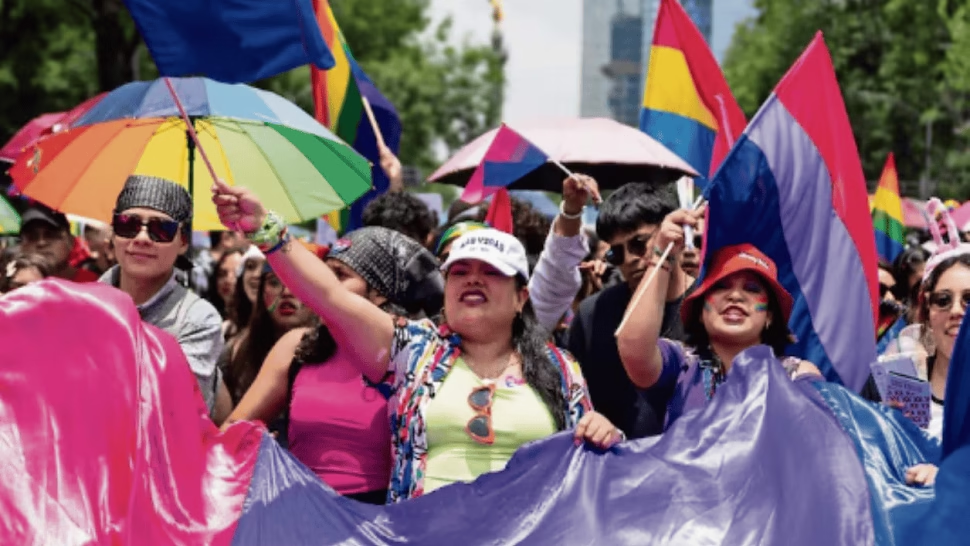
Pride March includes call for missing LGBT+ people

Collectives demand visibility for missing people of sexual diversity in CDMX.

One day before the 48th LGBT+ Pride March in Mexico City, groups called to march for missing people of sexual diversity.

Under the motto “Because we are also looking for them”, the LGBTTTIQ+ Contingent Against Disappearances called to gather this Saturday, June 27, at the Glorieta de los Desaparecidos de Reforma, at 10:00 a.m.

“This march represents a valuable opportunity to continue raising our voices, making our struggles visible and working together for a more just and inclusive society,” said the organizers.

Data on violence and disappearances

According to the National Observatory of Hate Crimes Against LGBT+ People, in 2025, 59 violent deaths, 34 disappearances, 16 attacks and 6 loss of life due to self-inflicted causes were documented.

The National Registry of Missing and Unlocated Persons reports, as of June 25 of this year, 135,155 missing people: 29,295 women, 105,489 men and 371 of undetermined sex.

An emblematic case is that of Lilith Saori Arreola Alvear, a young trans woman who disappeared at the age of 21 on January 2, 2023 in Puerto Escondido, Oaxaca. His search joins that of more than 133 thousand people in the country.

Impact of the mobilization

The march seeks to remember the victims and raise awareness about the violence faced by the LGBT+ community in Mexico. The demand for justice and visibility remains a central demand.

Continue reading

Sheinbaum and governors review progress of the IMSS-Wellbeing

Sheinbaum supervises progress of the IMSS-Bienestar with governors of 24 states to guarantee free, quality care.

President Claudia Sheinbaum led a meeting at the National Palace with federal authorities and the governors of the 24 entities attached to the IMSS-Bienestar health system. The objective: monitor progress and ensure quality, universal and free medical care.

“At the National Palace, we work with governors of states incorporated into IMSS-Bienestar to monitor progress. The objective is to guarantee quality, universal and free medical care for the people of Mexico,” the president published on her social networks.

The Secretary of the Interior, Rosa Icela Rodríguez, participated in the meeting; the legal advisor, Luisa María Alcalde; the Secretary of Health, David Kershenobich Stalnikowitz; the Undersecretary of Sectoral Integration and Development, Eduardo Clark García Dobarganes; and the general director of IMSS-Bienestar, Alejandro Svarch Pérez. Zoé Robledo, director of the IMSS, and Martí Batres Guadarrama, general director of the ISSSTE, were also present.

Built-in states and scope

Currently, 24 states are part of the IMSS-Bienestar: Baja California, Baja California Sur, Campeche, Chiapas, Mexico City, Colima, State of Mexico, Guerrero, Hidalgo, Michoacán, Morelos, Nayarit, Oaxaca, Puebla, Quintana Roo, San Luis Potosí, Sinaloa, Sonora, Tabasco, Tamaulipas, Tlaxcala, Veracruz, Yucatán and Zacatecas.

Impact on medical care

The implementation of the IMSS-Wellbeing seeks to improve access to health services in the country. According to the government, the program aims to guarantee that all citizens receive care at no cost, strengthening infrastructure and coverage in historically marginalized areas.

Continue reading

Pato Merlín achieves trademark registration with the IMPI

Merlin Duck receives official trademark registration in Mexico.

Official record of Merlin Duck

Merlin Duck, a well-known social media character, already has a trademark registration in Mexico. The Ministry of Economy and the Mexican Institute of Industrial Property (IMPI) granted protection to its owner, Karla Ivette Gómez López.

The application was submitted on June 22 through the Marcanet system. The registration numbers are 3646513 and 3646554. The trademark protects education, training, entertainment, sports and cultural activities services.

The Secretary of Economy, Marcelo Ebrard, and the general director of IMPI, Vidal Llerenas, delivered the certificate to the Gómez López family. During the event, Ebrard noted:

All trademark registration applications are subject to a technical and legal analysis procedure, with the aim of guaranteeing certainty, legality and transparency in the protection of industrial property rights in Mexico.

For his part, Llerenas explained that it is a public fact that Merlin Duck is the pet of the family of Karla Ivette Gómez, to whom the brand belongs.

The registration was granted after a person from Yucatán also submitted an application for the same name. The authority intervened to protect the rights of the owner family.

With this action, the Ministry of Economy and the IMPI reaffirm their commitment to providing legal certainty and protecting creativity and intangible assets in the country.

Continue reading