Merlin, the duck of the Cup, tours CDMX

The Peking duck with sandals and a Mexican shirt unleashes a tour of key venues in the capital.

An unexpected tour

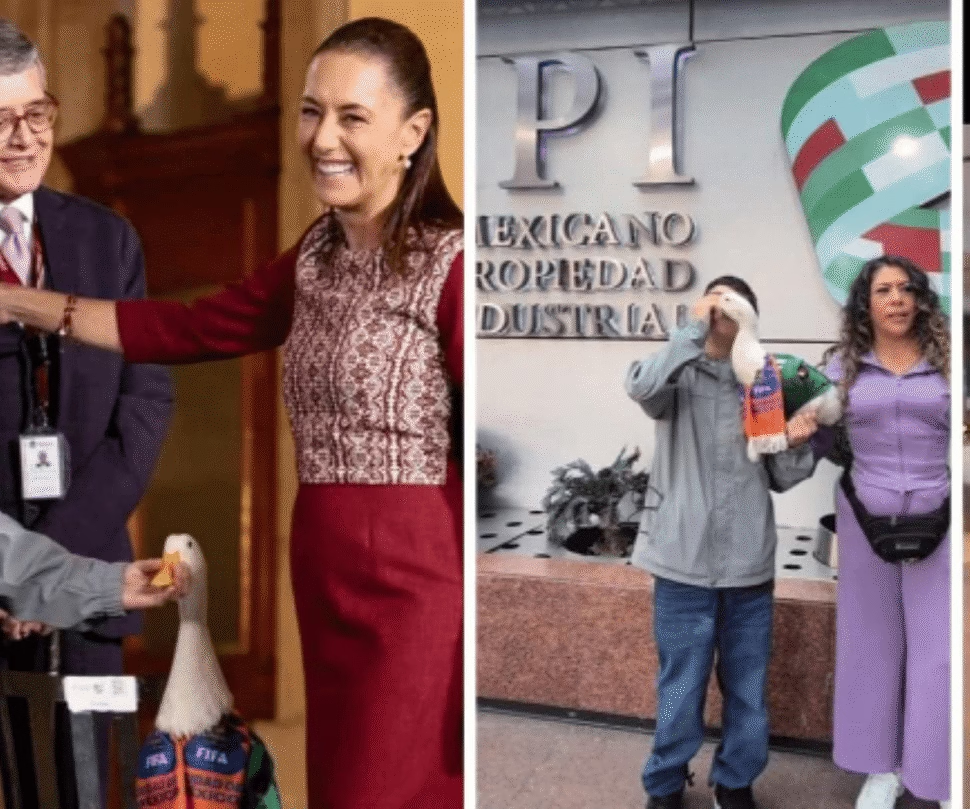
The Merlin duck, a Peking breed, went viral after appearing at the 2026 World Cup celebrations. Its distinctive features: small sandals to protect its legs, a National Team shirt and an evident closeness to its family. That video prompted a series of visits that its owners, the Gómez family, documented on social networks.

The logs of these tours show that the bird went to emblematic places in the Mexican capital. At the National Palace, he entered the Treasury Room during the morning conference, where he caught the attention of the staff and attendees.

RelatedMerlin the duck, from viral to official ambassador of CDMX for 2026

It also went through the Mexican Institute of Industrial Property (IMPI), where the family processed the official registration of the animal’s name to ensure exclusive commercial rights to its image.

Institutional recognition

Merlin visited the Netflix Mexico offices in Mexico City. Their presence generated digital interactions among the streaming platform’s workers. In addition, the ESPN and TV Deportes networks integrated it into their programming and special coverage around the tournament.

The Atlante Club, a local sports institution, incorporated it into its institutional activities and classified it as an amulet in promotional events.

The phenomenon reached the international level: FIFA granted official access to Merlín and his family to watch the Mexican National Team’s match against the Czech Republic from a box. Thus, the duck became an unexpected ambassador of the capital during the Cup.
14 mayors deprived of their lives during Sheinbaum’s six-year term

The attack on the mayor of Temoac raises the number to 14; Oaxaca and Michoacán concentrate the cases.

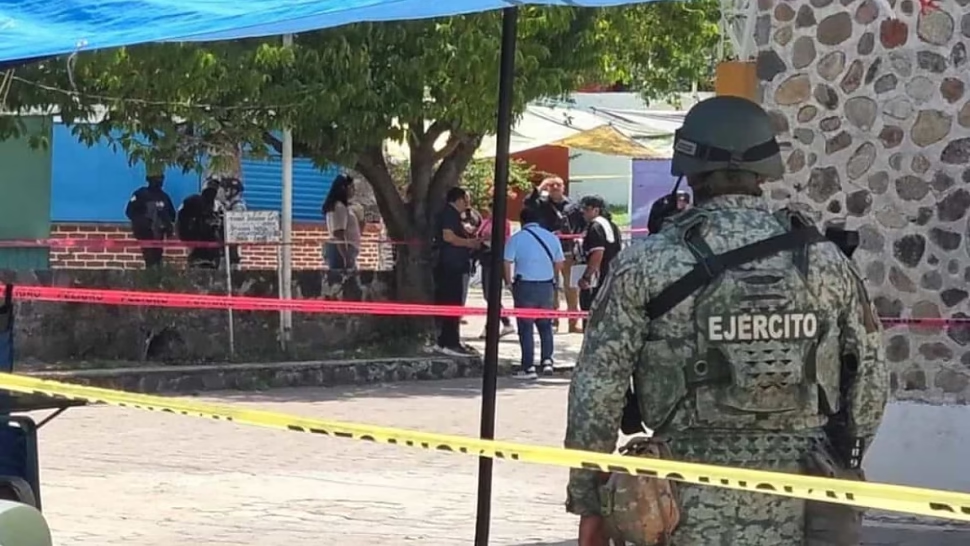
The armed attack against Valentín Lavín Romero, mayor of Temoac, Morelos, which occurred inside the City Hall, raised to 14 the number of municipal presidents deprived of their lives during the current government. Specialists warn that this reflects the advance of organized crime in local governments.

A crisis that is growing in small municipalities

According to records from civil organizations and local media, Oaxaca tops the list with five councilors who were victims of homicide in the last year and a half, followed by Michoacán with four. The attacks against municipal authorities show, according to experts, a dispute between criminal groups for territorial control and political influence in communities.

  • Alejandro Arcos Catalán, from Chilpancingo, Guerrero (October 6)
  • Román Ruiz Bohórquez, from Candelaria Loxicha, Oaxaca (October 15)
  • Jesús Franco Lárraga, from Tancanhuitz, San Luis Potosí (December 15)
  • Mario Hernández García, from Santiago Amoltepec, Oaxaca (May 15)
  • Isaías Rojas Ramírez, from Metlatónoc, Guerrero (June 2)
  • Yolanda Sánchez Figueroa, from Cotija, Michoacán (June 3)
  • Salvador Bastida García, from Tacámbaro, Michoacán (June 5)
  • Lilia Gema García Soto, from San Mateo Piñas, Oaxaca (June 15)
  • Martha Laura Mendoza Mendoza, from Tepalcatepec, Michoacán (June 17)
  • Miguel Bahena Solórzano, from Pisaflores, Hidalgo (October 20)
  • Carlos Alberto Manzo Rodríguez, from Uruapan, Michoacán (November 1)
  • Joel Ángel Bravo Martínez, from San Miguel Amatitlán, Oaxaca (June 13)
  • Eduardo Saavedra López, from San Miguel Yogovana, Oaxaca (July 12)
  • Valentín Lavín Romero, from Temoac, Morelos (July 22)

Security specialists point out that small municipalities are the most vulnerable due to their limited institutional and security capacities. Víctor Sánchez, academic at the Autonomous University of Coahuila, explained:

The attacks against mayors represent a symptom of municipal capture by criminal organizations, which seek to influence local police, political decisions and territorial control.

The PAN senator, Mario Vázquez, stated that these homicides reflect the abandonment of municipal governments in the face of organized crime and accused a lack of federal support. Meanwhile, federal authorities have noted a reduction in high-impact crimes, although experts consider that the security strategy has not been able to uniformly strengthen local governments.

Continue reading

Fox and former PAN governors defend Ruffo Appel

Fox and former PAN governors demand a fair process for Ruffo Appel indicated by the FGR.

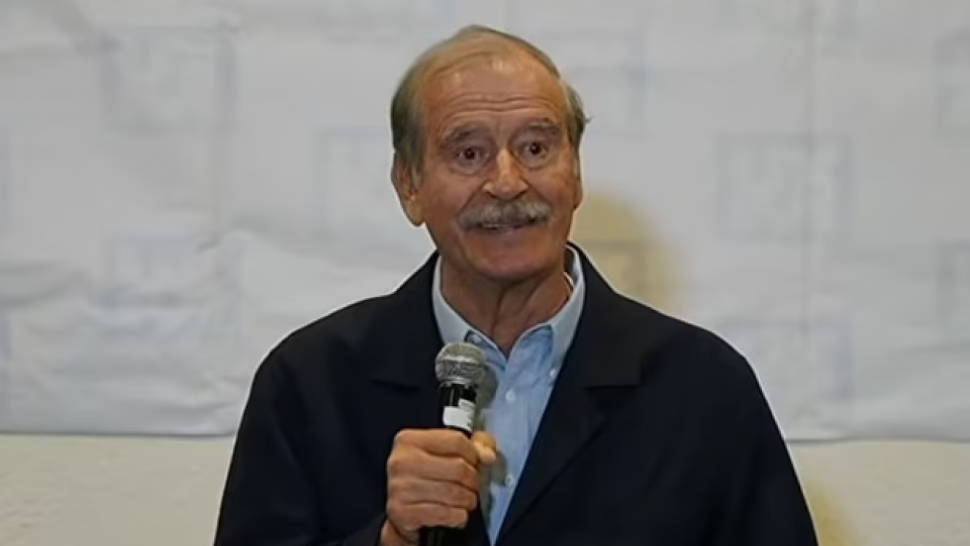
Former president Vicente Fox Quesada and four former governors of the National Action Party (PAN) formed a defense front for Ernesto Ruffo Appel, after the Attorney General’s Office (FGR) accused him of alleged crimes of organized crime and tax fraud.

At a press conference, Fox was accompanied by former governors Francisco Javier Ramírez Acuña and Alberto Cárdenas Jiménez, from Jalisco, as well as Juan Carlos Romero Hicks and Miguel Márquez Márquez, from Guanajuato. They demanded that the judicial process be carried out with transparency and adherence to the rule of law.

Fox stated that he “puts his hands in the fire” for who was the first opposition governor in the modern history of Mexico. He assured that the defense is not seeking privileges, but rather to guarantee that his constitutional rights are respected during the process.

The former president questioned the initial hearing against Ruffo Appel and pointed out that there are doubts about the impartiality of the procedure. He maintained that the accusations have a political background and recalled that large-scale fuel smuggling networks and tax fraud were previously reported.

Fox criticized the new Judiciary, which emerged from a popular election, which he described as a body without independence to guarantee fair processes. The former PAN governors insisted that the case must be resolved based on evidence and under the principles of legality and due process.

Continue reading

FDA false positive affects Mexican lettuce producers

The FDA withdrew its warning against Mexican lettuce after confirming an analysis error.

FDA Reporting and Correction

The United States Food and Drug Administration (FDA) initially linked a sample of lettuce from Taylor Fresh Foods, a company with operations in Guanajuato, with a gastrointestinal outbreak in that country. Days later, the authority retracted it: the result was a false positive. The case generated uncertainty in the export sector.

Reaction of Mexican producers and authorities

Given the accusation, the National Agri-Food Health, Safety and Quality Service (Senasica) analyzed 14 samples of lettuce and water from the producing areas. The results ruled out the presence of the Cyclospora cayetanensis parasite. The most affected entities were Guanajuato, Zacatecas, Puebla, Aguascalientes and Sonora, which concentrate a large part of lettuce exports to the United States.

Representatives of the agri-food sector requested to strengthen the budget for health and safety. They argue that more resources are required to ensure the safety of export products and prevent future incidents that damage buyers’ confidence.

The case exposes the fragility of the control processes and the dependence on external certifications. Producers are confident that the FDA’s rectification will help restore trade without further losses.

Continue reading