Marina finds toluene, a drug precursor, in the port of Sinaloa

The Navy secures 314 liters of toluene, an essential chemical for manufacturing synthetic drugs, in the port of Topolobampo.

Successful operation or drop in the bucket?

The Secretary of the Navy (Semar) announced with great fanfare the “Operation Sealing the Gulf of California.” The loot: six buckets and a drum. The content: 314 liters of toluene. The place: the port of Topolobampo, Sinaloa.

For those who do not have a PhD in organic chemistry, I translate. Toluene is an essential chemical. Essential for what, you ask. For the manufacture of synthetic drugs, mainly methamphetamines. It is not for making paint or cleaning tools.

“This substance is classified as an essential chemical product, the nature of which was confirmed by specialized identification equipment.”

The official version says that they found him during a routine check on a parcel tractor-trailer. One more vehicle among the many they reviewed. What a timely coincidence.

RelatedOperation in Sinaloa secures arsenal and chemicals of dubious domestic use

The material and the truck were made available to the Federal Public Ministry in Los Mochis. Semar was quick to highlight the coordination with all levels of government and the strict adherence to the legal framework. Always the legal framework, that favorite rhetorical shield of the institutions.

They reaffirmed their commitment to the rule of law and port security. They say it every time they make a discovery like this. Memory is short, but precedents are long: Sinaloa continues to be the main outlet to the Pacific for chemical precursors arriving from Asia.

Three hundred and fourteen liters sounds like a lot until you remember the tons that are moved each month. It’s like announcing that you stopped a bucket of water in the middle of a tsunami. The uncomfortable question that no one asks: where are the other 30,000 liters that surely passed this week?

Sheinbaum reinforces security and housing in Cuautla

The president presented a package of social and security actions in Cuautla, Morelos.

President Claudia Sheinbaum visited Cuautla, Morelos, to announce a set of social and security measures. Among them, the construction of 10 new schools of the “Margarita Maza” National High School, house-to-house visits, more jobs through Young People Building the Future and a greater presence of the National Guard.

“We are going to build together, because this is a job for everyone, for families to care for their children, for the state government and for the federal government,” the president highlighted.

The visit occurred after the arrest of the mayor of Cuautla. Sheinbaum instructed strengthening the federal presence with attention to the causes, as part of the National Security Strategy. Next week they will begin house-to-house tours and outreach to merchants. He promised to return in three months to monitor progress.

Housing for Wellbeing

At the event, 128 Infonavit homes and 207 Insus deeds were also delivered. Sheinbaum recalled the four components of the program: build 1.8 million new houses for people with incomes of one to two minimum wages; deliver the same number of credits for improvement; grant a million deeds; and restructure unpayable loans for 5 million families.

Octavio Romero Oropeza, director of Infonavit, reported that of the goal of 1.2 million homes, there are already 440 approved complexes that total 514 thousand houses (43% progress). In Morelos, the goal is 13 thousand new homes with an investment of 8,150 million pesos.

Edna Elena Vega Rangel, head of Sedatu, explained that 128 homes and 207 deeds were delivered. Governor Margarita González Saravia thanked the expansion of the state goal to 24 thousand houses in the six-year term, in addition to other works such as modernization of the countryside, a Convention Center in Cuernavaca and the “Circuito Tierra y Libertad” highway program.

The beneficiary Kendra Ramírez Orozco expressed her gratitude for access to housing. Sheinbaum reiterated his commitment to return in three months to follow up.

Continue reading

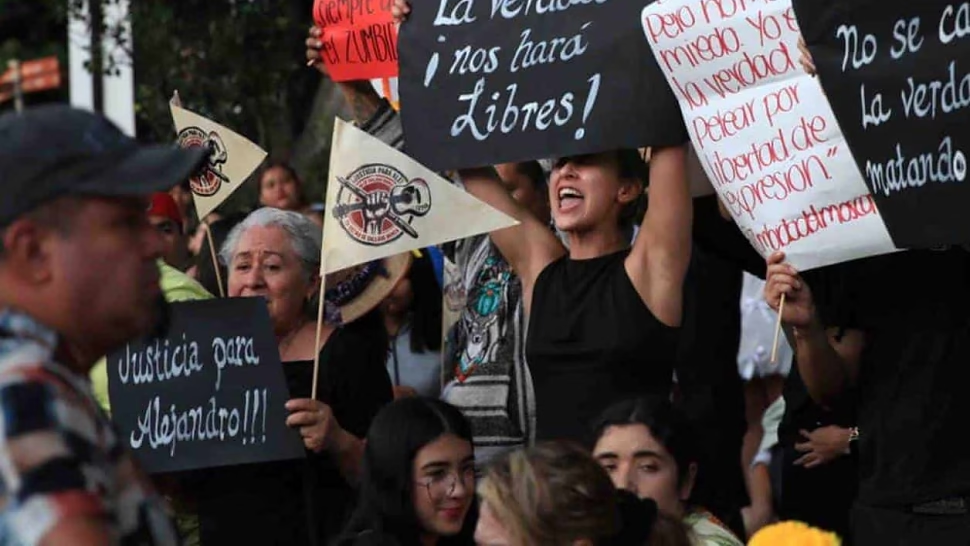
They demand justice for a journalist in Oaxaca; colleague receives threats

Threats against journalist in Oaxaca after the murder of Alejandro Leyva; protest in the Guelaguetza.

Threats against correspondent

After the murder of Francisco Alejandro Leyva Aguilar, Proceso‘s correspondent in Oaxaca, Pedro Matías Arrazola, was intimidated through social networks. They warned him that he would be next.

Organizations such as Reporters Without Borders and the UN demanded that the threats be investigated and security guarantees granted. The Oaxaca Prosecutor’s Office deployed two agents to protect him, and the state police carry out patrols near his home.

“I didn’t find out until they told me about Reporters Without Borders and then the UN, but I didn’t pay much attention to it (…). Better to keep a low profile,” declared Matías.

The journalist explained that he avoided spreading the threats so as not to divert attention from Leyva’s case. However, colleagues advised him not to minimize the risk, in a context of growing attacks against the press.

Two years ago, individuals threw Molotov cocktails with nails at his home, without causing any injuries. That attack forced him to leave the country for six months. Sixteen years earlier he was kidnapped and tortured.

“I am not afraid. I am a believer. I have a mission in this life and it will be until God decides,” he stated.

Matías filed a complaint for threats with the State Prosecutor’s Office. Its incorporation into the federal protection mechanism began.

“If we remain silent, they will have achieved their purpose. In recognition of Alejandro Leyva, I will continue along the same critical line,” he said.

Protest in Guelaguetza

Relatives and friends of Alejandro Leyva protested during the Guelaguetza delegation parade. With tarps, banners on the roof of a house and dressed in black, they demanded justice.

“We are Alejandro’s family and we ask for justice for my uncle. We know the situation in the country. It is not just Oaxaca, it is the entire country. Please join our cause,” expressed the protesters.

Continue reading

Sheinbaum announces border reopening for Mexican cattle

Gradual reopening of the US border to Mexican cattle at the end of August.

New stage for national livestock farming

President Claudia Sheinbaum confirmed that the United States border will gradually reopen at the end of August for the export of Mexican livestock. The measure represents economic relief for the country and for thousands of families dedicated to livestock farming.

Both nations suffered losses during the shutdown, caused by the presence of the screwworm. Sheinbaum acknowledged that the coordinated work between governments and producers for more than a year made it possible to contain the pest.

“You know that we have been working on the issue, both with all the livestock organizations and with the governors, to contain the screwworm,” said the president from Cuautla, Morelos.

As part of the strategy, a plant to produce sterile flies is already operating in Chiapas. In addition, Cofepris is analyzing a new strain that would make the process more efficient.

Sheinbaum explained that the effort is carried out in conjunction with the governments of Mexico, the United States and Panama. This articulation created the conditions for the US authority to authorize the opening of the border.

Continue reading