The crisis in the Middle East pushes millions into hunger

The WFP reports that millions of people in Somalia, Afghanistan and Sri Lanka are suffering from severe hunger due to the crisis in the Middle East.

The World Food Program (WFP) warned that the conflict in the Middle East is leading millions of people to severe hunger, as it anticipated if oil prices remained high.

Consequences for food security

According to WFP analysis in three vulnerable countries, an additional 2.5 million people in Somalia, 2.3 million in Afghanistan and 1.3 million in Sri Lanka are struggling to meet their basic food needs.

RelatedThe United States maintains humanitarian aid cuts in Afghanistan and Yemen

In March, the agency predicted that 45 million people could become food insecure by the end of June. That figure would be added to the 318 million who already suffer from it globally.

“We stand by those forecasts,” said Carl Skau, interim executive director of the WFP. “The relationship between energy and food prices is very close in many places, and in the poorest countries people already spend all their money on food; when prices rise, they eat less.”

The WFP report, released on Thursday, points out that the crisis in the Middle East generates “significant contagion effects” on food and fuel prices, altering trade. In already vulnerable countries, these factors combine to rapidly affect food security and livelihoods.

“These impacts are expected to intensify in the coming months, even if the crisis in the Middle East subsides,” the WFP added.

Skau mentioned other food insecure hotspots: Sudan, Gaza, southern Lebanon, Yemen and Haiti. The WFP has had to limit aid due to funding cuts. Skau urged donors to increase their contributions, especially for Somalia and Afghanistan, “because the human consequences of not doing more will be enormous.”


Ecuador agrees with Colombia and Peru to reinforce military and energy

Noboa reaches preliminary agreements on border security and provision of electricity and gas.

The president of Ecuador, Daniel Noboa, revealed that he held conversations with the elected leaders of Colombia and Peru, Abelardo de la Espriella and Keiko Fujimori. From these dialogues, preliminary agreements emerged on two fronts: border security and energy supply.

In terms of security, Noboa raised the need for a greater military presence of the armed forces of both countries on their respective borders with Ecuador. “Their presence at the border is going to be crucial,” he said in a radio interview. The border area is the focus of activities of drug trafficking groups linked to international cartels. According to the UN, 80% of the narcotics that enter Ecuador come from Colombia and the rest from Peru. The president had previously pressed a tariff war against Colombia, without receiving a response, and recently suspended it following a resolution from the Andean Community.

Regarding energy, Colombia will resume the sale of electricity to Ecuador. Noboa indicated that they will be able to receive up to 380 additional megawatts with a binational rate of about 30 cents per kilowatt/hour. The sale had been suspended by President Gustavo Petro in response to tariffs imposed by Ecuador. Now, with the agreement, the flow resumes. Ecuador faces a dry season that reduces hydroelectric generation – which provides 75% of electricity – and registers a deficit of at least 800 megawatts. At the end of 2024, Ecuadorians suffered blackouts of up to 14 hours a day due to the worst drought in six decades.

With Peru, the agreement consists of the provision of gas to generate electricity more cheaply in Ecuador. “That way we truly work together,” Noboa concluded.

The agreements reflect the political affinity between Noboa, De la Espriella and Fujimori, with a conservative profile, and seek to address two simultaneous crises: insecurity linked to drug trafficking and the energy emergency.

Continue reading

Oil exceeds $100 after Houthi attack on Saudi oil tankers

Houthi attack on two Saudi vessels sends Brent crude oil soaring to $100 and threatens key routes.

Yemen’s Iranian-backed Houthi rebels claimed to have attacked two Saudi oil tankers in the Red Sea. The event raises tension with Iran in the midst of international crude oil that has already exceeded $100 per barrel.

Economic impact on global markets

The price of Brent, an international reference, jumped more than 6% on Thursday to reach around $100. It is its highest level since May, when a preliminary peace agreement was still in force that has collapsed today. The world economy now faces the risk of a new closure of the trade route: the Houthis threaten the Red Sea, while Iran keeps the Strait of Hormuz blocked, through which a fifth of the oil and gas traded in the world normally passed.

Threats from Washington and diplomatic efforts

The United States completed its twelfth night of attacks on Iranian territory. President Donald Trump warned on social media:

“If they do this again, the United States will hold Iran responsible… significant military punishment will be inflicted on Iran and, of course, on the Houthis themselves.”

In parallel, Iraqi Prime Minister Ali al-Zaidi traveled to Tehran to ask for peace and dialogue. His office said he promised not to allow Iraqi soil to be used against Iran. Al-Zaidi had met with Trump in Washington earlier this month.

An Arab diplomat, speaking on condition of anonymity due to the sensitivity of the issue, indicated that the Gulf countries are growing in pessimism. He added that nations like Pakistan and Türkiye continue to push for a de-escalation.

Continue reading

Czech plane crash leaves one soldier dead

A military helicopter crashed in the Czech Republic; There is one death and four injured.

Accident at military base

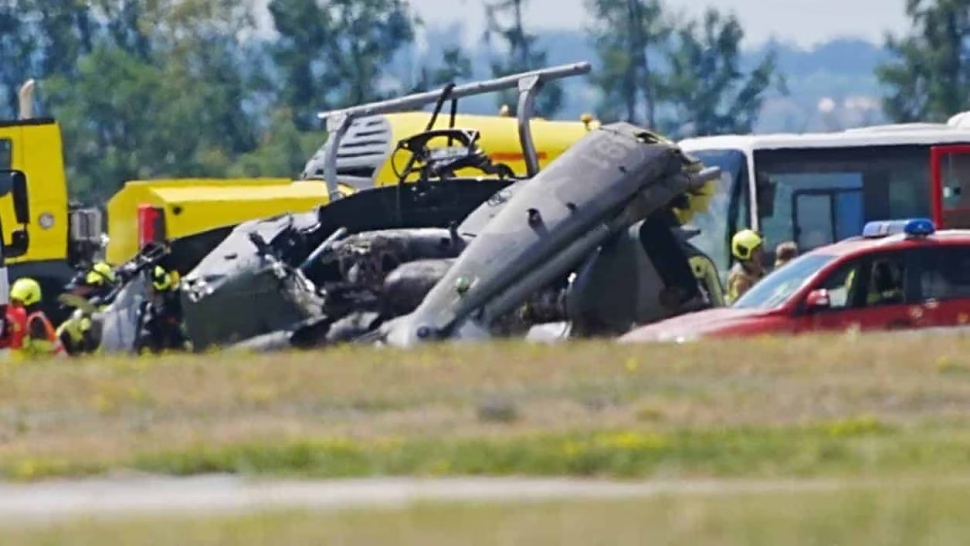
A Czech Army Venom helicopter, with five soldiers on board, crashed on Thursday. Authorities confirmed one death and four injuries.

The accident occurred around noon at the Námešt nad Oslavou air base, 180 kilometers southeast of Prague. The regional rescue service reported that one person did not survive the impact, while the other four crew members were taken to hospitals.

Following the incident, the Czech army grounded its 12 American-made UH-1Y Venom and AH-1Z Viper helicopters. Authorities are investigating the causes of the accident, although they have not released more details about the incident or the soldiers’ injuries.

Continue reading