June 1: will there be classes? SEP and CNTE in conflict

CNTE calls for a strike on June 1; SEP maintains normal classes throughout the country.

Next June 1 will be a regular school day for preschool, primary and secondary school students in Mexico, according to the 2025-2026 school calendar of the Ministry of Public Education (SEP). The date does not appear as an official suspension or mandatory rest.

However, the National Coordinator of Education Workers (CNTE) has called for a national strike. This has generated uncertainty among parents, who seek to confirm if there will be activities in schools.

RelatedThe SEP grants a measly day without classes in June so as not to collapse students

Position of the SEP and possible effects

The SEP has reported that classes must be held normally, both in public and private schools. The exception: when teachers decide to join the strike.

It is expected that some entities will register partial effects, especially in states where the CNTE has a greater union presence. Local suspensions could occur in those areas.

For now, the official recommendation is to go to class unless otherwise notified by the school. The authorities call to stay informed through official channels.
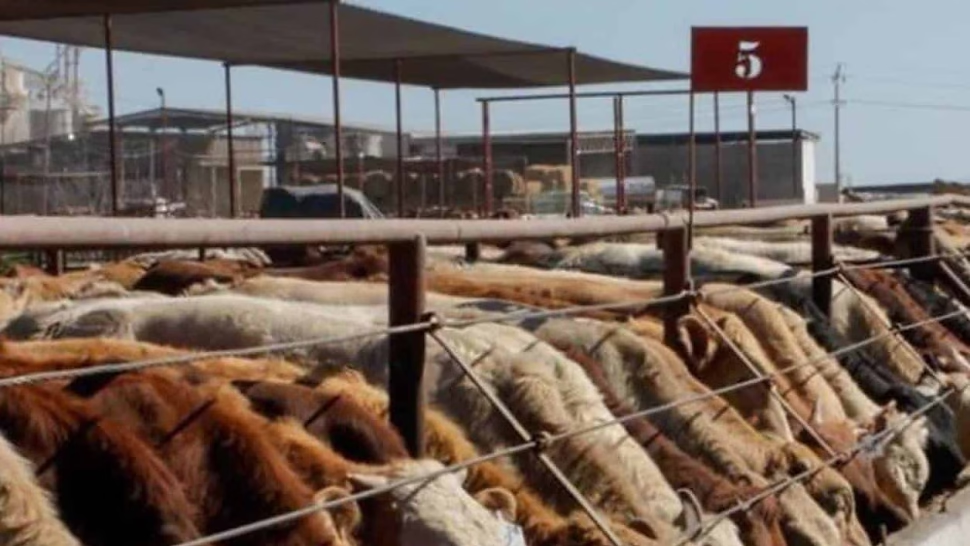

Sheinbaum announces resumption of livestock exports to the US

Mexico resumes exporting livestock to the US after control of the screwworm plague.

President Claudia Sheinbaum reported that the United States government authorized the resumption of Mexican livestock exports. The measure will begin to be applied in the last weeks of August.

Through social networks, the president explained that she received a letter from the US Secretary of Agriculture, Brooke Rollins, notifying the decision to reopen the borders to the national livestock sector.

The restart of the cattle crossing will begin at the border point of Agua Prieta, Sonora. Later, two additional crossings will be enabled in the state of Chihuahua.

Sheinbaum recognized the joint effort of the Ministry of Agriculture and Rural Development (Sader), Senasica and livestock producers to contain the screwworm plague. This achievement allowed binational trade to be unlocked.

“This is a new example that dialogue, cooperation and collaboration with mutual respect between Mexico and the United States yield great results for the benefit of our people,” said the head of the federal Executive.

Continue reading

SEP rejects violence under alleged military education

After the death of a teenager in a militarized camp, SEP refuses to justify abuses as 'military education'.

The Ministry of Public Education (SEP) condemned any act of violence or abuse against minors that attempts to justify with the term “military education.” Its owner, Mario Delgado, stated that this modality is not authorized in any basic education school in the country.

“It is inadmissible that, under a supposed ‘military education’, attempts are made to justify, normalize or hide acts of abuse, violence, mistreatment or practices that threaten the physical, psychological or emotional integrity of minors,” Delgado said in a statement.

The official stressed that this type of behavior constitutes a flagrant violation of human rights and the best interests of children. He recalled that military education is only taught in institutions of the Armed Forces and the National Guard, under the Secretariat of National Defense.

No authorization for militarized schools

The SEP reiterated that no basic education school can offer services under the name “militarized”, “military” or “military”. The agency warned that the educational authority of Tamaulipas is already investigating the case and will take action on the institution involved, which received authorization in 2005 and was updated in 2013.

Details of the case

The incident occurred at a private summer camp in Ciudad Madero, Tamaulipas. A teenager was admitted in good health on July 13. Days later, a coordinator informed the mother that the minor had fainted and suffered a fall. They sent him a video where the young woman appears lying down, with visible bruises on her face, saying that she was fine. Hours later, the teenager died inside the facilities.

The SEP regretted the death and strongly rejected any inhuman or degrading treatment against girls, boys and adolescents.

Continue reading

UN and Mexico discuss regulation of artificial intelligence

The UN analyzes in Mexico the impact of AI on human development.

Regulation of AI in Mexico

The United Nations Organization holds the second meeting on Artificial Intelligence and Human Development in Mexico. The objective: analyze how this technology redefines human progress.

Under the leadership of the UN Deputy Secretary General, Amina J. Mohammed, the dialogue takes place in collaboration between the UN Office for Partnerships and the Government of Mexico. It continues the first meeting held in Cairo.

At the former Colegio de la Santa Cruz de Tlatelolco, Chancellor Roberto Velasco highlighted the urgency of discussing how to regulate AI, govern it and reduce its risks. He noted that Mexico supports the initiative of the deputy secretary general, “Artificial Intelligence and Human Development”, because it coincides with national priorities. “From the vision of Mexican humanism, the answer is ethical,” he stated.

Velasco cited Pope Leo He also reflected on what AI is doing with human beings and what we must rescue from our humanity as technology advances.

Government actions on AI and childhood

President Claudia Sheinbaum reported that discussions have already begun on the use of social networks and AI in childhood, adolescence and youth in Mexico. In his conference on July 20 at the National Palace, he highlighted these forums to develop a proposal “for guidance and regulation.”

“When we hand it over to Congress, let Congress itself make its forums open, its debate, its discussion, and that we can protect girls and boys from this that can become an addiction,” said the president.

Foreign Minister Velasco stressed: “The regulatory challenge that lies ahead of us is pressing and Mexico is ready to face it through our multilateral diplomacy.”

Continue reading