Federal Judge Orders Full Funding of SNAP Program

A court ruling forces the administration to release full funds to avoid a national food crisis.

Court Ruling Guarantees Food Assistance for Millions

A federal magistrate in Rhode Island has issued a peremptory order to President Donald Trump’s government, instructing it to allocate the necessary resources to fully fund the benefits of the Supplemental Nutrition Assistance Program (SNAP) throughout the month of November. This court decision represents a turning point in the dispute over the financing of this vital social aid.

In his ruling, Judge John J. McConnell Jr. established a deadline, requiring that the administration make the corresponding disbursements no later than Friday. However, analysts anticipate that the nearly 42 million American beneficiaries will not see the money reflected immediately on the electronic debit cards they use for their food purchases.

RelatedGovernment shutdown threatens WIC nutrition program

Citizen Challenge and Court Ruling

The judicial measure responds to a legal challenge presented by a group of municipalities and non-profit organizations. These plaintiffs argued that the government’s initial offer of covering only 65% of the maximum benefit was insufficient and put the food security of the most vulnerable population at risk.

Justice McConnell was blunt in his assessment, noting that “defendants failed to take into account the practical consequences associated with this decision to only partially fund SNAP.”“they knew there would be a long delay in the payment of partial SNAP benefits and did not take into account the harm that would be suffered by people who depend on those benefits,” highlighting the lack of foresight about the humanitarian impact.

Context of the Crisis and Government Response

The origin of this controversy dates back to the announcement by the United States Department of Agriculture (USDA) last month, where it announced that November payments for the food stamp program would not be made as a result of the partial shutdown of the federal administration. This declaration triggered a race against time by food banks, state governments and millions of dependent households to find alternatives and guarantee access to basic products.

Initially, after a previous court order, the government committed to covering only half of the aid, a position it later revised to 65%. However, the plaintiffs and now Judge McConnell’s ruling insist that full funding is essential to avoid a public health and social crisis. The court ruling not only addresses the financial aspect, but also sets a precedent for the State’s obligation to protect essential social assistance programs during periods of political instability or administrative paralysis. The effective implementation of this order will be crucial for the stability of millions of families and for the functioning of the country’s nutritional safety net.

Share this important news on your social networks to keep your community informed and explore more content related to social policies and civil rights on our site.
US launches attacks in Iran after casualties in Jordan

New US attacks against Iran leave at least 50 dead and damage to infrastructure.

New attacks in the Strait of Hormuz

The US military reported Sunday that it carried out airstrikes against Iran to “quickly punish” the Revolutionary Guard. The action occurs after an attack in Jordan that left two US soldiers dead, another missing and four hospitalized.

The Central Command noted that the attacks seek to degrade Iran’s ability to restrict oil tanker traffic in the Strait of Hormuz, a route that before the war moved about 20% of the world’s oil supply.

An area near Sirik was attacked around 1:30 a.m., according to Iran’s state agency IRNA. Local authorities in the province of Hormozgán confirmed the fact.

Since the beginning of the conflict, 16 American troops have died and more than 430 have been injured.

Regional impact and warnings

In Iraq, a Kurdistan Freedom Party base was hit by a drone near Irbil, injuring eight of its members. Residents heard air defense explosions. Irbil has been the target of drones in the last four days, coinciding with the visit of the Iraqi prime minister to Washington.

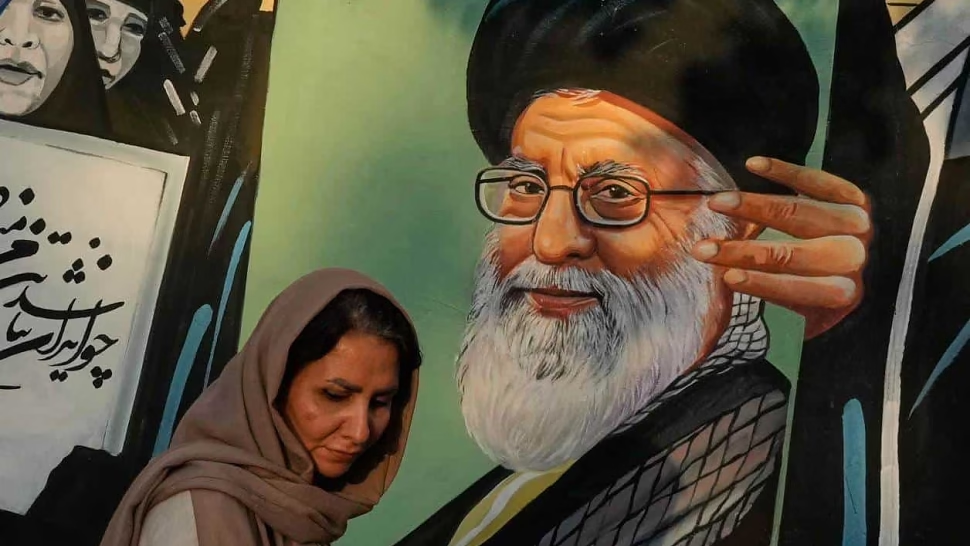
Iran’s supreme leader warned of “unforgettable lessons” if the US continues attacks. He also called President Trump’s signature “worthless.” An Iranian negotiator said Tehran has suspended its commitments under the deal signed a month ago.

Kuwait confirmed damage to a desalination plant and an oil facility. The country obtains 90% of its drinking water through desalination. Several firefighters and a worker were injured. Kuwait briefly closed its airspace and rescheduled flights.

Jordan reported shooting down Iranian missiles with its air defenses. Anti-aircraft alarms also sounded in Bahrain and Saudi Arabia.

The secretary general of the Gulf Cooperation Council accused Iran of war crimes for attacks on civilian infrastructure.

The United States stated that on its seventh consecutive night it hit surveillance sites, logistics infrastructure and underground warehouses. US attacks destroyed a desalination plant in Bonji, leaving some 10,000 people without water. They also damaged a plant on the island of Qeshm.

Iran reported at least 50 deaths and more than 500 injuries in three weeks of attacks, including eight who lost their lives in a bridge attack on Friday. The Ministry of Energy asked the population to reduce electricity consumption in southern provinces in the face of extreme heat.

Continue reading

Lula conditions his position on US tariffs

Brazil's president will wait for Trump to speak before responding to the tariff increase.

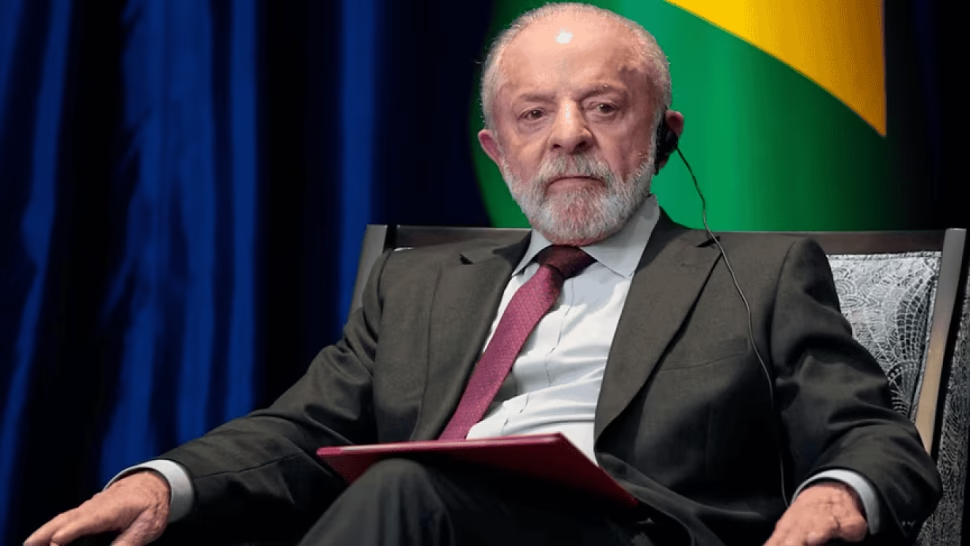
President Luiz Inácio Lula da Silva stated that Brazil does not accept being offended by any nation, in apparent reference to the tariff increase imposed by the United States. However, he warned that he will only comment on the measure after his colleague Donald Trump does so.

“This country must hold its head high because we do not accept that any other nation in the world wrongs Brazil. We want respect, in the same way that we will respect everyone,” he declared during an official event in Rio de Janeiro, accompanied by several ministers and Governor Ricardo Couto de Castro.

Strategic waiting

Lula added that he will wait for Trump’s statements before referring to the “increase in tariffs,” thus avoiding a direct exchange of accusations. “I’m going to wait to talk about the tariff when Trump speaks out. As long as he doesn’t speak, I won’t speak either, because we are going to show that no one beats Brazil with lies,” he said.

The Brazilian government, through its ministers, described as “unjustified” the 25% increase in the rates applied to the South American country’s exports. Washington’s decision has generated trade tension, although Lula opts for a prudent and conditional stance.

Regional context

The US measure impacts key sectors of the Brazilian economy, such as steel and aluminum. Brazil has historically maintained a complex trade relationship with the United States, alternating conflicts and agreements. Lula’s strategy seeks to avoid an escalation while evaluating possible retaliation or negotiations.

Analysts believe that the president’s momentary silence seeks to pressure Trump to take the first step, preventing Brazil from being seen as the initiator of a trade war. The international community is closely watching the development of this dispute between two of the largest economies on the continent.

Continue reading

China rejects Trump’s accusations of electoral interference

China rejects Trump's accusations and calls for stability in bilateral relations.

Accusations that strain the bilateral relationship

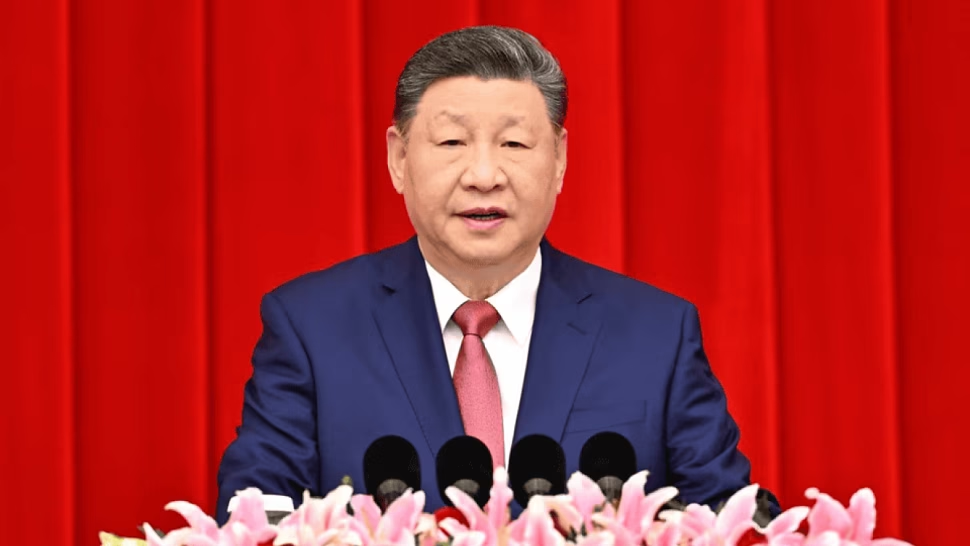
The president of the United States, Donald Trump, accused China of alleged interference in American electoral processes. The declaration conditions the diplomatic scenario between Washington and Beijing, just two months after Xi Jinping received Trump on a state visit.

The spokesperson for the Ministry of Foreign Affairs, Lin Jian, rejected the allegations, classifying them as fabrications and slander. He added that China has no interest in intervening in internal affairs or US elections, and urged maintaining communication channels under criteria of stability and mutual certainty.

The exchange occurs in a context of persistent commercial and technological rivalry. Washington maintains restrictions against Chinese technology firms, and Beijing has responded with regulatory countermeasures. Negotiations on semiconductors and foreign trade controls are at a standstill, threatening the rapprochement planned for Xi Jinping’s official visit to US territory in September.

Specialists consider that Trump’s accusations respond to internal political dynamics, since they were not accompanied by new sanctions or punitive measures. However, they move the dispute from the commercial sphere to that of national security, which increases the unpredictability in the relationship between both powers.

Continue reading