Federal judge blocks ICE access to Medicaid recipient data

A judicial measure stops the transfer of confidential information of beneficiaries to immigration control agencies, generating an intense legal debate.

Court order protects sensitive data of millions of beneficiaries

A federal magistrate has issued an order requiring the United States Department of Health and Human Services (HHS) to immediately cease sharing sensitive personal information of the 79 million enrollees in the Medicaid program with immigration enforcement officials. This court decision represents a turning point in the debate over health data privacy and the use of government information for immigration enforcement purposes.

The controversy arose when HHS began providing, for the first time in June, sensitive personal data of millions of Medicaid beneficiaries in several states to deportation agencies. This policy, which was not publicly announced, included the transfer of home addresses, Social Security numbers and other personally identifiable information.

RelatedJudge blocks use of Medicaid data for deportations

Policy Expansion and Legal Response

Subsequently, in July, the Centers for Medicare and Medicaid Services (CMS) formalized a new agreement that gave the Department of Homeland Security (DHS) daily access to the entire database of nationwide Medicaid enrollees. The revelation of this practice by The Associated Press triggered an immediate legal response from twenty states, which filed a class-action lawsuit to stop its implementation on the grounds that it violated the privacy rights of their citizens.

The court order, issued by Judge Vince Chhabria in the Northern District of California, establishes a temporary injunction that prevents the Department of Health from continuing to share the personal data of Medicaid enrollees from those twenty plaintiff states, which include major jurisdictions such as California, Arizona, Washington and New York.

In his brief, Judge Chhabria, appointed by President Barack Obama, argued forcefully: “Using CMS data for immigration enforcement threatens to significantly disrupt the operation of Medicaid, a program that Congress has deemed critical to providing health coverage to the country’s most vulnerable residents.” This statement highlights concern about the possible deterrent effect that this practice could have on the participation of migrant communities in essential health programs.

Broader Immigration Policy Context

This Medicaid data sharing is part of a broader initiative by President Donald Trump’s administration to provide DHS with greater information collection capabilities on migrants. In May of that same year, another federal court refused to block the Internal Revenue Service’s (IRS) practice of sharing immigrant tax data with Immigration and Customs Enforcement (ICE), intended to help agents locate and detain people residing without legal status in the country.

The extraordinary disclosure of personal health information to deportation officials within the government’s broad immigration crackdown raised immediate concerns about privacy and protection of sensitive data. Health law experts have pointed out that these practices could violate fundamental principles of medical confidentiality established in legislation such as the Health Insurance Portability and Accountability Act (HIPAA).

Justice Chhabria established that the prohibition order will remain in effect until the Department of Health presents “reasoned decision making” that adequately justifies its new policy of sharing data with deportation officials. This judicial requirement requires HHS to demonstrate that it conducted a thorough analysis of the legal, ethical, and operational impacts of its decision, especially considering the effect on participation in public health programs.

The court ruling represents a significant milestone at the intersection between health data privacy, migrant rights, and immigration law enforcement policies. Privacy advocates have celebrated the decision as a crucial victory for the protection of sensitive information, while the long-term implications for data-sharing policies between government agencies continue to unfold across the American legal landscape.

Do you think health data protection is important? Share this analysis on your social networks and visit our health policy section to stay informed about crucial developments in medical privacy and digital rights.
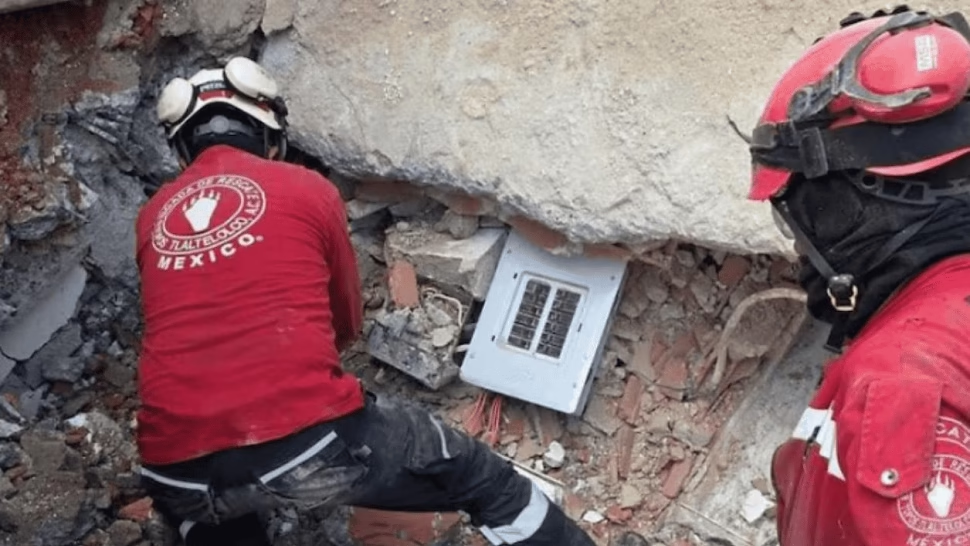
The rescue that gave hope in the midst of the tragedy in Venezuela

Rescuers celebrate the discovery of a survivor after eight days under rubble in Venezuela.

The stench of decomposing bodies spread through the streets of La Guaira as rescue brigades moved from searching for survivors to recovering remains. However, unexpected news restored spirits to the international and local teams.

The rescue of Hernán Alberto Gil Flores

Venezuelan and foreign officials celebrated the discovery alive of a 43-year-old security guard, trapped for almost eight days under the rubble of a shopping center. Television cameras captured the emotional moment when he was extracted and placed on a stretcher, while the crowd burst into applause.

Hernán survived thanks to an air pocket and the food and water that the rescuers sent him through the cracks. It far exceeded the critical threshold of 72 hours, when experts consider it most likely to find people alive.

The other side of tragedy

In other areas of the state of La Guaira, the most affected, the outlook was bleak. The port city of Catia La Mar saw officials moving around carrying body bags and stacking coffins. Equipment with seismic sensors was removed without detecting signs of life.

The government of the interim president, Delcy Rodríguez, reported at least 2,295 deaths and more than 11,000 injuries. His management has been criticized for its slowness and disorganization. Thousands of people sleep in shelters or outdoors, and doctors warn of a health crisis due to infections and untreated injuries.

Among the victims is Daniel Alejandro Núñez Ramírez, 28, deported from the United States hours before the earthquake. He had arrived on a flight with more than a hundred Venezuelans and was transferred to a hotel in La Guaira that his mother, Oswadeliz Núñez, described as a prison. Thirty minutes after a phone call, the building collapsed. His mother collected his ashes in a morgue.

“My son was not a criminal. Why do they treat people with no criminal record as criminals?” —Oswadeliz told The Associated Press.

Support from the United States

Washington supports Rodríguez and has allocated more than $300 million in assistance. John M. Barrett, US chargé d’affaires in Venezuela, assured that funds from Venezuelan oil production will be available for reconstruction. However, organizations such as the Washington Office on Latin American Affairs ask for transparency in the use of that money.

The government’s response remains under scrutiny, as the 180-day term of Rodríguez’s interim presidency expires.

Continue reading

Dog “Sarita” rescued alive from rubble in Venezuela

Mexican rescuers found "Sarita" alive under rubble in La Guaira, giving hope to affected families.

Rescue in La Guaira

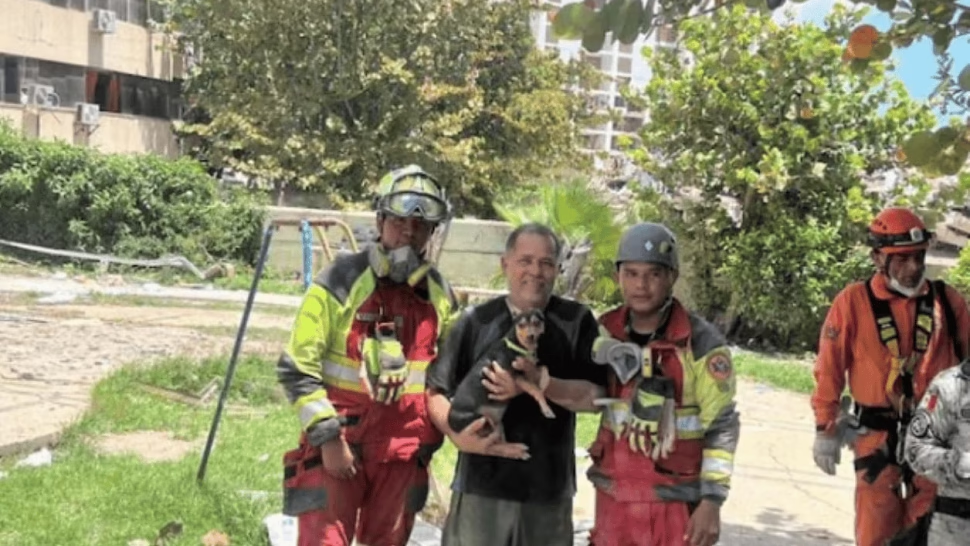
During search efforts after the June 24 earthquakes in Venezuela, elements of the Mexican Army and the National Guard located a dog named “Sarita” alive. The discovery occurred in the Vargas municipality, La Guaira state, when a man was looking for his missing daughter. Upon hearing noises among the rubble, he alerted the uniformed officers.

The canine team made up of the national guard Tonantzin Arroyo Sarmiento and the rescue dog “Kai” located the animal. After cutting and removal work, Sergeant Julio César Castro Díaz managed to extract “Sarita” alive. The owner burst into tears when he met her again and expressed that this fact renewed his hope of finding his daughter.

The tasks continue in the area as part of the “Yumare” Humanitarian Aid Group.

Humanitarian support from Mexico

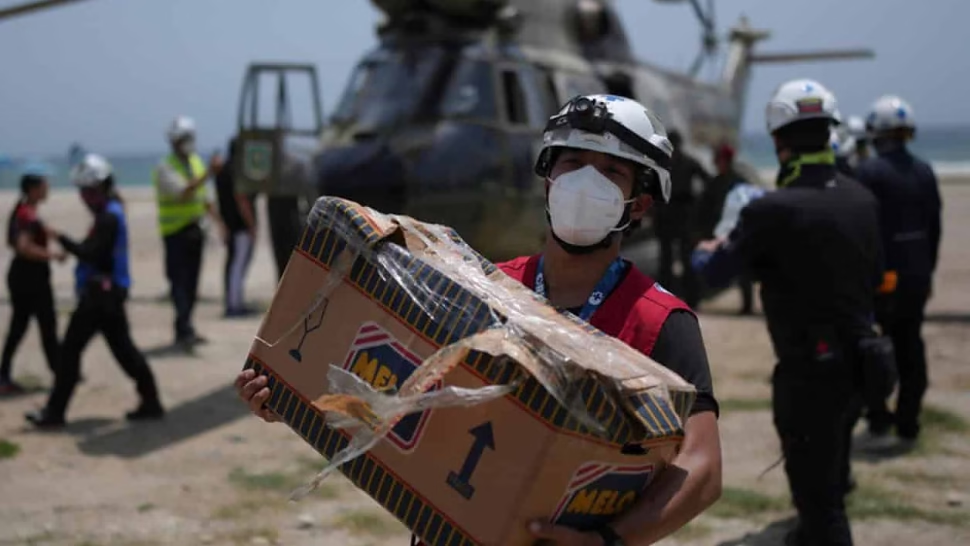
On Wednesday, a C-130 Hercules aircraft of the Mexican Air Force took off from Santa Lucía bound for Maiquetía, Venezuela. It transported medical and electronic supplies, as well as first aid material from the Mexican Red Cross and five electric power generating plants.

Since June 24, there have been five humanitarian aid flights with 240 members of the Army, including 151 rescuers, 60 doctors and health personnel, eight dog lovers from the Army and 10 from the National Guard, 11 from the Mexican Air Force. 13.1 tons of medicines have also been sent – 8.3 from Defense and 4.8 from IMSS-Wellbeing -, four tons of rescue equipment and eight generating plants.

The aid seeks to restore basic services and care for the population affected by the earthquakes that left thousands dead and injured.

Continue reading

Mali: the Belgian shepherd who rescues lives in Venezuela

The Belgian pastor Mali has located four people after the earthquakes in Venezuela.

A Belgian shepherd in the disaster zone

Mali, a seven-year-old Belgian shepherd, is part of the Topos Azteca rescue group. Since the earthquakes of June 24 in Venezuela, their work has been key to locating four people in the rubble. Two of them were found alive, along with a puppy.

Miguel Ángel García, their human guide, explains that rescue dogs speed up searches thanks to their keen sense of smell and hearing. Mali has tirelessly toured the most affected areas of Caracas and other towns.

Behind every find are years of training and unwavering determination. While machines remove debris, Mali searches for the most valuable thing: a sign of life. His work reminds us that hope can also come on four legs.

Topos Azteca rescuers continue at ground zero, searching for more survivors.

Continue reading