Judicial reform increases costs for companies in Mexico

Swiss banking warns about the structural impact on private investment and the increase in operating costs for corporations.

A Verdict that Shakes the Business Foundations

In a turn that threatens to redefine the national economic landscape, the financial giant UBS Global Wealth Management has issued a warning that resonates like thunder in the corridors of corporate power. His forecast is clear and forceful: the judicial reform in Mexico is not just a change of rules, it is a slab that will dramatically increase the legal costs for companies operating in the country. This is not a simple adjustment, it is a structural factor of a profound uncertainty that hangs over the future of investment, a specter that could cool the spirit of the most daring entrepreneurs.

In a press conference that could well be the prologue of a new era of caution, Gabriela Soni, the head of investment strategy for Mexico at UBS, spoke words that will mark a before and after. With the serenity of someone announcing a storm, he declared that the legal cost for Mexico is destined to escalate. However, in an almost tragic act of faith, the demand to invest in the country remains strong. “The only way out,” he explained with a realism that cuts like a knife, “is that companies are going to demand a much higher risk premium to bet on our country, because figuring out how to operate in Mexico has suddenly become an infinite labyrinth.”

RelatedReform to the Amparo Law modernizes Mexican justice

The Final Judgment for Corporations and the Sword of Damocles of the T-MEC

But how does this legal earthquake affect companies that are fighting for their survival? The answer paints a two-way scenario. On the one hand, the powerful large corporations, those titans with unlimited resources, will be able to adapt through dispute resolution mechanisms, although carrying the burden of higher costs on their backs. The real, heart-wrenching tragedy is reserved for the smallest companies. For them, this reform is not an obstacle, it is an insurmountable wall. “The problem is really for the smaller companies,” Soni warned, “for them, this can be a lethal issue, a challenge that they will not be able to overcome, because many times these new dispute resolution mechanisms entail such a high outlay that their fragile economies will not be able to absorb.”

And while the business world holds its breath, judicial uncertainty stands like an invisible judge. “Now, we find ourselves in the most absolute darkness, we still do not know how the judges are going to act,” confessed the strategist, “and this judicial uncertainty, this impenetrable fog, will continue to poison the investment prospects, becoming an already structural issue, a curse that will haunt our economy.”

But destiny has more cards on the table. Another epic battle looms on the horizon: the review of the T-MEC. UBS estimates, with the hope of a castaway who glimpses land, that a successful review of the trade agreement in 2026 will be the bulwark that reactivates private investment and improves economic prospects. Although the worst-case scenario has a low probability, hovering around a terrifying 5% or less, there is a more subtle and feasible threat. A risk that would be prolonged torture: that the treaty is not renewed for 16 years and remains subject to annual reviews between 2026 and 2036, an endless spiral of uncertainty that would strangle any hope of recovery of the investment.

The battlefields in this negotiation will be brutal: access to the energy market, stricter rules of origin than chains, working conditions and possible tariffs to avoid the triangulation of Asian products. Despite this conflict scenario, UBS predicts that Mexico, with the astuteness of an experienced strategist, will maintain a favorable commercial position.

As the clock ticks towards the decisive moment, gross fixed investment will remain contained, biding its time. Soni anticipates that the rebound will come, like a dawn after the darkest night, starting in the second half of 2026, driven by an increase in public investment. The road will be littered with obstacles, with temporary pressures on inflation and a pause in rate cuts by Banxico, before resuming the march towards a terminal rate of 6.5%. By the end of 2025, the firm predicts economic growth of a modest 0.5%, which will become 1.4% in 2026 and a promising 2.1% in 2027. Figures that, like a whisper of hope, could rise to the top if that long-awaited and successful renegotiation of the T-MEC.

Has this analysis of Mexico’s economic future impacted you? Share this crucial chronicle on your social networks and help others understand the challenges ahead. Explore more content related to finance and the business landscape on our site to stay informed.

More than eight million apocryphal cigarettes seized in Manzanillo

Joint operation in Manzanillo detected shipment of counterfeit cigarettes.

Operational in the port of Manzanillo

Federal authorities seized more than eight million allegedly apocryphal cigarettes in the port of Manzanillo, Colima. The operation was coordinated by agencies of the security cabinet and the National Customs Agency of Mexico (ANAM).

Personnel from the ANAM and the Administrative Unit of the Manzanillo Customs detected inconsistencies in an operation to import cigarettes from abroad. This led to a specialized review.

As a result of the inspections, the authorities located 8 million 436 presumably counterfeit cigarettes. The merchandise was insured with the support of the Secretary of the Navy (Semar).

The ANAM reported that this type of operations are part of the permanent mechanisms of operational intelligence, risk management and strategic analysis. The objective is to strengthen security in foreign trade operations and detect documentary irregularities or goods of illicit origin.

The comprehensive analysis of the operation made it possible to reinforce documentary traceability, operational review and validation of commercial profiles. The authorities maintain surveillance at entry points into the country to combat illegal trade.

Continue reading

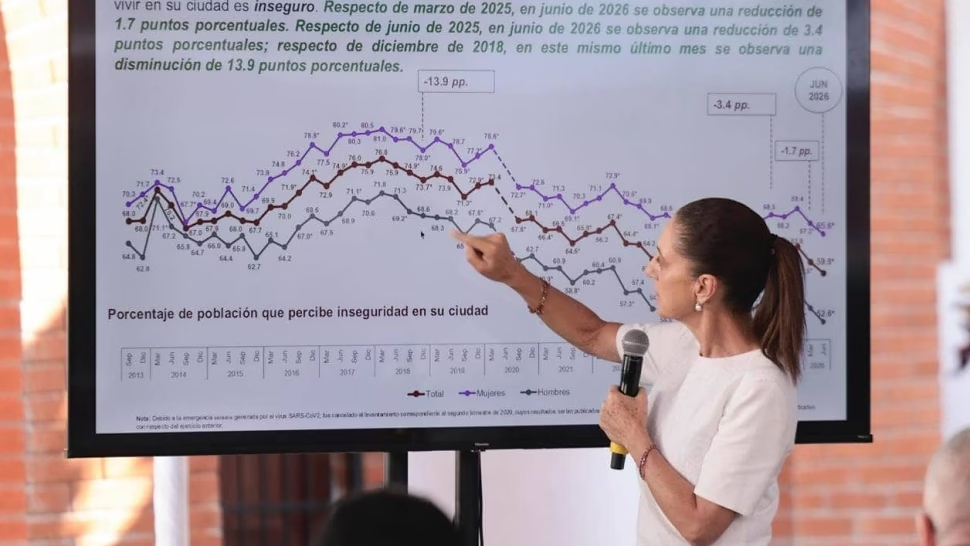
Perception of insecurity drops to 59.8%: Sheinbaum

Perception of insecurity in Mexico drops to 59.8%, the lowest figure since 2018.

ENSU results

President Claudia Sheinbaum reported that the perception of insecurity in urban areas fell to 59.8% in June 2026, according to the National Urban Public Security Survey (ENSU) of the INEGI. In December 2025 it was 63.8%, which represents six consecutive months of decline.

“The important thing here is that we are giving results in the security indicators and people are beginning to notice this decrease,” he said during the morning conference in Cuernavaca, Morelos.

Historical comparison

Sheinbaum recalled that in December 2018, under the government of Andrés Manuel López Obrador, the perception of insecurity was 73.7%. The previous lowest point was reached in September 2024 at 58.6%. The president attributed the improvement to the National Security Strategy.

The ENSU measures citizens’ feeling of insecurity in their environment. Recent data reflects a positive trend, although the challenge remains to maintain the reduction in crime. The authorities continue to implement actions to consolidate these results.

Continue reading

Sheinbaum delivers 43 homes in Morelos through the Housing Plan

President delivers homes, settlements and deeds in Xoxocotla, Morelos.

President Claudia Sheinbaum led in Xoxocotla, Morelos, the delivery of 43 new homes from Conavi, 348 settlement certificates from Fovissste and 79 deeds from INSUS. It’s all part of the Housing for Wellbeing Program.

“Previous governments took from the people, we increased the minimum wage, we are providing homes with accessible loans and we are removing debt from families,” said the president.

“Those from before governed for a few, the governments of the Transformation govern by the people and for the people of Mexico,” he added.

Plan details

Sheinbaum recalled that the program contemplates the construction of 1.8 million new homes in the country; the forgiveness and restructuring of unpayable loans for 5 million families; and the delivery of one million deeds to guarantee legal certainty.

The homes are aimed at people with incomes of one to two minimum wages. The land for new houses is already available throughout the national territory.

The Secretary of Agrarian Development, Edna Elena Vega Rangel, explained that in Morelos the goal was expanded from 10 thousand to 24 thousand new homes. Of these, 3,893 are already hired. In addition, 8 thousand families will receive deeds and more than 35 thousand will improve unpayable loans. Nationally, the program will benefit more than 10 million families.

The director of Conavi, Rodrigo Chávez Contreras, reported that of the 500 thousand homes under his charge there are already 320 projects to build 150 thousand houses. Of them, 75 thousand have already been assigned in 119 municipalities. In Morelos, 2,000 homes are being built in seven municipalities; 90 of them for Xoxocotla, of which 43 were delivered today.

Governor Margarita González Saravia thanked the president and confirmed that the state already has land for the 24 thousand houses in eleven municipalities.

One beneficiary, Araceli Pacheco López, thanked the delivery of her home, which she described as “very nice.”

Continue reading