A Legal Transformation That Defines Our Future
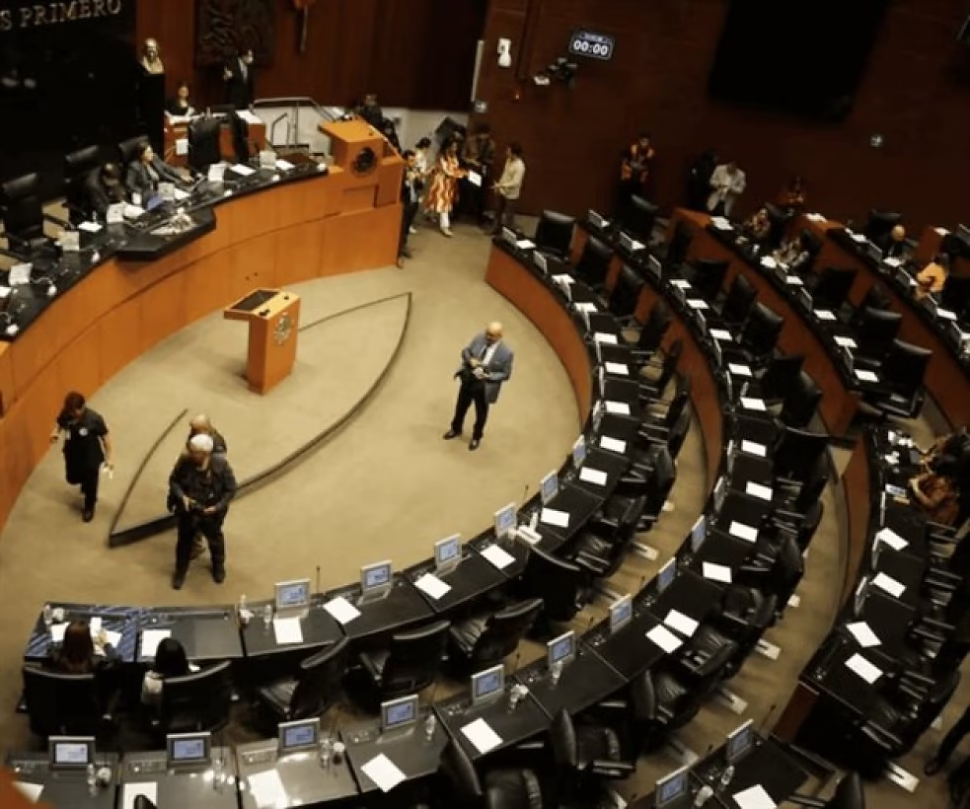
Friends, have you ever felt that change is inevitable and that, instead of resisting it, we should boldly embrace it? This is exactly how we should view the evolution of our legal system. The reform to the Amparo Law has generated a torrent of opinions in the Upper House, demonstrating that when it comes to protecting our rights, every detail counts. Morena incorporated a transitional article that proposes the retroactive application of the new regulations, a movement that has ignited a fascinating debate about the future of our justice.
While the legislators of the ruling bloc chose not to reveal the specific origin of the instruction to include said clause—whether from the National Palace or from their own parliamentary coordination—the opposition raised its voice with a crucial warning: eliminating retroactivity in San Lázaro does not solve the deeper challenges posed by this legal modification. This reminds us that in any transformation process, we must look beyond the surface and address the root causes.
Inner Voices and the Search for Consensus
Within this panorama, an inspiring figure emerges: Enrique Inzunza, senator from Morena and president of the Legislative Studies Commission. His decision to absent himself from the final vote as an act of protest against the last-minute introduction of the reservation is a powerful reminder that integrity and consistency must guide our actions. Inzunza clearly pointed out that including the transitional article was a mistake, and although several legislators anticipated it and even managed to withdraw it during discussions in committees, it was finally reintroduced without the necessary consensus.
“The dictum that we agreed upon did not contain that transition; however, it was distributed with it. For that reason, at the beginning of the commission meeting, we decided that the correct thing to do was to submit it to the consideration of the members of the three commissions, representatives of all the political parties, and it was determined that, indeed, a mistake had occurred, because thus we assumed that it was an error,” he stressed with conviction. Inzunza acknowledged that in Morena’s internal debate on the reform “there was a legal difference, not a political difference“, highlighting the importance of separating technical analysis from partisan disputes.
“My position was always that, in its original form, it was not compatible with constitutional article 14. I even presented a proposal from a very early stage that, I am convinced, solved the problem. My initiative established that the pending processes would be substantiated until their final resolution in accordance with the applicable legal provisions, which are evidently those established by the reform decree, without being applied retroactively, because the issue does not appear in the procedural laws. of retroactivity, since these are stages that are not acquired rights, but rather expectations of rights,” he explained in detail. What a wonderful example of proactivity and finding solutions!
On the other hand, Manuel Huerta Ladrón de Guevara, senator from Morena and proponent of the controversial reservation, reiterated that the objective of the modification is to avoid tax evasion through the use of multiple protections. He clarified that the proposal was debated internally in the caucus and had the support of 60 senators. He assured that the reform is not retroactive and is based on current jurisprudence, always seeking to protect citizens without affecting legal application. When asked if there was an attempt to “score a goal against the president“, he responded firmly: “No, how do you think? In no way, on the contrary, I am convinced that the president, in the Zócalo, recognizes the patriotic work that we are modestly carrying out from the Senate of the Republic. (…) I am certain that the deputies are going to do their review work and do it We will be watching here.”
The Defense of Legal Certainty and the Opposition’s Response
Javier Corral, president of the Justice Commission, defended the reform with solid arguments, ensuring that the correction of the transition period provides legal certainty and preserves access to individual and collective justice. “I believe that by eliminating that element and maintaining the wording proposed (by Minister Arturo Zaldívar), we settle the controversy, give legal certainty to all the actors, to all the parties, and we fulfill the purpose of the reform,” he noted optimistically. This is what we need: solutions that unite and give clarity!
However, from the opposition, Ricardo Anaya, PAN coordinator, warned that even if the transitional article is eliminated, the law continues to limit legitimate interest and the suspension of protections, leaving citizens “without a shield against acts of authority that violate their human rights.” “The fact that they eliminate this transitional article is a necessary condition, but not sufficient. That is, the reform to the Amparo Law continues to be very serious because it continues to limit the legitimate interest and the suspension, in colloquial terms. It left citizens without a shield, without protection, without defense against acts of authority that violate their human rights,” he declared vehemently.
Claudia Anaya, PRI senator, agreed that the elimination of retroactivity is not enough. He pointed out that the reform imposes restrictions on the expansion of demands, limitations on suspensions and the possibility of denying protection for issues of public or social interest, which affects investments and generates legal uncertainty. When asked: “Isn’t it enough then to withdraw retroactivity?”, he responded clearly: “No, I think it is very important that they realize the great damage they are causing to this country. The issue of the reform of the protection law, the extinction of the autonomous bodies, the judicial reform, has stopped investment and foreign investment has been coming up. So, in that sense, if they do not want to reconsider the structural damage that they are causing to Mexico, they are going to continue generating more economic problems for us.”
The legislator warned that the law leaves citizens without adequate protection against possible abuses of authority, underlining the need for a legal framework that balances the public interest with individual guarantees. In an ever-changing world, our ability to adapt laws without compromising fundamental rights is what defines our greatness as a society. Every debate, every disagreement, is an opportunity to grow and build a more fair and resilient system for everyone.
Are you passionate about understanding how legislative decisions shape our daily lives? Share this analysis on your social networks and help us amplify the conversation about the future of justice in Mexico! Explore more related content to stay informed and empowered.