Journalist Xavier Ramos is murdered in Guayaquil with a knife

Violence shakes the journalistic union in Ecuador after the communicator was found with fatal injuries.

Finding of the body and immediate response from the authorities

The communicator and journalist Xavier Ramos, renowned professional of the newspaper El Universo, was found dead in his home located in the La Alborada sector, in Guayaquil. The discovery occurred after an alert generated by his unusual absence from work, which motivated his colleagues to investigate his whereabouts. The Ecuadorian security forces confirmed the death, indicating that the body had injuries consistent with a knife.

National Police spokesperson Gino Sánchez provided initial details of the case in a formal statement. He pointed out that the body corresponded to a 47-year-old man and that the physical evidence preliminarily pointed to an attack with a sharp instrument. Immediately after the discovery, law enforcement officers proceeded to cordon off the perimeter of the home to begin a meticulous criminal investigation. The main objective of these actions is to collect all the necessary forensic evidence to clarify the exact circumstances of his death and determine the authorship of the crime.

RelatedThe United States designates Ecuadorian gangs as terrorist organizations

Impact on the journalistic community and institutional reaction

This tragic event has deeply shocked the community of social communicators and journalists in Ecuador, generating a wave of dismay and solidarity. The disappearance and subsequent discovery of Ramos’s body once again puts in the spotlight the serious risks that press professionals face in the exercise of their work, especially in contexts of high crime. The Government of Ecuador, through an official statement, expressed its deepest condolences and deeply regretted the death of the colleague. The official text conveyed “all its solidarity to the families, friends and loved ones” of the deceased, recognizing their contribution to national journalism.

The case of Xavier Ramos is part of a complex national panorama regarding the safety of journalists. International organizations that defend freedom of the press have repeatedly expressed their concern about the increase in violence directed against communicators in the region. This incident not only constitutes an irreparable human loss, but also a hard blow to the right to information and democracy in the country. The investigation is carried out in a climate of high expectations, both on the part of citizens and the international community, which is observing whether justice will be delivered effectively.

The El Universo team, to which Ramos dedicated part of his professional career, has shown deep regret and has asked the authorities for an exhaustive investigation that leads to the capture and punishment of those responsible. This crime not only mourns an editorial team, but also sends an alarming message about the state of security for the practice of investigative journalism and freedom of expression in Ecuador. The resolution of this case is emerging as a crucial precedent for the protection of communicators in the country.

Share this information on your social networks to keep your community informed about crucial events affecting press freedom and the safety of journalists. Explore more content related to citizen security and journalism in our news section.
Attack on oil tanker in Strait of Hormuz fuels tensions

An oil tanker is hit by a projectile off Oman. Tensions grow with Iran.

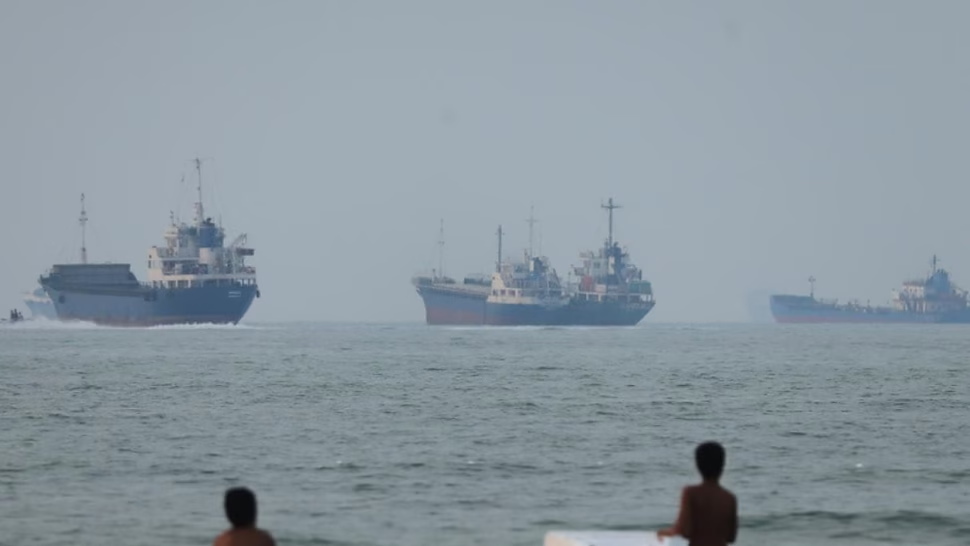
An oil tanker sailing off the coast of Oman, in the Strait of Hormuz, caught fire early Tuesday after being hit by a projectile, the British Army reported.

It is the most recent attack against a vessel on that strategic route, through which in peacetime a fifth of the oil and natural gas traded in the world transited. Suspicions point to Iran, which has already been accused of previous attacks in waters near the Omani coast.

Negotiations on pause and mass funeral

The United States seeks to resume negotiations with Iran to fully reopen the strait, reduce Tehran’s nuclear program and permanently end the war that began on February 28. However, the attacks on vessels have provoked military responses from Washington, followed by Iranian responses against Gulf Arab states, raising the risk of escalation.

The talks appear suspended until the funeral of Iran’s supreme leader, Ayatollah Ali Khamenei, who died in the first hours of the conflict, is concluded. His body was airlifted to the city of Qom, where a crowd honored him on Tuesday.

Attack details

The UK’s Maritime Trade Operations agency said the ship was attacked near Limah, Oman. The projectile hit the port side while trying to exit the narrow course towards the Gulf of Oman. No environmental impact was reported and authorities are investigating.

Previously, Iran’s joint military command warned that all tankers must use approved routes. “Any non-compliance will have an immediate response,” said an Iranian statement, which also threatened to react to US interference.

As part of a provisional pact, both countries agreed to free navigation for 60 days, but Tehran insists on controlling the routes and charging for passage, which Washington and several Arab countries reject. Previous attempts by Oman and the UN to establish an alternate route sparked attacks in the Middle East.

The Kpler firm reported that at least 108 ships crossed the strait over the weekend using various routes.

Khamenei’s funeral

Iranian state television showed live hundreds of thousands of people walking towards the Jamkaran mosque for a funeral service. Banners featured images of Khamenei and his son, Moytabá Khamenei, named the new supreme leader, although he has not yet appeared at the ceremonies. He is believed to be in custody after being injured in the attack that caused his father’s death.

Authorities closed streets and airspace for mourning, which ends Thursday, when Khamenei will be buried in Mashhad. He was 86 years old.

Continue reading

Canada chooses Germany for its largest military purchase: 12 submarines

Canada appoints German firm to build up to 12 submarines, the largest military acquisition in its history.

Canada chooses ThyssenKrupp for its largest military acquisition

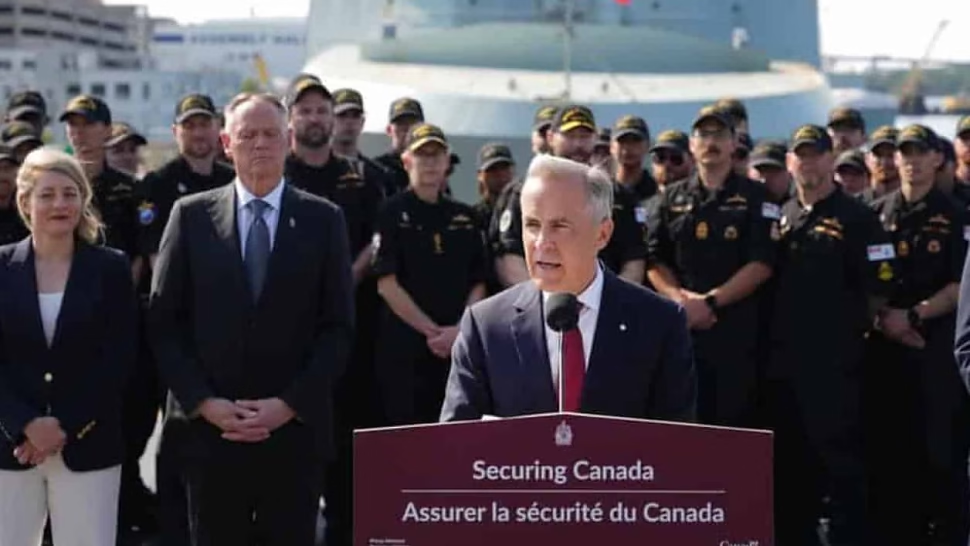
Canada selected the German company ThyssenKrupp Marine Systems (TKMS) as a preferred supplier for the construction of up to 12 submarines. Prime Minister Mark Carney called the operation the largest military acquisition in the country’s history.

The announcement comes days before Carney attends a NATO summit, where allies face pressure to increase their defense spending. The president affirmed that the TKMS platform is optimal for Arctic waters and for the alliance.

“The submarine is proven and capable,” declared Carney.

TKMS supplies submarines to more than a third of NATO members. Carney declined to reveal the exact price, but said it will involve an investment of “tens of billions of dollars.”

German Chancellor Friedrich Merz thanked Carney and stressed:

“This is a strong signal for our transatlantic and European alliance.”

The German company beat the South Korean Hanwha Ocean. ThyssenKrupp said its submarines will strengthen interoperability, as many NATO allies already operate conventionally powered vessels.

Canada has committed to increasing its military spending after years of lagging behind NATO goals. Carney promised to raise defense spending to 5% of GDP by 2035, after reaching 2% of GDP this year, the alliance’s previous goal. The Canadian fiscal plan foresees spending reaching 4% of GDP by 2030.

Germany and Norway, countries that design the submarines together, will open production spaces to speed up deliveries. Canada would receive four submarines by 2034, two years earlier than projected. The new fleet will replace the four Victoria-class submarines, purchased second-hand from the United Kingdom in the late 1990s.

No American company submitted a bid, as the United States only builds nuclear-powered submarines, while Canada was looking for conventional vessels.

“The sovereignty of our country, bounded by three oceans and the longest coastline in the world, depends on our maritime capabilities,” concluded Carney.

Continue reading

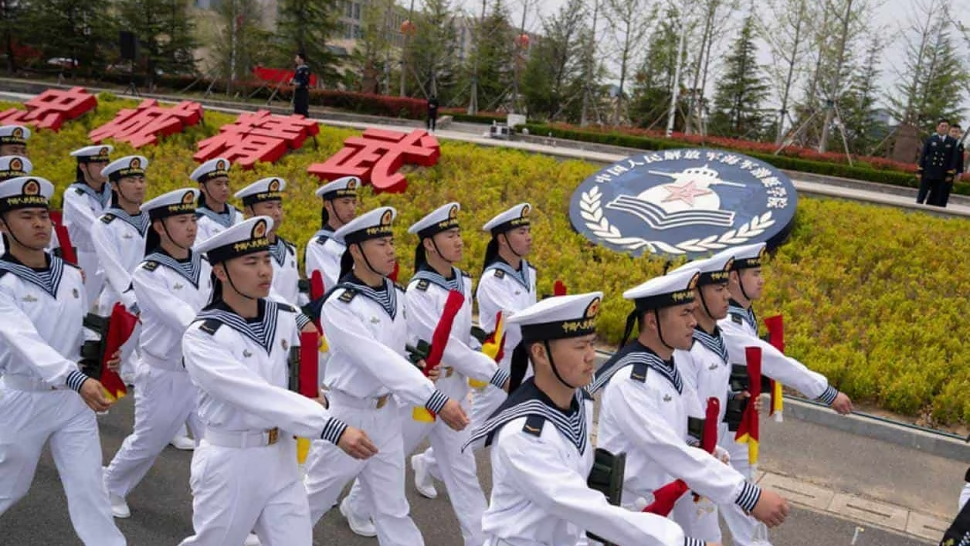
China launches ballistic missile from nuclear submarine in the Pacific

Test with dummy warhead draws criticism from Australia, Japan and New Zealand.

Ballistic missile test from nuclear submarine

China’s military on Monday test-launched a long-range ballistic missile from a nuclear-powered submarine in the South Pacific Ocean. The warhead was fictitious, according to the official Xinhua agency. The launch, at 12:01 local time, was part of routine annual training and was not directed against any country, said a brief Xinhua statement republished by the Ministry of Defense.

Australia, Japan and New Zealand protested. New Zealand Foreign Minister Winston Peters declared:

“It appears that, despite our long-standing concerns about this type of activity, China carried out the test within hours of informing us.”

The test occurred on the same day that Australia and Fiji signed a mutual defense treaty, in a gesture to counter Chinese influence. Australian Foreign Minister Penny Wong said:

“Australia has been clear with China that we consider this to be destabilizing for the region.”

Japan expressed concern. Chief Cabinet Secretary Minoru Kihara said:

“China’s military activities, combined with its lack of transparency, have become a serious concern for Japan and international society.”

Beijing dismissed the criticism. A Foreign Ministry spokesperson stated: “We hope relevant countries will avoid overinterpretation.”

The United States also reacted. State Department spokesman Thomas Pigott said:

“Beijing’s rapid and opaque buildup of nuclear weapons is of grave concern to the region and the world.”

Experts pointed out the lack of transparency. Drew Thompson, a researcher at Nanyang Technological University, commented: “China’s modernization and military buildup have occurred without parallel increases in openness and transparency.”

Lyle Morris of the Asia Society Policy Institute noted that it is the first publicly acknowledged test of a dummy warhead from a nuclear submarine traveling so far in the Pacific. Morris stressed that Japan, New Zealand and Australia received notifications, but not the United States.

China maintains a “no first use” policy on nuclear weapons, but modernizes its arsenal. According to the Pentagon, China had about 600 warheads in 2024 and projects more than 1,000 by 2030.

Continue reading