Award recognizes research on genetic variant of Alzheimer’s in Mexico

An award-winning report reveals the impact of a unique genetic variant that concentrates cases of early dementia in a region of Mexico, highlighting the rigor of specialized journalism.

A report on the Jalisco Mutation wins the National Scientific Journalism Award

The eighth edition of the Hispanic American Scientific Journalism Forum concluded with the presentation of the National Scientific Journalism Award 2025 to the journalist Claudia Solera. His journalistic work, published in the newspaper Milenio, focuses on a profound investigation: the so-called Jalisco Mutation (A431E), a hereditary genetic variant linked to early-onset Alzheimer’s identified in the region of Los Altos, Jalisco. Solera, upon receiving the award, stressed the need to “give visibility to a disease that for generations was hidden, due to fear and prejudice”, thus highlighting the social dimension of her informative work.

The award-winning research details precisely how geographic isolation and historical endogamy practices in that area of Mexico preserved this genetic alteration in descendants of converted Sephardic Jews. This unique context has allowed scientists to study a pattern where the neurodegenerative disease manifests itself early, before the age of 40, with a 50% probability of transmission to the offspring of a carrier. The report not only exposes the biomedical finding, but also delves into its complex community, ethical and psychological implications.

RelatedJosué Segura wins award for video report Guerrero de Sangre Azul

Journalistic depth and rigor in scientific coverage

The article meticulously explores the binational research work between Mexico and the United States, the delicate process of informing the local population—where it is reported that 8 out of 10 people take the genetic test, but only half want to know the result—and the innovative lines of study that seek treatments, including the use of brain organoids or “mini brains.” María Paula Rubiano, award judge and environmental journalist, described the winning work as captivating, highlighting its ability to “weave polished scientific explanations, lives and findings” into a story that combines “rigor, narrative and international significance.”

The jury, made up of professionals such as Emilio Godoy, noted that, of the 36 works registered in the call, approximately 70% addressed environmental issues, which shows a trend and a “collective task ahead” in regional scientific journalism. Godoy also emphasized the scarcity of collaborative projects in this edition, an aspect considered crucial for the advancement of science journalism.

The forum as an incubator of narratives and specialized tools

The event, organized by the Mexican Network of Science Journalists (Red-MPC) and held from November 27 to 29 at the Cultural Center of Spain in Mexico, was oriented towards the creation of “stories beyond the laboratory.” Its programming included seven specialized workshops designed to provide communicators with practical tools. In the narrative field, sessions were taught such as “Covering science in the field“, “Diverse territories = diverse narratives” —focused on addressing the realities of indigenous peoples— and “How to communicate risks“, to improve the coverage of statistical concepts.

At the same time, technical courses were provided on the use of platforms such as EurekAlert! and the Science Press Package to access embargoed research; sound production techniques in “Sounds of Science“; and concise audiovisual formats in “Science in 55″. One notable project, supported by the Schmidt Science Communication Catalyst Grant, seeks to develop an accessible toolbox for anyone interested in covering scientific topics in Latin America.

Nely Toche, president of the Red-MPC, emphasized that “for scientific journalism to be of excellence, it must start from the formative point of view,” emphasizing the importance of mentoring for new generations. He thanked the extensive network of collaborators and allies who made the forum possible, including academic institutions, media and civil society organizations. The award, which included recognition and a financial stimulus of 20 thousand pesos, served as the culmination of a meeting dedicated to strengthening rigor, ethics and creativity in the dissemination of science.

Are you interested in the future of scientific journalism and stories that change paradigms?Share this article on your social networks to make visible the importance of rigorous coverage and explore more content related to advances in neuroscience and scientific communication on our platform.

AI becomes a dating coach, but divides opinions

Users turn to chatbots to start romantic conversations, but doubts persist about authenticity.

The role of AI in modern romance

Marie Lansley recently arrived in San Francisco and, while looking for a partner, decided to try artificial intelligence. “I’ve tried everything,” says the 36-year-old engineer, who consults chatbots like ChatGPT and Claude to help her start conversations on dating apps. “I’m open to AI finding the love of my life, but I’m not totally convinced,” she says. “Chemistry is always going to be analog.”

More and more people are using chatbots to compose messages or interpret responses. Dating coach Carey Gaynes compares him to Cyrano de Bergerac: “You’re using a voice that’s not your own.” He worries about overdependence, although he recognizes that it can be useful.

Mason Naung, a 25-year-old student in Los Angeles, only turns to AI to break the initial ice. “If the messages go further, it would be a small warning sign,” he says. San Diego businesswoman Dani Cohen prefers an AI-written farewell message to being ghosted. “Anything that gets people to communicate in a friendly way is great,” he says.

Other voices are more critical. Clara Sullivan, a 22-year-old student, would not respond to a profile that uses AI. “It’s scary how dependent people are. It’s taken away the ability to think creatively,” he says. A Pew Research Center survey reveals that 53% of US adults believe AI will worsen creativity, and half think it will affect meaningful relationships.

Dating apps already integrate AI. Tinder has Chemistry, Hinge uses AI launchers, and Bumble plans to eliminate swipe to prioritize automated matching. Its CEO, Whitney Wolfe Herd, says that technology “should make love feel more human, not less.”

Mohammed Nizami, 23, does not use AI for dating. “We all crave authentic connection. If there’s a filter, it’s not a good way to start,” he says. Jake Clay, a content creator in New York, calls the situation a “vicious cycle” that bypasses sacred processes of life. “It’s sad to delegate something so fundamental to an AI that doesn’t understand emotions,” he laments.

Despite reservations, the merger between AI and dating seems inevitable. Efficiency gains ground, but authenticity remains the challenge.

Continue reading

NASA takes the 2026 World Cup ball into space and plays it on the ISS

NASA sent an official 2026 World Cup ball into space and opened an exhibition in Houston.

World Cup ball arrives at the International Space Station

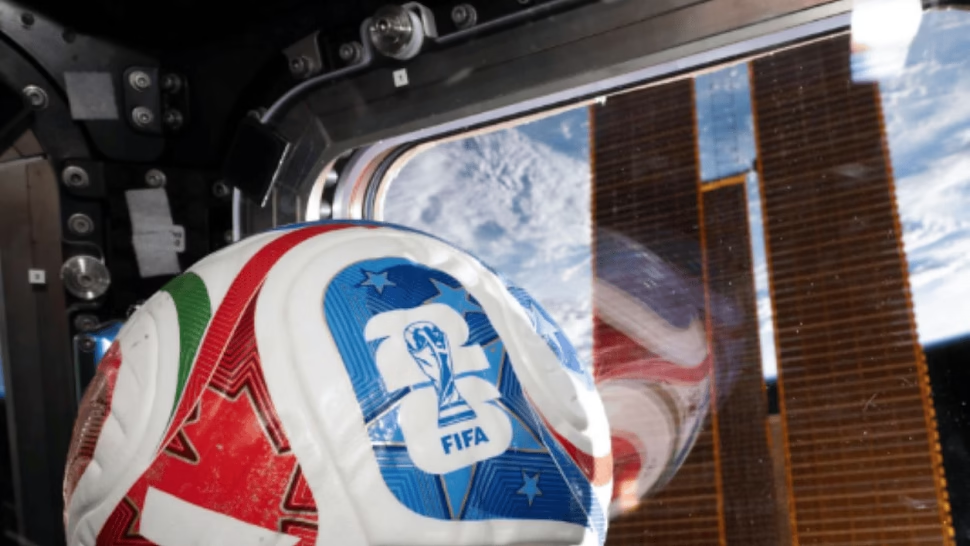
The fever of the 2026 World Cup permeated the atmosphere. NASA sent an official World Cup ball to the International Space Station (ISS). In a video shared on social networks, four astronauts are seen playing with the ball in microgravity. The message: “We work to inspire the next generation by showing how space exploration drives innovation in sports science.”

The agency seeks to disseminate how research on the ISS generates advances in science, technology and human health. Benefits that even reach the soccer field.

Exhibition at the FIFA Fan Fest in Houston

NASA set up an exhibit at the FIFA Fan Fest in Houston, Texas. It opened on June 11 at the start of the World Cup and will be available until July 19. Visitors can discover how space research improves life on Earth and learn about the Artemis program missions.

The exhibition explains how more than 25 years of studies on the ISS have helped understand the aerodynamics of the ball. According to a statement from the Johnson Space Center, previous research analyzed how internal mass, sensors and seam texture affect stability and rotation under real-play conditions.

Science applied to sports

As part of the project, NASA and Adidas present the “STEMonstration” demo. They compare how balls spin with different balance in microgravity. The objective: to show that space discoveries benefit athletes and fans of the most popular sport in the world.

Continue reading

Users report massive drop in X this Monday

Users report problems accessing social network X this Monday, June 22.

Cuts in X during Monday

Users of the social network X, formerly Twitter, reported this Monday, June 22, difficulties accessing and browsing the platform. According to data from DownDetector, a site that monitors digital failures, 1,131 people have reported problems with the application, loading the main feed and connecting to servers.

The most common issues include the inability to refresh the home page, errors when displaying posts, and crashes when using basic functions. When trying to log in, some see messages like “Something went wrong. Try loading again,” without the platform recovering.

So far, X has not issued an official statement on the origin of the failures or the estimated time to restore service.

Continue reading