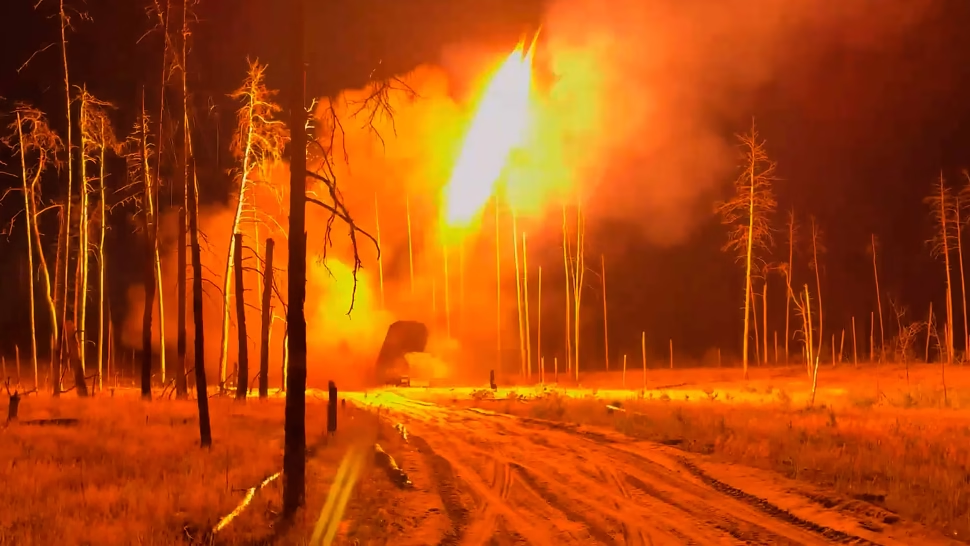
Iranian missiles target the secret base of Diego García

Iran attacks key US and UK base in the Indian Ocean, reigniting tensions and a controversial sovereignty agreement.

A target in the middle of the ocean

The Iranian missiles missed their target, but the message came through loud and clear. The British government has already condemned what it called “reckless attacks” against Diego García, a lost island in the Indian Ocean that is much more than it seems.

“Although the projectiles missed their target, the British government condemned Iran’s ‘reckless attacks'”

This base is the jewel in the Western military crown in the region. With some 2,500 troops—most of them Americans—it has been a platform for everything: from Vietnam to Iraq, including Afghanistan.

RelatedTrump travels to the United Kingdom on a state visit with royal pomp

Last year, it even hosted nuclear-capable B-2 Spirit bombers during the campaign against the Houthis in Yemen.

The broken promise and the controversial agreement

Here comes the interesting thing. Britain first denied that the base could be used for attacks against Iran. Then, with tensions rising, he gave the green light… but only for “specific and limited defensive operations.”

Iran directly accused Prime Minister Keir Starmer of putting British lives at risk.

And while the missiles fly, the very future of the island is being debated in London. Because Diego García has a dark history: its inhabitants were expelled in the 60s and 70s to build the base.

The international community has been calling for years for the United Kingdom to return sovereignty to Mauritius. In 2025, a deal appeared to be reached: London would relinquish formal control, but lease the base for another 99 years.

“Former President Donald Trump called the measure ‘an act of great stupidity'”

But that pact is frozen. British opposition politicians, descendants of the displaced and even Donald Trump fiercely criticize him. In Washington they do not give their final approval.

So we have Iranian missiles flying toward a base whose very existence is an unresolved diplomatic conflict. Geopolitics gives no respite, not even to a remote island.
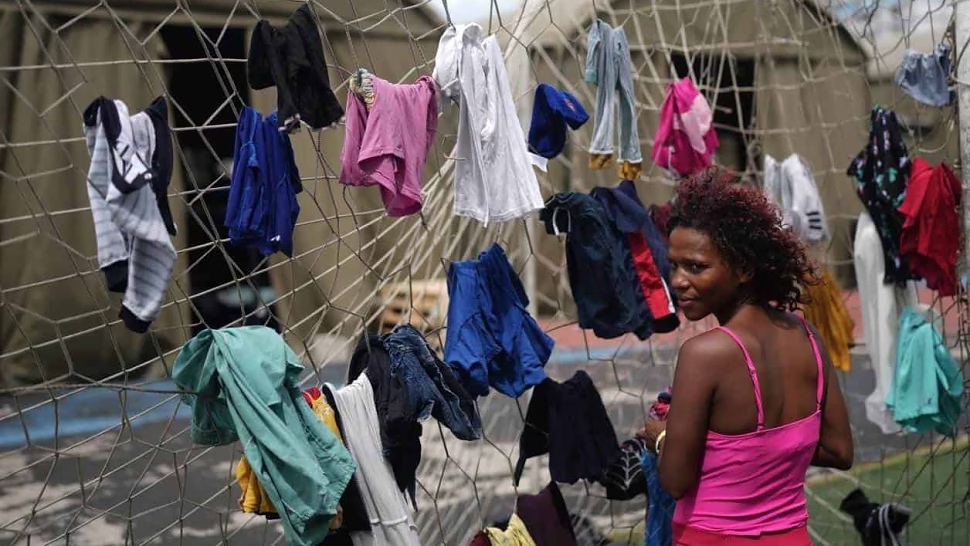
Two weeks after earthquakes in Venezuela, the emergency worsens

Thousands of Venezuelans seek medical attention after earthquakes that left more than 3,800 dead.

The health emergency worsens

Two weeks after the earthquakes that shook northern Venezuela, the humanitarian crisis intensifies. Thousands of victims go to mobile clinics and community kitchens in search of medical care and food. The UN appealed to raise $300 million and assist 1.3 million people.

The state of La Guaira, the most affected, concentrates the efforts of non-governmental organizations that now operate freely, in contrast to previous years of official restrictions. UN humanitarian aid director Tom Fletcher visited the area and warned of a rise in chronic and acute illnesses among survivors.

“They’re not just coming in with fractures anymore; they’re coming in with these other longer-term health needs,” Fletcher told The Associated Press.

Doctors in Catia La Mar report an increase in skin conditions and diarrheal diseases. There is also a lack of medications for diabetes and hypertension. Overcrowding and poor water and sanitation conditions aggravate the situation.

Irma Echarri, 67, went to a mobile unit hoping to restock her eye drops and painkillers. He was also looking for relief for a nose pain that appeared after the earthquakes of June 24.

“It hurts quite a bit,” he noted while waiting his turn.

The earthquakes left 3,889 dead, 190 buildings collapsed and 856 structures damaged, according to authorities. Some 18,000 people lost their homes and live in schools, sidewalks and parks.

Zulbey Reyes, 41, lost her job as a nanny and her house. He went to a clinic run by the Paluz organization, in alliance with the International Rescue Committee, for chest pain. The diagnosis revealed a nerve inflamed by the scream on the day of the earthquake.

The Pan American Health Organization reported that 50% of health professionals in La Guaira were directly affected: some died, others disappeared or suffered family crises.

According to the UN Office for Disaster Risk Reduction, damage to homes and infrastructure amounts to about $37 billion. So far, the United States has provided most of the aid. The response contrasts with the previous persecution of NGOs under the government of Nicolás Maduro.

Fletcher concluded: “When you have a crisis of this magnitude, people put politics aside and can focus on saving as many lives as possible.”

Continue reading

Ebola expands to new areas in Congo; There are 600 deaths

Suspected cases in Tshopo and Haut-Uele raise the Ebola alert in the Democratic Republic of the Congo.

Authorities in the Democratic Republic of the Congo warned this Thursday that the Ebola outbreak could have reached new regions. Suspected cases were detected in the provinces of Tshopo and Haut-Uele. The death toll rises to 600, while confirmed infections total 1,759.

Measures and current situation

The Ministry of Health reported two possible cases in the city of Kisangani, Tshopo province. One is linked to the Nia-Nia area, in Ituri, where the outbreak began. The other has no apparent connection with previous outbreaks, so it is already being investigated.

The government declared a health emergency on May 15, after the virus circulated for several weeks without being detected. The outbreak corresponds to the Bundibugyo variant, a rare strain of Ebola for which there are still no vaccines or approved treatments.

Given the seriousness of the situation, clinical trials began last week to evaluate possible treatments. It is hoped to find an effective alternative that contains the spread of the virus and reduces mortality.

Continue reading

Ukraine intensifies offensive against Russian oil infrastructure

kyiv attacked fuel depots and two ships in the Sea of ​​Azov.

Ukraine hits Russian oil infrastructure

kyiv intensified its drone offensive against Russian fuel depots this Thursday. The impacts hit facilities in the Tver and Stavropol regions, as well as two oil tankers in the Sea of ​​Azov. Russian authorities reported large fires.

The escalation comes a day after US President Donald Trump announced that he will grant Ukraine a license to manufacture Patriot air defense systems. Moscow claimed its air defenses shot down 73 Ukrainian drones. For its part, kyiv noted that Russia responded with 94 attack drones and two ballistic missiles against Ukrainian territory.

Russian response and dynamics of the confrontation

The Ukrainian attacks directly affect Russia’s ability to manage its energy infrastructure. Images of the fires on oil tankers circulated widely, evidencing the impact of the offensive. Russia’s response was immediate, increasing the use of drones and missiles in its counteroffensive.

This dynamic reflects the growing tension in the region. Both countries continue to exchange blows, which makes the situation of the confrontation even more complex.

Continue reading