Intellectuals reflect on the arrest of Maduro and the future of Venezuela

Intellectuals and writers analyze the profound consequences of a historical event for the future of Venezuela and the region.

A historical moment that awakens voices and reflections

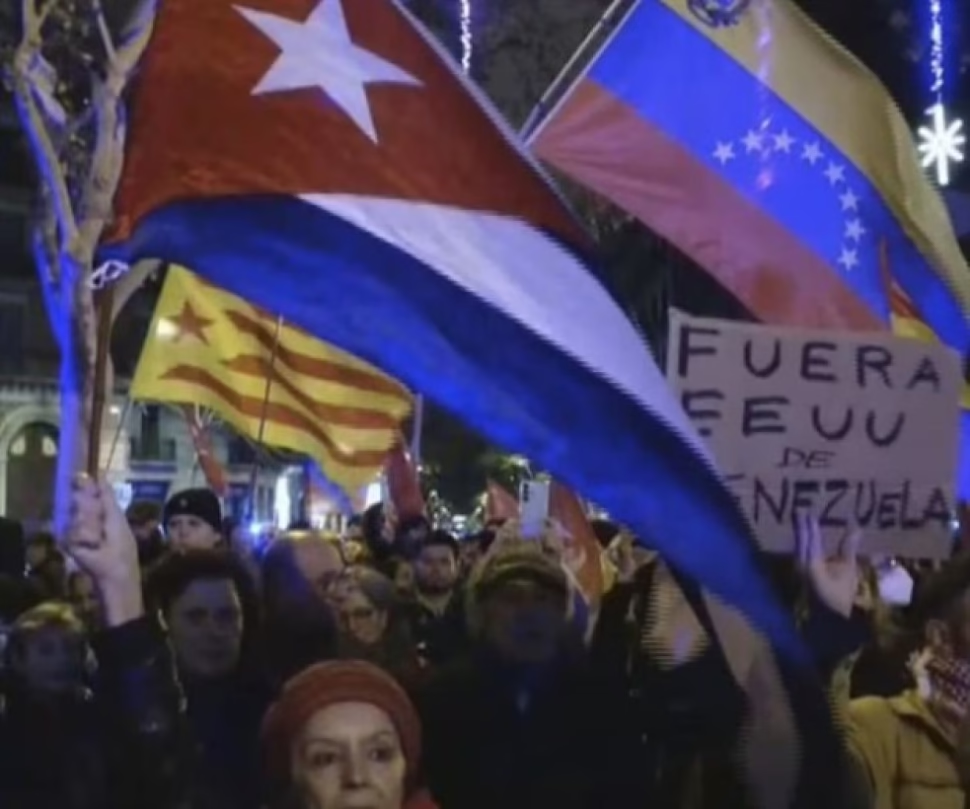
The detention of the president of Venezuela, Nicolás Maduro, by the United States government, has generated a political earthquake whose shock waves go far beyond the borders. This momentous event has not only provoked support and questions for the US intervention, but, above all, it has ignited a deep collective reflection on the enormous challenges that this action represents for the Venezuelan nation and its people. It is a turning point that forces us to look towards the immediate future with a mixture of hope and cautious concern.

The voices of the intellectuals: between hope and criticism

Social networks have become the public square where renowned thinkers and writers have expressed their analysis. The historian Enrique Krauze took his account of On the other hand, the poet Malva Flores expressed her solidarity with an emotional message: “Long live the brave people! I hug all my Venezuelan friends,”, celebrating the spirit of the people.

RelatedThe United States carries out a military operation and captures Maduro in Venezuela

However, other perspectives paint a more complex and gloomy picture. Writer Federico Guzmán Rubio offered a stark vision, describing Venezuela as a country caught between two evils: a dictatorship and a foreign intervention eager for resources. His reflection points to a global crossroads where, according to him, freedom is reduced to choosing between different forms of authoritarianism and impoverishment, making an urgent call to imagine new forms of social organization to escape this labyrinth.

The impact and unknowns of the power vacuum

Krauze himself later added a criticism of the “unilateral indignation” of certain sectors, denouncing the double standards of those who condemn right-wing dictatorships but excuse left-wing ones. He reaffirmed his liberal position, opposed to both Chavista tyranny and fascism, and expressed his desire for Venezuela to be rebuilt in democracy and for the United States to preserve its own. Meanwhile, from the field of political analysis, an essayist and professor at CIDE warned about the dangerous power vacuum created. He raised crucial questions about who will contest command, with what strength and legitimacy, warning that the following hours and days will be decisive for the stability of the country.

Sovereignty and resources: the center of the debate

The poet María Rivera focused her criticism on the economic aspect and national sovereignty. With forcefulness, he stated that The United States is stripping Venezuela of its oil, describing the action as an invasion, an occupation and a flagrant theft that violates Venezuelan sovereignty. His words resonate with the historical fear of many Latin American nations towards foreign interference motivated by the control of natural resources, an issue that strikes a chord with the independence and self-determination of peoples.

This event, without a doubt, marks a critical chapter in the contemporary history of Venezuela. The reactions of these intellectuals not only comment on a news event, but also draw the map of the ideological tensions, ethical dilemmas and hopes that define our time. Maduro’s arrest is just the beginning of an uncertain process where the fate of Venezuelan democracy, regional stability and the very meaning of sovereignty in a world of complex geopolitics will be at stake. The road to reconstruction will be long and full of obstacles, but the first step, always, is informed reflection and open debate.

Do you share this reflection on a crucial moment for Latin America? Spread this analysis on your social networks to expand the conversation and explore more content related to politics and society in our analysis section.
Farías Laguna appeals ruling that denied protection for huachicol

The defense seeks to have the case transferred to military jurisdiction. He alleges lack of direct evidence.

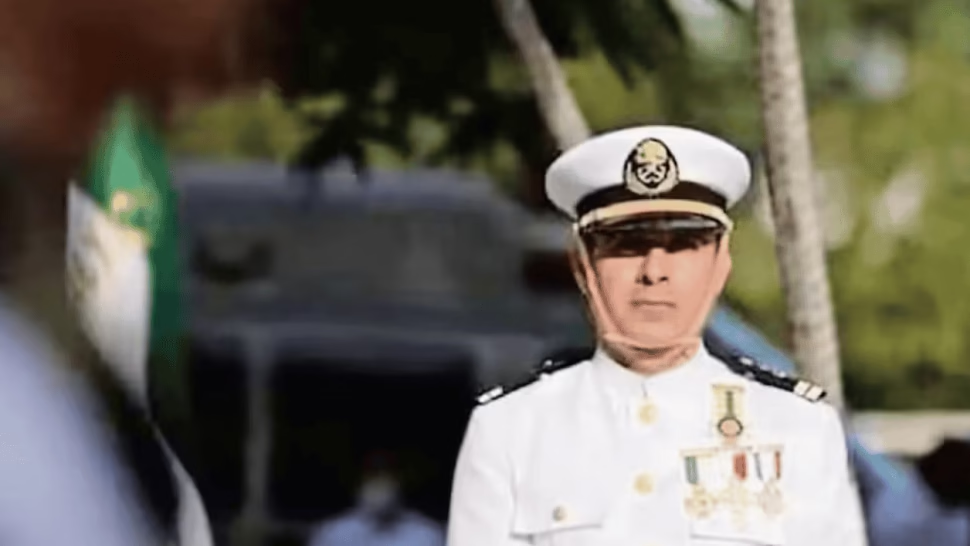
Vice Admiral Manuel Roberto Farías Laguna, nephew-in-law of former Secretary of the Navy José Rafael Ojeda Durán, filed an appeal for review against the ruling that denied him protection to annul his connection to the process. He is accused of leading a network of fiscal huachicol from the naval institution.

The defense requested that it be analyzed whether the criminal process should be transferred to military jurisdiction, in accordance with article 13 of the constitution. He maintains that the control judge Mario Martínez Elizondo should have carried out that analysis.

“The accusation was built on the quality of vice admiral and the functions he performed within the Navy Secretariat,” the defense said in a statement.

The appeal challenges the decision of Judge Jorge Adrián Cruz Flores, who last June denied federal protection. Now, a Collegiate Criminal Court will review the case.

Arguments against the sentence

The defense assures that neither the Attorney General’s Office (FGR) nor the ruling identify a specific order or act by Farías Laguna that demonstrates his participation in the alleged organization. The accusation, he affirms, is based on institutional hierarchy, geolocations and family ties, not on direct evidence.

He also accuses that the judge gave improper scope to a letter attributed to Fernando Rubén Guerrero Alcántar, interpreting it as a direct accusation. Furthermore, he points out that the sentence validates a collective narrative without distinguishing the specific conduct of the vice admiral.

“The appeal insists that the question remains regarding the constitutionality of article 4, section I, of the Federal Law against Organized Crime, considering that it raises problems of exhaustiveness, legality and legal certainty,” indicated the defense.

The criminal process continues in federal jurisdiction, while awaiting the resolution of the Collegiate Court.

Continue reading

Municipal police die after falling from a highway distributor in León

An officer fell from the highway distributor in León. He had shared a video about depression.

An officer lost his life at the Juan Pablo Segundo highway distributor

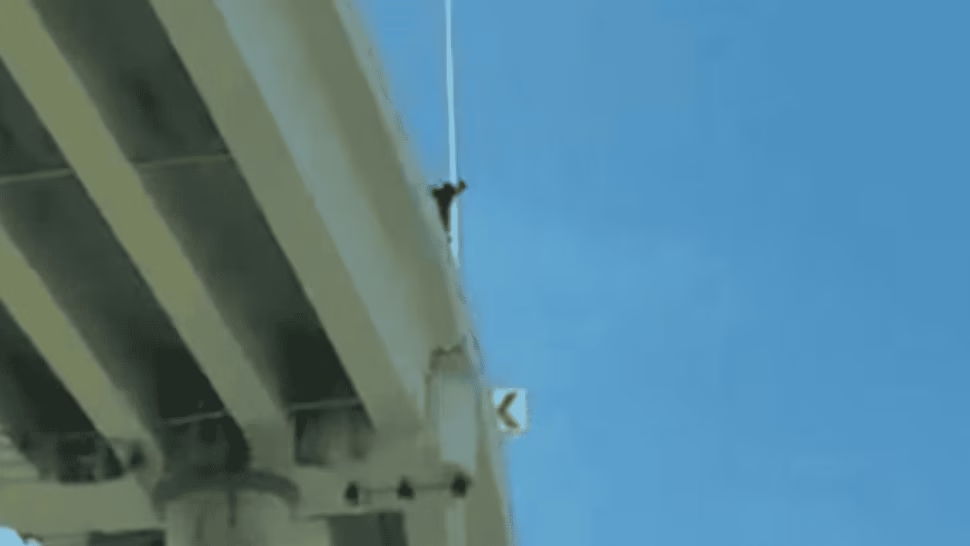
Minutes after 11:00 a.m. this Tuesday, a municipal police officer died after falling from the upper lane of the Juan Pablo Segundo distributor, near Plaza Altacia, at the exit to Silao, east of León. At that time there was high vehicular traffic on Morelos and Aeropuerto boulevards.

The officer was in uniform and on duty when the fall occurred. Before the event, he recorded a video while driving a patrol car and posted it on his social networks. In the message he recommended seeking help for any mental health problem.

“Don’t be sad, I had been going through a silent depression for a long time that ended up consuming me,” he expressed.

He asked them not to be sad and to remember the good times.

The moment was captured by witnesses with cell phones and broadcast on digital platforms. Until now, the Ministry of Security, Prevention and Citizen Protection of León has not issued official statements.

Warning signs and how to help

Losing a loved one to suicide is a complex mental health issue. Talking about wanting to die needs to be taken seriously and requires offering support. Some warning signs include:

  • Feeling like there is no hope or reason to live
  • Feeling trapped or in unbearable pain
  • Believing that you are a burden on others
  • Increased alcohol or drug consumption
  • Anxious, agitated, or dangerous behavior
  • Sleeping too little or too much
  • Social isolation
  • Anger or desire for revenge
  • Extreme mood swings

If you identify these signs in someone, don’t leave them alone. Seek help from a doctor, psychologist, thanatologist or therapist. Remove any weapons, dangerous substances or objects.

During confinement, requests for support for stress, anxiety, depression, violence and substance use increased through the Línea de la Vida (@LaLineaDeLaVidamx and @LineaDe_LaVida) or by calling 800 911 2000.

Continue reading

Mexico and Panama refine trade and aerospace agreements

Foreign Minister Velasco receives the Panamanian president prior to the bilateral summit with Sheinbaum.

Official visit of the Panamanian president

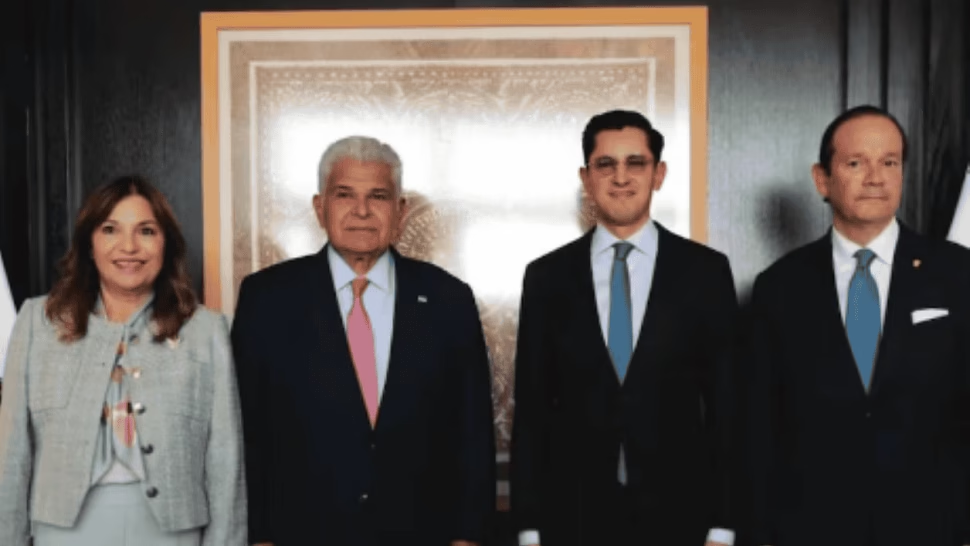
This Tuesday, Foreign Minister Roberto Velasco received the President of Panama, José Raúl Mulino, and his wife Maricel Cohen at the SRE headquarters. The meeting occurred hours before the meeting that Mulino will hold with President Claudia Sheinbaum at the National Palace.

Velasco was accompanied by his Panamanian counterpart, Javier Martínez-Acha. The Mexican Foreign Ministry highlighted that both countries remain committed to strengthening diplomatic ties on issues such as commercial exchange, investments, the agricultural sector and development cooperation.

Bilateral agenda and new agreements

The government of Panama reported that the visit responds to an official invitation from President Sheinbaum. Among the planned topics are trade, investment, security, customs and cooperation. The signing of new bilateral agreements is expected, including the possible accession of Panama to an aerospace agreement for Latin America and the Caribbean.

In addition, Mulino will meet with representatives of 23 Mexican companies interested in expanding operations in Panama or establishing themselves for the first time in that market, taking advantage of their logistical and service advantages to access other markets in the region.

The meeting between both leaders will take place this Wednesday. The Foreign Ministry did not detail whether there will be joint statements.

Continue reading