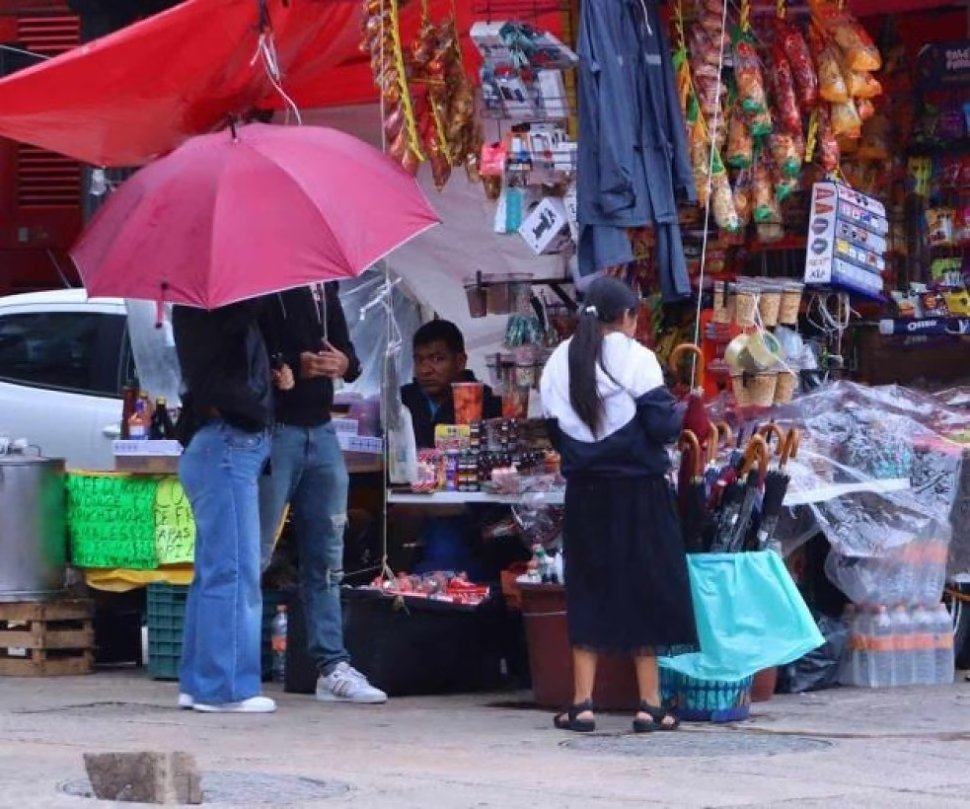
Informal labor income is equivalent to 48% of formal income in Mexico

The income gap remains despite slight improvements, with an unequal impact between urban and rural areas.

Analysis of the Income Gap and Working Poverty in Mexico

The National Institute of Statistics and Geography (Inegi), in its first official report on working poverty, reveals a substantial economic disparity between the formal and informal employed population in Mexico. The data, corresponding to the second quarter of 2025, detail that the average monthly labor income of a formal worker was 10,821 pesos. In contrast, the average remuneration for an employee in the informal economy was 5,257 pesos. This figure represents exactly 48.6% of formal income, highlighting a profound inequality in the country’s remuneration structure.

Although both sectors experienced positive annual growth in their real perceptions, the progress was marginal. The income of the formal sector registered an increase of 2.9%, while that of the informal sector increased by 2.7%. This parallel growth, although positive, does not contribute to closing the percentage gap between both groups, maintaining the relative economic disadvantage of informal workers.

RelatedThe informal economy in Mexico registers 16 quarters of growth

Evolution of In-Work Poverty and Regional Disparities

The concept of working poverty refers to the condition in which the per capita labor income of a household is insufficient to acquire the basic food basket. At the national level, this indicator showed a worrying stagnation, going from 35.0% in the second quarter of 2024 to 35.1% in the same period of 2025. This slight increase of 0.1 percentage points hides opposite trends when disaggregating the data by geographic area.

The analysis by area reveals a critical situation in rural areas, where the incidence of working poverty increased by 1.5 percentage points, climbing from 47.6% to 49.1%. This means that practically one in every two Mexicans in rural communities does not generate enough income through their work to cover their basic food needs. On the contrary, in urban areas a slight improvement was observed, with a minimum reduction from 30.9% to 30.8%.

The state perspective offers a heterogeneous panorama. In 21 of the 32 states an increase in real labor income per capita was recorded. The greatest advances were concentrated in three states: Quintana Roo led with an impressive growth of 12.1%, followed by Yucatán with 9.8% and Aguascalientes with 9.5%. At the opposite extreme, the largest falls seriously affected San Luis Potosí, which suffered a contraction of 15.0%, the State of Mexico with a decrease of 9.0% and Guerrero with a decrease of 7.2%.

Wage Mass and Gender Inequality

One of the most alarming data in the report is the contraction of the real wage bill at the national level. This economic aggregate, which represents the total sum of all labor income of employed people, decreased by 2.8% year-on-year. The value fell from 384,907 million pesos to 374,281 million pesos, indicating a reduction in the collective purchasing power of the Mexican workforce, despite individual increases in average income.

In addition to the formal-informal gap, the Inegi report highlights the persistent gender inequality in the labor market. The real average monthly labor income for employed men was established at 8,278 pesos, while for employed women it was 6,625 pesos. This difference means that women earn, on average, only 80% of the male salary, evidencing another critical dimension of economic inequality in the country.

The national average labor income for the entire employed population, integrating both sectors and genders, stood at 7,596 pesos per month during the second quarter of 2025. These findings underline the urgency of comprehensive public policies that not only encourage the formalization of employment, but also address deep regional and gender disparities, and stimulate robust growth in the wage bill that benefits the entire population. economically active population.

Does this analysis reflect the economic reality of your environment? Share this information on your social networks to contribute to an informed conversation about the future of work in Mexico and explore more content related to the national economy on our site.

Beatriz Mojica leaves the Senate to seek the governorship of Guerrero

The senator leaves office to compete for the governorship of Guerrero in the Morena poll.

Senator Beatriz Mojica Morga requested leave to separate from her position in the Senate. Its objective: participate in the internal process of Morena that will define the person in charge of coordinating the Defense of the Fourth Transformation in Guerrero. That position would lead her to the candidacy for governor of the state.

The legislator reported that she made the decision responsibly and with respect for the party’s rules. She stated that she was prepared to face the new political challenges in the entity.

Commitment to Warrior

In a message on social networks, Mojica assured that he will continue working alongside citizens. He pointed out that his political career has always been linked to the demands of the people of Guerrero.

“The charges are temporary, but the commitment to Guerrero is for life,” he said.

The senator trusts in democratic participation. He said that the people must define the direction of the transformation movement. He also expressed his support for President Claudia Sheinbaum Pardo’s project and called for maintaining unity in Morena.

Context of the process

Mojica’s departure occurs a week before Morena publishes the official call for the internal selection process. In parallel, the senator of the Green Party, Jasmine Bugarín Rodríguez, also requested a license to participate in the similar survey in Nayarit.

Mojica leaves his seat at a key moment for the definition of candidates in Guerrero. Morena’s internal process will be decisive for the gubernatorial race.

Beatriz Mojica deja el Senado para...

Continue reading

CNTE reduces its sit-in in the Historic Center of CDMX

15 days after the strike, the presence of the CNTE in the Zócalo decreases. There are internal differences about continuity.

Fewer blockades and camps

15 days after the national strike and sit-in began in the capital’s Zócalo, the presence of the National Coordinator of Education Workers (CNTE) in the Historic Center of Mexico City has been reduced.

Roads such as Francisco I. Madero, Simón Bolívar, 5 de Mayo and Isabel la Católica have fewer blockages and greater pedestrian traffic. The change contrasts with the first days of protest, prior to the start of the 2026 World Cup.

There are still camps in streets such as Tacuba, Ignacio Allende and Donceles, but the presence of dissident teachers is smaller. In the Republic of Cuba, Palma Norte and Belisario Domínguez, the main facilities continue with kitchens, dining rooms and tents.

Internal differences and continuity

Some members began to remove their belongings. Within the movement, differences persist over the continuity of the strike. There have been internal discussions between those who propose abandoning the mobilizations and those who seek to maintain pressure on the federal government.

Despite the reduction in some areas, the CNTE announced that it will continue with protest actions in different entities. They demand a direct dialogue table with President Claudia Sheinbaum.

CNTE reduce su plantón en el...

Continue reading

AICM taxis offer discounts of up to 18% to users

Discounts of up to 18% on authorized AICM taxis for frequent travelers.

Agreement between authorities and concessionaires

Authorized taxis at the Benito Juárez International Airport in Mexico City (AICM) will offer discounts of up to 18% on their rates. The benefit is part of an agreement between the airport authorities and the concessionaire groups.

The program includes loyalty systems and benefits for frequent travelers. The measure seeks to reduce the costs of land transportation and improve conditions for those who use the country’s main airport daily.

No specific details have been released regarding start dates or requirements to access the discounts. It is expected that in the coming days the authorities will expand the information.

Taxis del AICM ofrecen descuentos de...

Continue reading