


A message with more layers than an onion (and that stings almost the same)
It seems that the geopolitical playbook in the Middle East is being written on the fly, and the latest installment comes from Naim Kassem, the leader of Hezbollah. This Wednesday, the head of the Lebanese political-military group dropped a pearl that resonated louder than a tweet from an influencer during rush hour: Israel’s attack on Qatar is nothing more than a sinister warning for all Gulf countries. Basically, the message is: “if you defeat us, the resistance army, you are next on the list.” A rather apocalyptic mood, really.
Kassem’s comments came just one day after the Israeli Air Force attempted, unsuccessfully, to wipe out Hamas’s political leaders in Doha. The result: five lower-ranking members and a Qatari security agent died. An epic fail in terms of accuracy, but a resounding success in sending a message of intimidation. Qatar, in case you didn’t know, has been the star mediator in this war reality show that is the war in Gaza, so the movement is as symbolic as it is strategic.
The doctrine of “every man for himself” (but in a geopolitical version)
Kassem, with heated rhetoric, declared that they are on the side of Qatar, victim of an “aggression”, and support the Palestinian resistance. But the juicy part came later: he accused Israel of trying to create a “Greater Israel” in large parts of the Middle East. In other words, the expansionist and ultra-violent version of a Risk game. According to him, the only reason why the Jewish state has not achieved its expansionist objectives is because of the annoying (for them) presence of armed groups in Lebanon, Gaza and other areas. Therefore, he issued a not-so-subtle call to the Gulf oil monarchies: they should support these groups financially, politically, and socially. Basically, he told them, “fund us now or you’ll be the next to get taken over.”
“If the enemy defeats the resistance, and it will not be able to do so, you will be next,” Kassem stated, looking directly at countries like Bahrain and the United Arab Emirates, which decided to normalize their relations with Tel Aviv. A warning that sounds like a prophecy from those dystopian futures series that we like so much.
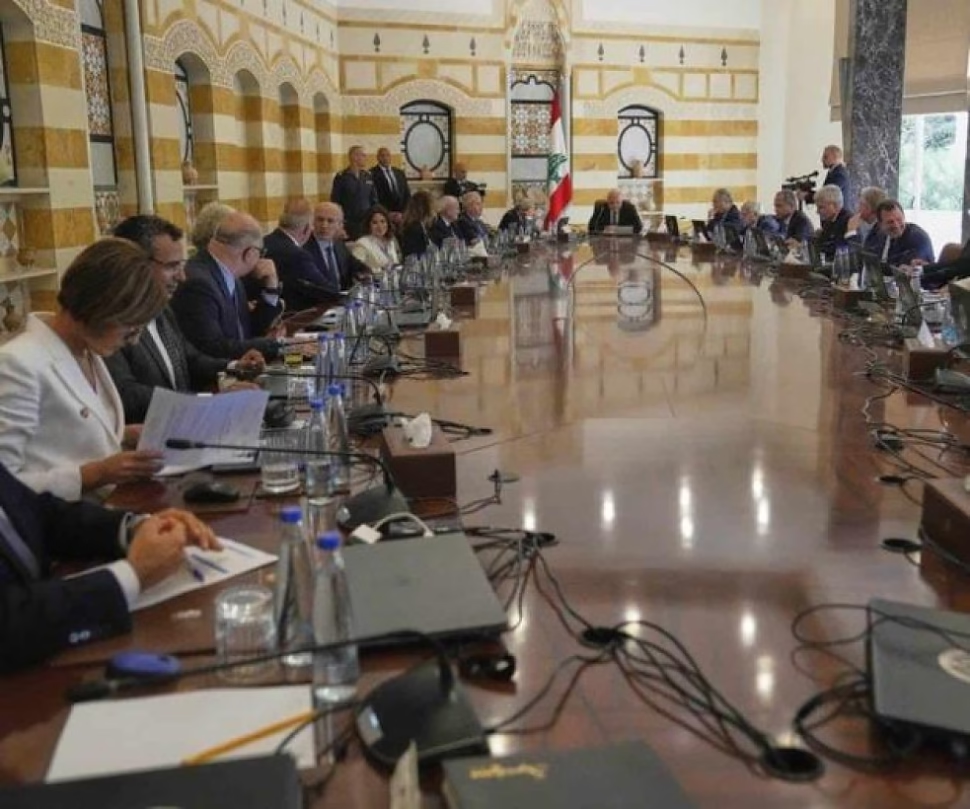
This speech does not come out of nowhere. It comes days after the Lebanese government approved a proposal to disarm Hezbollah, which was badly battered after its 14-month war with Israel. A conflict that ended in November with a ceasefire mediated by the United States, but which, according to Kassem, has achieved nothing because Israel continues to violate the truce on a daily basis. Since the paper peace was signed, Tel Aviv has carried out almost daily airstrikes in Lebanon, targeting members of Hezbollah, accusing them of wanting to rebuild their military capabilities.
A ceasefire that sounds like a bad joke
Talking about that ceasefire, it’s like that peace agreement that everyone signs but no one reads the terms and conditions. Kassem made it clear that it is not working. Israel continues bombing, and Hezbollah flatly refuses to talk about disarmament until Israel withdraws from five hills it occupies inside Lebanon and stops the air strikes. A dead spot more blocked than rush hour traffic.
The figures from their last confrontation are crazy: more than 4,000 dead in Lebanon (hundreds of them civilians, because of course, in these wars those who least want to play always lose), and a destruction valued at 11,000 million dollars, according to the World Bank. On the Israeli side, 127 died, 80 of them soldiers. The war broke out when Hezbollah began firing rockets on October 8, 2023, a day after the Hamas incursion into southern Israel that unleashed hell in Gaza. Israel responded with bombings and airstrikes in Lebanon, and thus began an escalation that became an all-out war at the end of September 2024. A domino effect of terror.
Kassem also called for national unity in Lebanon, because nothing unites more than a common enemy, and made it clear that they will not negotiate their weapons outside of a “national security strategy.” In other words, they won’t just disarm. The situation is so tense that a misplaced sneeze could unleash chaos again.
In short, we are facing a pulse of power where words are missiles and warnings are ticking bombs. Hezbollah, with Iran as an opening act, is telling the Arab world to fall in line or prepare for the consequences. And Israel, with its military power, continues to mark territory with attacks that seek to weaken its enemies. A dangerous game where the pieces are entire countries and the civilian population pays the highest price. As always.
Did this analysis impact you? Don’t be left wondering, share it on your social networks and tag those who should understand the complexity of this conflict. Explore more related content in our international politics section to stay up to date.


