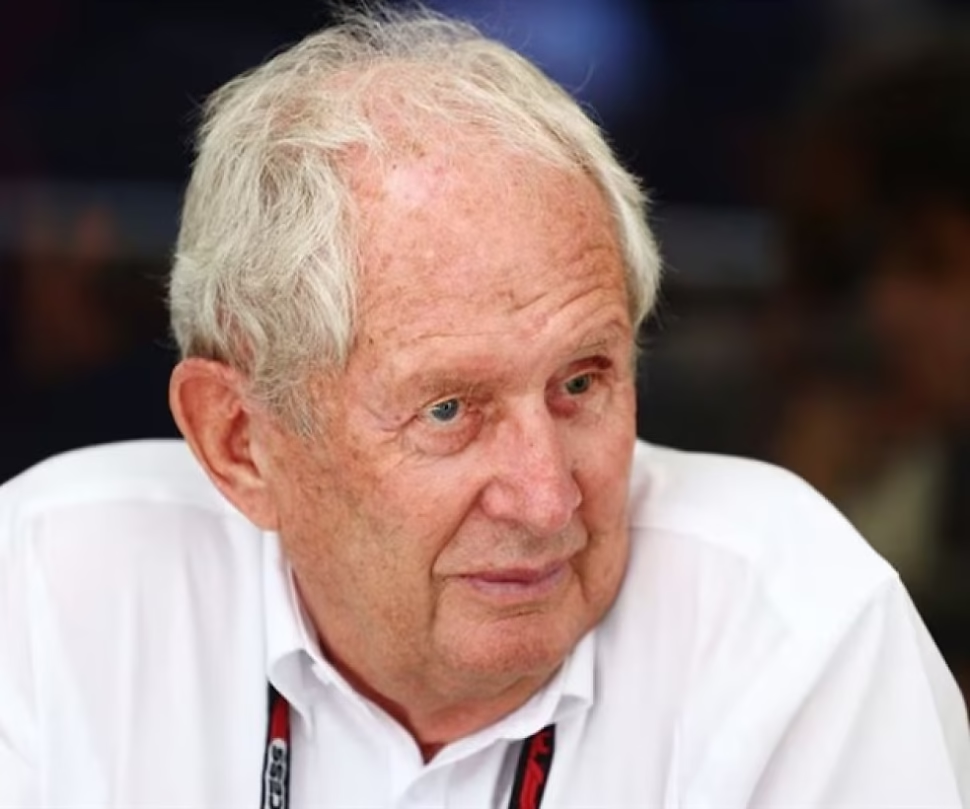
An era ends in Formula 1: Marko leaves Red Bull
Helmut Marko, fundamental architect and sports advisor of Red Bull Racing since the team was founded in 2005, has confirmed his departure at the end of the current Formula 1 season. At 82 years old, the veteran Austrian strategist puts an end to more than two decades of decisive influence, a period in which he meticulously supervised the development of the young talent program and was a witness and architect of the team’s greatest achievements and conquests.
This decision, validated through official F1 channels, signals a moment of profound transition for the Austrian team. After failing to reach the constructors’ championship in the 2025 campaign, the team faces a restructuring that seeks, with a new perspective, to regain the path of success in the face of the regulatory change of 2026. Marko’s absence completely redefines the internal panorama.
The legacy of a talent scout: from Vettel to Verstappen
Helmut Marko’s mark on world motorsport was forged thanks to his acute perception to identify and enhance exceptional driving skills. His management was instrumental in the rise and consecration of legends such as Sebastian Vettel, a key driver for Red Bull’s first titles, and Max Verstappen, the current dominator of the grid. However, its methodology was also characterized by a direct and sometimes controversial communication style, especially in the public evaluation of its pilots’ performance.
This facet was particularly evident in his relationship with the Mexican Sergio “Checo” Pérez. In repeated interventions, Marko attributed the fluctuations in the Guadalajara driver’s performance to his Latin American origin, suggesting a lack of the competitive mentality that, according to his view, European drivers possess. These statements generated a wide debate inside and outside the paddock, questioning the evaluation parameters and putting the focus on the prevailing culture within the team structure.
Impact and future: a new chapter for Red Bull
The departure of a figure with as much institutional weight as Marko will inevitably alter the operational dynamics of Red Bull Racing. His influence extended beyond sports management, permeating competition philosophy and strategic decision-making. The biggest question lies in the future of the incubator of drivers, a project that bore its indelible stamp and that has been the main source of talent for the parent team and its affiliated teams.
Management must now establish a new leadership framework that preserves the competitive aggressiveness that brought the team to the top, but potentially moderates the most controversial aspects of its previous management. This change represents not only an alteration in the organizational chart, but an opportunity to redefine the team’s identity in the post-Marko era. The balance between continuing a winning legacy and renewing internal processes will be the main challenge for the management team.
The world of Formula 1 is watching closely how one of its strongest institutions navigates this transition. Marko’s legacy is unquestionable: a winning machine built from the ground up. His departure closes a definitive chapter and opens one full of unknowns, where Red Bull must demonstrate that its success is a lasting system, beyond the individual figures who led it.
Do you think the post-Marko era will strengthen Red Bull or start a cycle of uncertainty? Share this analysis on your social networks and explore more content on the strategy and future of the leading teams in Formula 1.