Heineken will invest 2.75 billion dollars in a new plant in Yucatán

The multinational brewer reinforces its commitment to Mexico with a strategic project that will promote employment and regional development.

Strategic investment with economic and social impact

The Government of Mexico, in coordination with the Secretary of Economy, announced a milestone in the Plan México: the multinational Heineken will allocate 2.75 billion dollars (mdd) between 2025 and 2028 to build a brewing plant in Kanasín, Yucatán. This project is part of a broader industrial relocation strategy, where companies prioritize regions with key resources, in this case, water availability.

Institutional trust and economic strengthening

President Claudia Sheinbaum highlighted that this investment reflects the solidity of the national economy, evidenced by the stability of the Mexican peso, which is trading below 19 pesos per dollar. During his morning conference, he emphasized: “Investments continue in Mexico, trust continues”, linking this movement with current economic policy.

RelatedIndustrial parks and CFE create special energy packages

For his part, the Secretary of Economy, Marcelo Ebrard, explained that the initiative is part of a portfolio of more than 200,000 million dollars under the Mexico Plan. He highlighted that Yucatán was selected for its logistical and environmental advantages, aligned with the sustainability criteria demanded by global markets.

Quantifiable benefits and community commitment

Oriol Bonaclocha, CEO of Heineken México, specified that the project will generate:

  • 300 direct jobs permanent
  • 2,500 indirect positions in the value chain
  • Up to 2,000 temporary hires during construction

In addition, the company implemented a consultation process with indigenous communities, being a pioneer in establishing this dialogue in the region. Bonaclocha stressed: “We trust in Mexico and what we can build together”, reinforcing the 135-year legacy of the brand in the country, which currently operates with 18,000 collaborators and 21 brands in its portfolio.

Synergies with the industrial ecosystem

The governor of Yucatán, Joaquín Díaz Mena, highlighted that the investment will activate an ecosystem of local suppliers, while the AMPIP (Mexican Association of Private Industrial Parks) reported progress in its goal of 100 industrial parks for the six-year period: 13 are already in development with an investment of 626 million dollars, and are projected additional 5,000 million dollars in the future.

Héctor Ibarzábal, AMPIP advisor, specified that the association—with 477 parks in 28 states—captures 95% of manufacturing investment in Mexico, consolidating the country as a preferred destination for industrial operations.

Perspectives and call to action

This project not only consolidates Yucatán as a development hub, but also sets a precedent in responsible investment, combining economic growth with social inclusion. The integration of environmental and community criteria reflects the current demands of consumers and shareholders.

Are you interested in the impact of foreign investments in Mexico? Share this analysis on your social networks and discover more content on sustainable economy on our portal.

Explore more: Subscribe to our newsletter to receive updates on industrial projects and economic trends.
One year after the discovery in a crematorium, families march for justice

One year after the discovery of 386 bodies, families demand justice and an end to corruption.

March for justice one year later

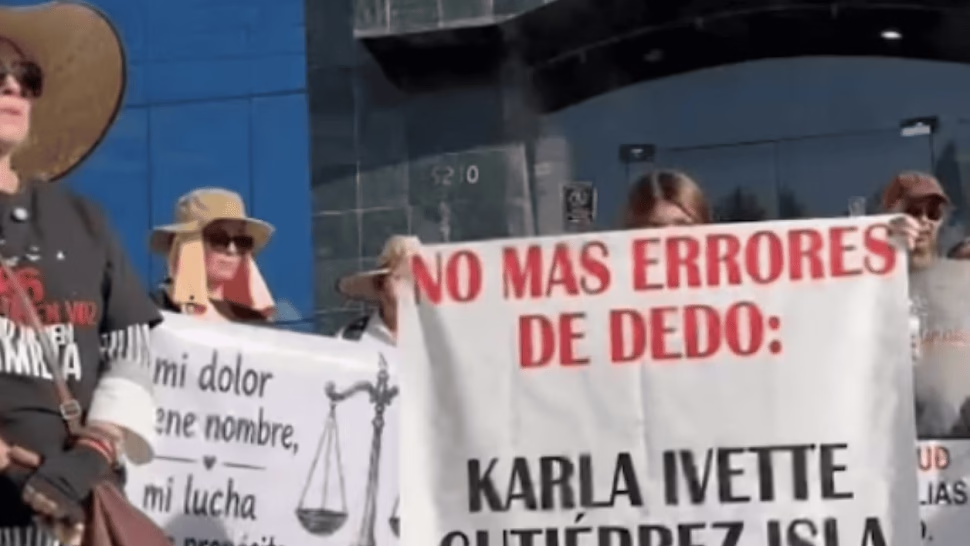
On Saturday afternoon, groups of families affected by the Plenitude crematorium case demonstrated. The discovery of 386 bodies turns one year old, and the bereaved demand answers.

The protest began at the Latinoamericana funeral home, one of those identified by family members. From there, the protesters walked towards the State Attorney General’s Office (FGE).

Dora Elena Delgado, spokesperson for the Justicia para Nuestros Deudos collective, reported that at least 1,500 families were affected. The central demand: no more impunity, no more corruption and full justice.

Actions pending by the authority

The protesters carried blankets with messages of justice. They demand action against Coespris officials involved in the case, as well as the recapture of José Luis A. C., owner of the crematorium. He was released by a federal judge, and a red card from Interpol is expected to arrest him again.

So far, of the 386 bodies found, the FGE reports that 135 remain to be identified. The identification process continues.

The collective Memory, Dignity and Justice joined the mobilization. They placed a permanent memorial in the shape of a cross outside the Prosecutor’s Office, as a reminder of the victims.

Continue reading

Sheinbaum asks to preserve native corn for national sovereignty

Sheinbaum highlights that native corn is key to food sovereignty and national identity.

President Claudia Sheinbaum Pardo reaffirmed that the governments of the Fourth Transformation defend national sovereignty in all areas. During a meeting with farmers in Pijijiapan, Chiapas, he highlighted the importance of native corn as a pillar of Mexican identity and self-sufficiency.

Defense of sovereignty through native corn

Sheinbaum presented the “Corn is the Root” program, whose objective is to improve the conditions of producers and reduce dependence on seeds controlled by large corporations.

“Conserving native corn also means defending sovereignty,” he stated.

The president warned about the risks of hybrid seeds:

“If we continue with pure hybrid corn, people will depend on buying seeds and those who sell the seeds will be a few companies.”

He stressed that preserving native varieties is essential to avoid this economic dependence.

“If we did not have native corn, we would lose a good part of food sovereignty, of what we are as Mexicans,” he said.

In addition, it extended the defense of sovereignty to the energy, cultural and food fields. She assured that the Fourth Transformation drives her “in every possible way.”

The program seeks to strengthen small farmers and conserve the genetic diversity of corn, a central element in the country’s diet and culture.

Continue reading

Mexico sends rescue team to Venezuela after earthquakes

25 specialists and 5 canine pairs travel to support search efforts in Venezuela.

Solidarity in action

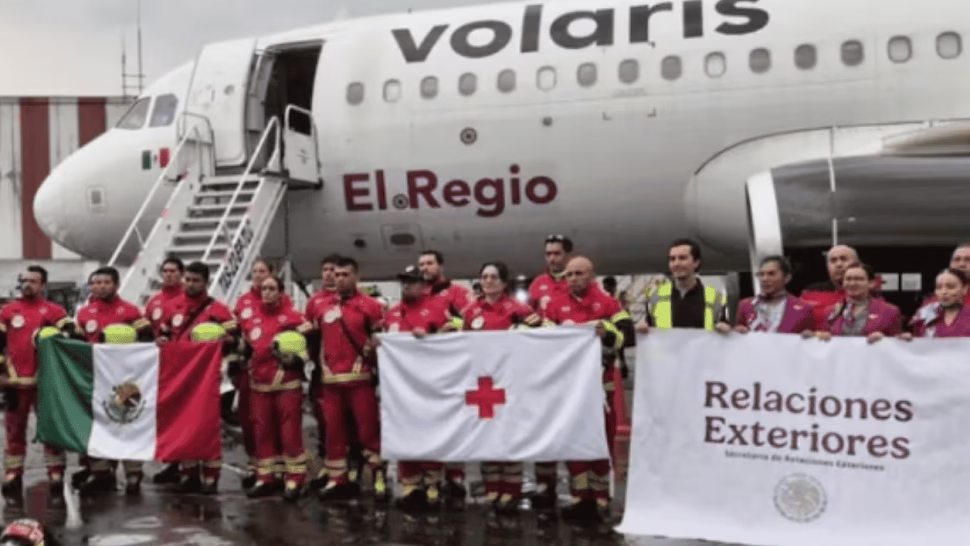
After the earthquakes of magnitude 7.2 and 7.5 registered in Venezuela on June 24, which left 1,430 dead and 3,328 injured, Mexico reinforced its humanitarian support. The Ministry of Foreign Affairs (SRE) coordinated the sending of a rescue mission with the Mexican Red Cross and the Volaris airline.

“This afternoon a support team made up of 25 specialists from the Urban Search and Rescue Unit (USAR) of the Red Cross and the Cancun International Rescue Brigade (USAR BRIC) left for Venezuela, as well as a brigade element from the Azteca Topos,” the agency indicated.

Equipment and logistics

The mission includes five canine pairs and 3.5 tons of specialized equipment for search and rescue tasks in the rubble. The shipment was transported on a Volaris flight.

“With this, Mexico reaffirms its solidarity and commitment to the Venezuelan people in these difficult times,” the SRE said in a statement. Foreign Minister Roberto Velasco heads the coordination of this aid.

Continue reading