Greece alerts over military drone with explosives found on Ionian island

Fisherman finds drone with explosives in Lefkada coastal cave.

A drone that did not fly, but did threaten

The Greek government is not mincing its words: the discovery of a military maritime drone loaded with explosives on the island of Lefkada is “extremely serious.” It is not for less. The Minister of Defense, Nikos Dendias, made it clear: this puts security and freedom of navigation in the Mediterranean in check.

What happened in that cave

A fisherman was surprised on May 7. Inside a coastal cave, the device floated like a bad omen. He towed it to the nearest port. The next day, the military took him to a naval base. There, the explosives were destroyed in a controlled manner. End of the immediate danger, but not of the questions.

RelatedThe Cueva twins win silver in the Diving World Cup

Whose was it? What were you doing there?

Here comes the messy thing. Greece has not released any information about the origin of the drone. But in the Mediterranean, strange movements are nothing new. From tension with Türkiye over energy resources to instability in Libya, any misplaced military device raises alarm bells. Dendias did not name names, but his tone suggested that this was no accident.

History repeats itself

If I have learned anything in these years covering conflicts, it is that drones are not just a thing from the sky. The maritime ones are the new headache. We already saw them in the Black Sea, in the Persian Gulf. Now, in the Ionian. Every time a fisherman finds a war toy, it’s because someone lost it—or left it there on purpose. And that is always a bad sign for those of us who live in the region.

“It represents a threat to security and freedom of navigation in the Mediterranean,” declared Nikos Dendias.

Authorities continue to investigate. But meanwhile, the Greeks on the islands look at the sea with different eyes. And I, from my desk, can’t help but wonder: how many more of these artifacts are floating around, waiting to be found?
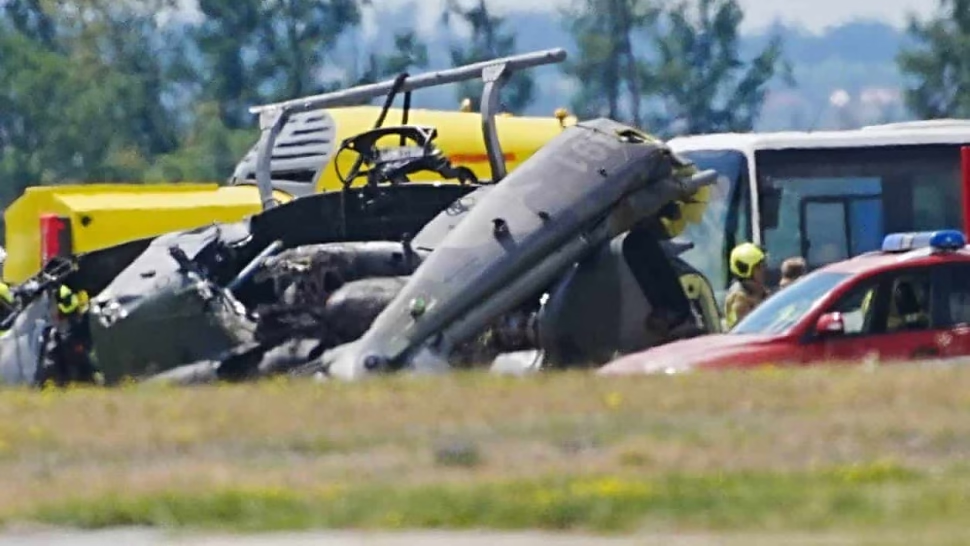

Military helicopter crash in Czech Republic leaves one dead

A military helicopter crashes at a Czech base; one soldier dies and four are injured.

Accident at Námešt nad Oslavou air base

A Czech Army UH-1Y Venom helicopter crashed this Thursday at an air base located southeast of Prague. The accident occurred around noon at Czech Air Force facilities, according to authorities.

Emergency teams responded to the scene. They confirmed the death of one of the occupants, while four other soldiers were injured and taken to hospitals to receive medical attention.

Preventive suspension of flights

Following the accident, the Czech military ordered the temporary suspension of operations of its UH-1Y Venom and AH-1Z Viper helicopters, both of which are American-made. The measure is preventive while the causes of the collapse are clarified.

Authorities have not provided additional details about the condition of the injured or the possible causes of the accident. A preliminary report is expected to be issued in the coming days.

Continue reading

Drug trafficking advances on Ashaninka lands in the Amazon

The Ashaninka community faces armed invasions while asking for state protection in Brazil.

The Ashaninka indigenous community, which recovered its territory on the Brazilian border with Peru three decades ago, now faces a growing threat. Gangs and drug trafficking groups invade their lands, using the Amazon rivers to move drugs. Leaders have reported violent episodes, including this month, and demand protection from the Brazilian government.

The invasion is part of the expansion of criminal routes in the Amazon, known as the Solimões River route. Experts point out that indigenous territories are key to stopping deforestation, but they also offer attractive hideouts for traffickers.

Blind spot in security

Jonatas Soares, mayor of Tabatinga and police officer, said:

“There is an institutional and intercultural blind spot in the public security services provided to indigenous peoples. The State formally recognizes their territories, but fails to translate that presence into continuous protection adapted to their specific needs.”

The Solimões route—from the border with Peru to Manaus—is largely controlled by the Red Command, according to retired colonel César Mello, an expert in Amazon security. Mello warns that indigenous communities are vulnerable due to their remote location, lack of supervision and cultural differences.

Resistance and complaints

The Ashaninka have refused to collaborate with traffickers. In the past, they rejected the construction of a clandestine landing strip. Francisco Piyãko, coordinator of the Organization of the Indigenous Peoples of the Juruá River, related:

“We have a long history of opposing any type of illegal activity.”

On July 6, a group of five armed men—Spanish speakers with machine guns—invaded Kampa territory, threatening families and searching for leaders. Piyãko filed a formal complaint and security forces were deployed. “They came looking for our leaders, with the intention of killing them,” he said.

Brazil’s Indigenous Peoples and Justice ministries did not respond to requests for comment. The Foreign Ministry reported that they will receive the Ashaninka leaders in Brasilia to evaluate joint actions with Peru.

In previous months, Judge Flávio Dino ordered the federal government to intensify work against organized crime in the Amazon. Piyãko stressed that confronting these groups is not the responsibility of the indigenous people, but of the State: “They allowed this to happen due to their absence, so they bear that responsibility.”

Continue reading

Ford and Geely join forces to produce ecological cars in Spain

Ford and Geely will manufacture low-emission vehicles in Valencia, Spain.

A strategic alliance

Ford and China’s Geely Auto announced an agreement to jointly manufacture low- or zero-emission vehicles at a Ford plant in Valencia, Spain. The alliance seeks to reactivate Ford’s offer in Europe and compete with Chinese manufacturers that dominate the global market.

If it receives regulatory approval, Ford will own two-thirds of the joint venture; Geely, also owner of Volvo and Polestar, will control the rest.

Planned vehicles

Both companies plan five models. Ford will continue production of the Kuga plug-in hybrid and will launch a new Bronco in 2028. Geely will build two electric trucks at the plant, the first also in 2028. In addition, they will develop a “multi-energy” crossover that will hit the market that same year.

“The joint venture addresses the new realities of the European market—intense global competition, relentless cost pressure and increasingly strict regulations,” said a statement from the two companies.

Context of the decision

Ford has lost ground in Europe: from selling more than a million vehicles a decade ago, last year it sold less than half a million. The Valencia plant has capacity for 500,000 cars annually, but its production fell below 100,000 in 2025.

The alliance reduces financial pressure by sharing costs. Ford and Geely already have history: Ford sold Volvo Cars to the Chinese company in 2010.

“This deal provides a roadmap for how traditional manufacturers can survive and thrive in Europe,” said Jessica Caldwell, director of analytics at Edmunds. “Ford gains scale and cost efficiencies; Geely a shortcut to avoid EU tariffs.”

Challenges in the US

Meanwhile, in the United States, Donald Trump’s administration has weakened fuel efficiency standards and eliminated tax credits for electric vehicles. This creates uncertainty, but also drives manufacturers like Ford to look for opportunities in Europe.

“Like GM, Ford has been reducing its dependence on Europe. Now, with Geely, it can have new products designed for that market without assuming the entire development cost,” said Sam Fiorani, vice president of AutoForecast Solutions.

Chinese automakers, with government subsidies, have gained ground in Asia, Latin America and parts of Europe. The alliance with Geely not only expands China’s presence in local European production, but also helps keep Ford workers on the assembly line.

Continue reading