Godoy Ramos bets on key chips in the states

The FGR appoints eleven new federal prosecutors in ten states to reinforce security operations and coordination.

A strategic move on the board of justice

The Attorney General’s Office has just moved its pieces. Ernestina Godoy Ramos appointed eleven new federal prosecutors in ten states, a move that smacks of much more than a simple bureaucratic replacement. This is high-level political theater, and the setting is national security.

The official statement talks about “promoting operation” and strengthening work in harmony with the Security Cabinet. But between the lines, one reads a clear strategy: take territorial control of the prosecutor’s offices that were previously delegations. It’s not a name change, it’s a philosophy change.

“The function constitutes a responsibility to face challenges with integrity, professionalism and firm commitment,” Godoy highlighted during the meeting with those appointed.

The key details of the new deployment

This is where it gets interesting. The incumbent is not bringing in new faces from abroad. It is promoting from within, betting on profiles with decades of experience in the trenches. It is as if he had decided that the war against impunity is won with soldiers who already know the battlefield.

RelatedThe PAN affirms that it is not afraid of the arrival of Godoy to the FGR

Teófila González Lozada takes Baja California after passing through Ensenada. Margarita Galván Rodríguez jumps from Guanajuato to Campeche. In Mexico City, Laura Gabriela Chang Marroquín was already handling complex cases. Rosalía Juárez Ramírez has been working as a Public Prosecutor for more than 20 years before arriving in Durango.

Each appointment tells a story. Enrique Landeros Curiel comes from Zapopán to Jalisco. José Guadalupe González Guajardo crosses from Reynosa to Nuevo León. Damaris Baglietto Hernández leaves CDMX for Oaxaca after having been a subdelegate in several states.

My father always said that politics is lived in the streets, not at desks. Seeing these profiles, Godoy seems to have understood the lesson. They are not bureaucrats; They are investigators, litigants, people who have seen the coffee-stained files and the statements taken in the middle of the night.

The question I ask myself while drinking this coffee is: will this really strengthen coordination? Or it will be another act in this play where each actor says his lines but the script remains the same. The curtain has just risen for these eleven prosecutors. Now it’s time to see how they act.

T-MEC: Mexico, the US and Canada resume negotiations in July

Sheinbaum announces virtual and in-person meetings to review the T-MEC in July.

President Claudia Sheinbaum confirmed that on July 1 economic authorities from Mexico, the United States and Canada will hold a virtual meeting to advance the review of the T-MEC.

Scheduled meetings

“In any case, on July 16 or 20 there is a meeting here, in Mexico, to continue the talks,” declared the president. Sheinbaum specified that, although Washington has requested bilateral talks, Mexico insists on a trilateral format.

“The treaty is very good for the three countries; those who defend it the most are even the American, Mexican and Canadian companies themselves,” he added.

The president highlighted that Mexico and Canada have strengthened their trade and investment relationship. He mentioned a relevant project in the port of Altamira, Tamaulipas.

Canadian mining cases

Sheinbaum also referred to two cases of alleged irregularities by Canadian mining companies in Mexico, which are being analyzed by the Security Cabinet. He stressed the importance of complying with environmental laws, a topic he discussed with Prime Minister Mark Carney.

“Alicia Bárcena sent a list of problems of Canadian mining companies in Mexico that have not fully complied with remediation, environmental impacts or mitigation; they should comply,” he stated.

Profepa and Semarnat are working on these non-compliances.

Security and reduction of homicides

The president also highlighted a decrease in homicides during her administration, attributing it to the security strategy based on attention to the causes.

The July meetings will define the course of the review of the T-MEC, in force since 2020 and key for the regional economy.

Continue reading

Labor trials against the CFE double in 2025

Litigations against CFE double in 2025, totaling 20,036 cases.

Labor litigation in the CFE: doubling in 2025

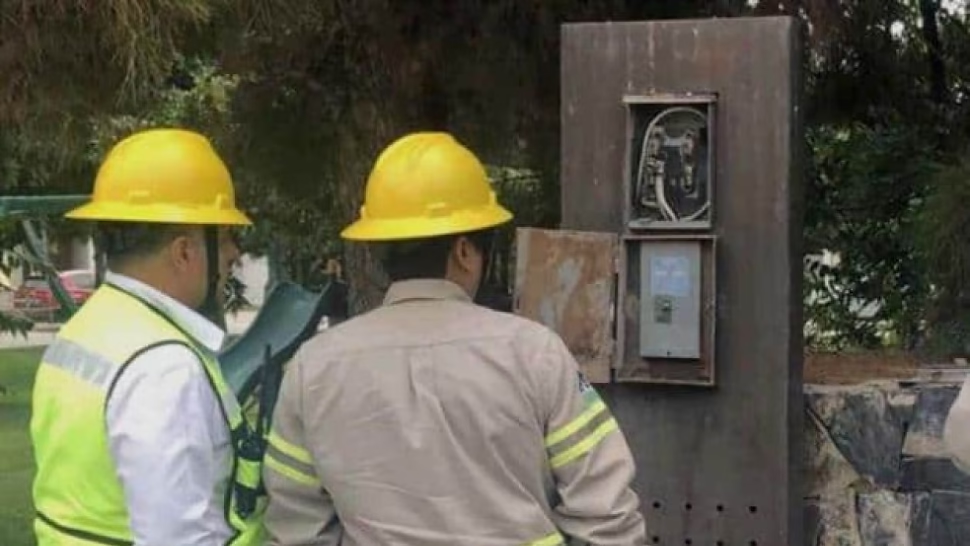
New labor lawsuits against the Federal Electricity Commission (CFE) doubled during 2025. According to the company’s annual report, 20,036 cases were reached.

In 2024, 9,944 processes were registered. In 2023 there were only 2,206. Specialists attribute the increase to tensions over working conditions, layoffs and benefits.

The CFE recognizes this scenario as a liability due to legal contingencies. It allocated 14,478 million pesos in 2025 to face possible adverse resolutions.

According to the report, the lawsuits include requests for reinstatement, recognition of seniority, pension adjustments, application of collective contracts and claims for benefits.

The company affirms that it has strengthened conciliation mechanisms. However, specialists warn that the increase in demands could reflect structural problems that affect the productivity and operation of the energy sector.

Continue reading

How to prevent illnesses and falls with low-cost changes

WEF study proposes simple changes in homes and physical activity to save billions.

Small actions, big savings

Reducing diabetes, preventing falls, and preventing dementia is possible with minimal home adjustments, physical activity programs, and accessible technology. This is stated by the World Economic Forum (WEF) in its study “The longevity dividend”.

The report estimates that shifting policies toward prevention would free up $6.4 trillion globally. These resources today are used to treat diseases that could be avoided.

Concrete strategies

To prevent falls, experts recommend grab bars and lighting on stairs. With an investment of less than 400 billion dollars, almost 400 million falls would be avoided by 2040. This would generate more than 5 trillion in health savings.

In diabetes, community physical activity programs could stop 8.5 million cases of type 2 diabetes by 2040. The cost per person ranges between one and 40 dollars, and the gains in productivity would exceed 125 billion.

Hearing loss has a direct link to dementia. Expanding access to hearing aids would prevent 2.4 million cases of dementia and save more than 325 billion in health.

Economic benefits

The study, applied in 21 countries by the WEF and Marsh, indicates that companies and governments address health, finances and work separately. If integrated, they would unlock 5.8 trillion in healthcare savings and 645 billion in productivity gains.

“Poor health strains health systems and personal finances, affecting financial resilience and generating broader economic costs,” the report warns.

Impact on women

A relevant fact: women who dedicate a year to care work see their retirement savings reduced by 24% due to absence from work and the wage gap. Institutions often treat these problems separately, despite their consequences.

The WEF concludes that there is a window of opportunity to align health, finance and employment policies. The key: allocate budgets to prevention and care for the elderly population with public-private collaboration.

Continue reading