Government announces dejection of El Mencho, leader of the CJNG

Federal forces announce the death of the CJNG leader in Jalisco, in what they describe as a historic coup.

An official statement and many unanswered questions

Omar García Harfuch, the Secretary of Security, went out to X to distribute recognitions. The reason: an operation in Tapalpa, Jalisco, where they claim that Nemesio Rubén Oseguera Cervantes, El Mencho, the brain of the Jalisco New Generation Cartel (CJNG), was killed.

“We make broad recognition of the bravery, professionalism and loyalty of the personnel of the Mexican Army, the National Guard and the Mexican Air Force,”

he wrote. The official message is a hymn to coordination and an accurate blow to crime. Sounds good. It sounds like a victory.

RelatedThey report the despondency of ‘El Mencho’, leader of the CJNG

But this is where my legal training sounds an alarm. When a statement shines so brightly, you have to rub it to see if it’s gold or just varnish. A milestone is announced, an international criminal organization is weakened… and then silence on concrete operational details.

How many troops? Was there months-long prior intelligence or was it an ambush? Official versions are usually brief for national security. Also for narrative convenience.

The historical memory that we must not lose

I remember too many definitive blows to organized crime that, over time, revealed themselves as chapters of an endless war. The capture or death of a boss rarely means peace. It usually means power vacuum, violent realignments and revenge.

Authorities say they are monitoring the situation to ensure safety. It’s the least we can expect after announcing something like this. The uncomfortable question is: what then?

The statement ends with the priority of protecting the population. Hopefully that protection includes transparency about what really happened in those hills of Jalisco, beyond the triumphalist bulletin. Because the truth, unlike the bosses, should never be down.

Sheinbaum and Greer hold key meeting on T-MEC

Meeting at the National Palace advances in the review of the T-MEC and bilateral agreements.

Meeting at the National Palace

At the National Palace, President Claudia Sheinbaum Pardo received the United States trade representative, Jamieson Greer, this Thursday. The meeting lasted an hour and a half.

According to Sheinbaum, they made progress in the review of the T-MEC and in bilateral agreements. “At the National Palace, we met with the United States trade representative, Jamieson Greer; we advanced in the review of the T-MEC and bilateral agreements for the benefit of both peoples,” he wrote on social networks.

For Mexico, the Secretaries of Economy, Marcelo Ebrard, attended; of Foreign Affairs, Roberto Velasco; Undersecretary Luis Rosendo Gutiérrez; the coordinator Julio Berdegué; and the coordinator Altagracia Gómez. The U.S. delegation included Deputy Representative Jeff Goettman, Ambassador Ronald Johnson, Chief Negotiator Julie Callahan and Chief of Staff Sam Mulopulos.

Sheinbaum stated in his morning conference that his government has done “everything humanly possible” so that Mexico faces the trade review in the best conditions. He added that they will continue to defend national interests against unilateral decisions by Washington.

“We don’t know exactly what the United States is going to do; what we do is our best work to find the best conditions for our country,” he said.

He recalled that the United States unilaterally imposed tariffs on various countries and that a new round is approaching under Section 301. Therefore, Mexico remains attentive.

The president also rejected statements from US legislators about an alleged failure to deliver water. He described that statement as false.

The meeting is part of the T-MEC negotiation rounds, in a complex trade context due to Washington’s protectionist measures.

Continue reading

México Canta 2026: 16 thousand young people seek peace through music

16 thousand participants registered for the 2026 edition of the binational México Canta contest.

A contest that bridges borders

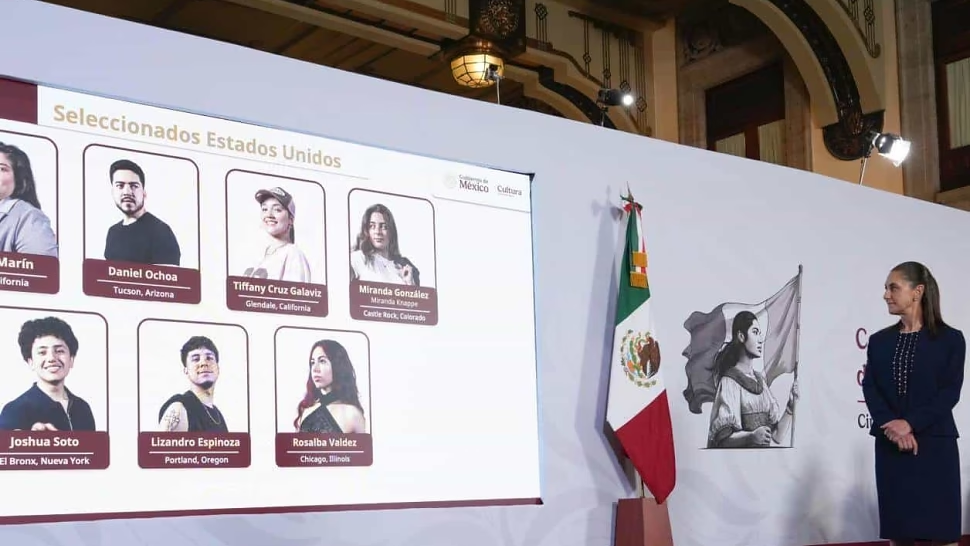
President Claudia Sheinbaum Pardo presented the seven Mexican-American semifinalists of México Canta 2026. She highlighted that the contest promotes values, love for Mexican music and the bond between families on both sides of the border.

“That bond is never broken, it is part of fraternity, love, solidarity,” he stated during the morning conference.

Sheinbaum stressed that the initiative transcends politics: it is a cultural defense that puts love above all.

Figures and stages

The Secretary of Culture, Claudia Curiel de Icaza, explained that in the first stage (May 11 to June 10) 16,289 participants were registered: 10,528 from Mexico and 5,761 from the United States. After in-person auditions, the Mexican Music Council selected 14 semifinalists: seven Mexicans and seven Mexican-Americans.

The seven selected from the other side of the border are:

  • Grecia Marín (Perris, California)
  • Daniel Ochoa (Tucson, Arizona)
  • Tiffany Galaviz (Glendale, California)
  • Miranda González (Castle Rock, Colorado)
  • Joshua Soto (The Bronx, New York)
  • Lizandro Espinoza (Portland, Oregon)
  • Rosalba Valdez (Chicago, Illinois)

The semifinals are broadcast on 45 public media on Sundays from 7 to 9 p.m. The live performances will be on August 23 at the Million Dollar Theater (Los Angeles) and August 30 at the Ángela Peralta Theater (Mazatlán). The public will choose six finalists in real time. The grand final will be on September 13 at the National Auditorium, and the winners will be presented on September 15 at the capital’s Zócalo.

The singer Armando Toledo Rosas “El Bogueto” celebrated the contest as a sign that young people can get ahead with talent and work. Grecia Marín, representing the semifinalists, thanked the president for opening spaces that carry messages of hope. Joshua Soto added that México Canta shows that music inspires and unites.

Continue reading

FDA recognizes false positive in Taylor Farms lettuce

Cofepris analysis rules out contamination; FDA admits error in initial sample.

Analysis results

The Ministry of Health reported that tests carried out on lettuce and water samples from the Taylor Farms Mexico plant were negative for the parasite Cyclospora cayetanensis —which causes severe diarrhea— and also for fecal coliforms. The analyses, carried out by Cofepris, confirmed that the product complies with the physicochemical parameters established in national standards.

Traceability and false positive

Taylor Farms has a traceability system that allowed United States authorities to identify the origin of the product and track a batch held at customs in Laredo, Texas. That batch never entered US territory.

The sample obtained from that batch returned a false positive, a situation that the United States Food and Drug Administration (FDA) recognized in an update published on July 19. The Ministry of Health emphasized that the product is suitable for human consumption.

Continue reading