Gigablue’s controversial technology to capture carbon in the ocean

A startup promises to clean the air with particles in the ocean, but scientists aren't convinced.

Gigablue and its “magic solution” for climate change (spoiler: it may not be)

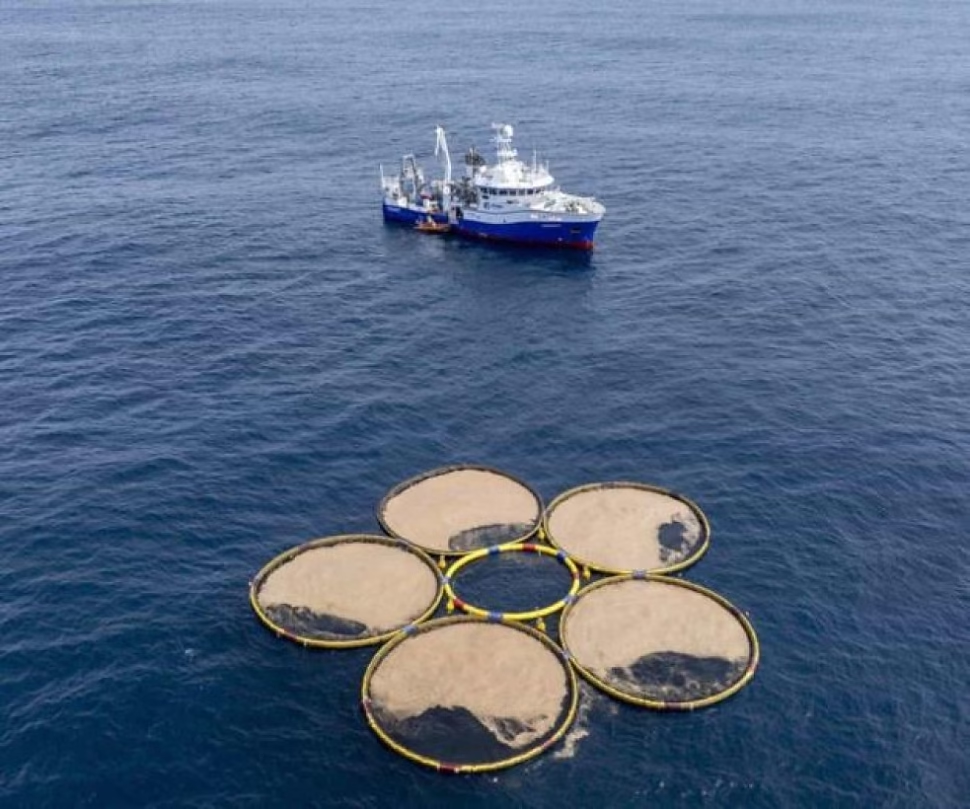
The Israeli startup Gigablue proclaims itself the new savior of the planet, and no, it is not the script for a Marvel movie. This year they announced with fanfare the sale of 200,000 carbon credits, basically the ecological equivalent of selling smoke… but with a techie twist. His great idea: throw particles into the ocean so that the carbon disappears like WhatsApp messages after 24 hours. Will it work? Science says, “Let’s see, show us the data first.”

The ocean “garbage can” and other questionable metaphors

Jimmy Pallas, an Italian event planner, bought the idea (literally). He compared Gigablue’s service to an “extra garbage can” for his emissions. “Just like I don’t follow the garbage truck, I trust them,” he said, in what might be the most millennial analogy for the climate crisis. Meanwhile, independent scientists are frowning: Do these particles really do anything or are they the ocean equivalent of placebos?

RelatedGiant freshwater aquifer discovered under the Atlantic Ocean

The company, founded by four technology entrepreneurs (yes, the same ones who previously sold avocados online), claims that its AI and its “digital twin” of the ocean are the key. But its COO comes from a startup that tracked trees, and its CTO was inspired by seeing bleached reefs on his diving vacation. Green CV or greenwashing? The debate is served.

Carbon credits: the new Bitcoin (but with more controversy)

Carbon credits are the “okay, I owe you one” of green capitalism. Gigablue sells them like hotcakes, with its largest buyer, SkiesFifty (an “eco-friendly” aviation company, because the irony has no limits). Although they do not reveal prices, their graph suggests that they are cheaper than a coffee at Starbucks. Of course, its goal of capturing 10 tons of CO₂ for every ton of particles sounds like an influencer’s promise: grandiose, but difficult to verify.

Meanwhile, giants like Microsoft and Google buy credits voluntarily, because nothing says “we are green” like paying to cleanse your conscience (and your carbon footprint). But in a market with more regulation than a Telegram group, doubts persist. Are we facing the next environmental Tesla or another ecological Fyre Festival?

Now what? If you are intrigued by this climate-technological circus, share the article and tag that friend who believes that AI will fix everything. Or better yet: explore more content on how to distinguish real innovation from smoke (literal and figurative). 🌍💨

Note: No oceans were harmed in the writing of this article…that we know of.
The informant who exposed the Jensens for fuel smuggling

An informant with a criminal history testifies again against oil magnate James Jensen in the Pemex robbery case.

An old acquaintance returns to court

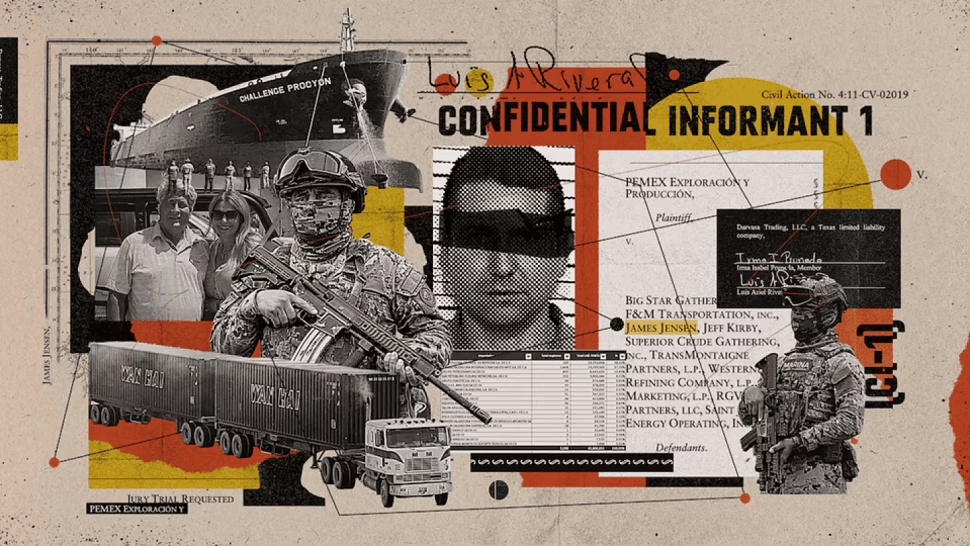
The United States Attorney’s Office bases much of its accusation against oil magnate James Jensen and his family on the testimony of a confidential informant who had already collaborated with justice more than a decade ago. This is Luis Ariel Rivera Rodríguez, a 53-year-old naturalized Mexican-American, owner of the company Luxemborg Trading LLC.

Rivera, identified as CI-1 in court documents, met secretly with prosecutors and agents from the FBI, DEA and Homeland Security in Texas since mid-2024. He recounted how the Jalisco New Generation Cartel (CJNG) participated in the theft of oil from Pemex and its smuggling into the United States.

300 million dollar business

According to the indictment, between 2018 and 2025, around 4,000 shipments of crude oil worth $300 million were trafficked. The fuel was brought into the US disguised as “petroleum distillate” or “used lubricating oil.”

Rivera stated that the CJNG controlled the roads in Mexico and collected extortions. He said he paid $2,000 per tank to operate. He also mentioned that he bribed federal, state and local officials, and that customs intermediaries falsified documents to export crude oil.

A history that repeats itself

Rivera is not new to this type of case. In 2008 he was arrested in an operation against the Gulf Cartel, which then controlled the theft of hydrocarbons in the Burgos Basin. Pemex reported losses of 300 million dollars. Rivera collaborated with the authorities and spent some years in prison until 2013.

At that time, James Jensen was already listed as a buyer of the stolen fuel, linked to companies such as Big Star Gathering LTD. However, Jensen avoided the accusations at the time.

The restaurant trap

In April 2025, Rivera arranged a meeting with James and Maxwell Jensen at a restaurant in Dallas. He had hidden microphones. He spoke about his relationship with the CJNG, mentioned leaders such as El Mencho (who died this year in a Mexican Army operation), El Tanque and Chuy 7, and recalled that President Trump had classified the cartel as a terrorist organization. That conversation supports the accusation that the Jensens knew they were dealing with organized crime.

The Jensens’ defense maintains that Rivera set a trap for them and that they were unaware of the illicit origin of the fuel. But the fact that both were involved in the same criminal plot twenty years ago complicates their version.

James Jensen, his wife Kelly Anne, and their children Maxwell and Zachary were arrested on April 23, 2025. They face charges of smuggling, money laundering, and financing a terrorist organization. The case is being litigated in the Southern District Court of Texas.

Continue reading

Avalanche in China leaves 21 dead and dozens rescued

Authorities confirm 21 victims after an avalanche in Gansu province.

Avalanche in northwest China: 21 dead

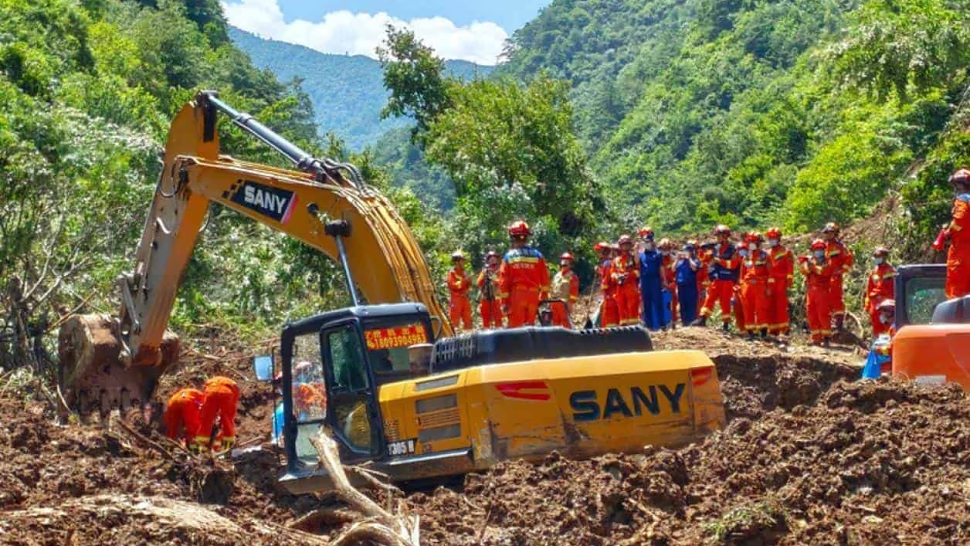
The death toll from a landslide in Longnan, Gansu province, rose to 21 people, according to the official Xinhua agency. The incident occurred on Tuesday minutes before 7 a.m., when an avalanche buried 33 people in the municipality of Nanhe.

Rescue operations concluded early Wednesday morning. State television CCTV reported that all the trapped people were located: 21 dead, seven slightly injured and five unharmed.

Without determined cause

So far, authorities have not specified the origin of the slide. Images broadcast by CCTV show excavators and rescue teams working on mounds of earth under clear skies.

The event occurred in a mountainous region prone to this type of phenomena. Emergency teams acted immediately to care for those affected.

Continue reading

Attacks on oil tankers raise tension in the Strait of Hormuz

Three ships were attacked in the strategic passage. There are no injuries.

Incidents in the Strait of Hormuz

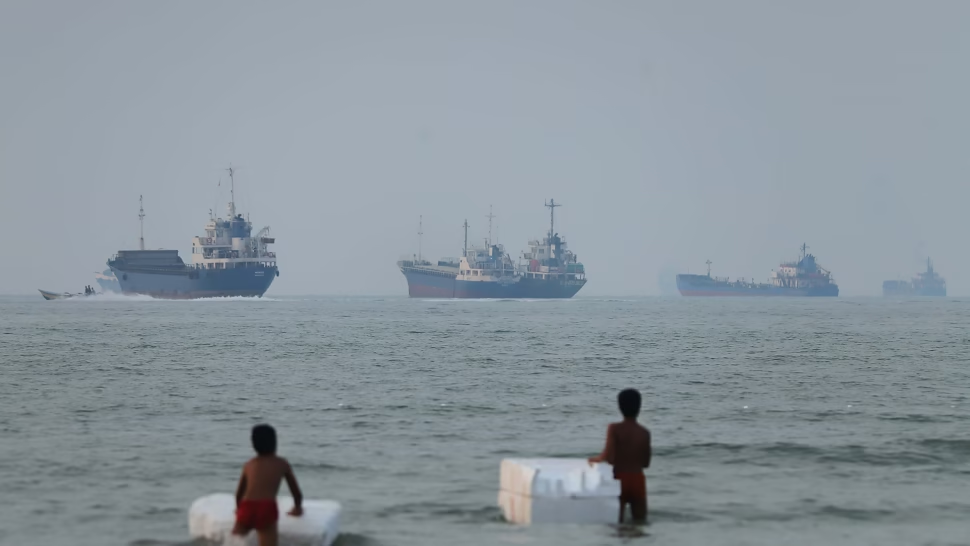
Three oil tankers were attacked this Tuesday in the Strait of Hormuz, one of the most important routes for global hydrocarbon trade, according to the British Army. The events raise regional tension and put maritime traffic at risk in that passage that connects the Persian Gulf with the Gulf of Oman.

The British Maritime Trade Operations Agency detailed that one of the ships, which was transporting liquefied natural gas off the coast of Oman, caught fire after being hit by a projectile. Two other ships were also hit, one of them by a drone. The authorities reported only material damage and confirmed that there were no injuries.

Iranian state television claimed that the gas ship was attacked after ignoring warnings about the shipping route, although Tehran did not officially claim responsibility. For its part, Qatar condemned the attack against one of its oil tankers and held Iran legally responsible, considering that the action violates international law and the safety of navigation.

The attacks occur as the United States seeks to resume negotiations with Iran to normalize transit through the strait, limit Iran’s nuclear program and reach an agreement to end the regional conflict. However, talks remain suspended during the funeral ceremonies for Iranian Supreme Leader Ali Khamenei, who died at the start of the war.

The Strait of Hormuz concentrates under normal conditions about 20% of the oil and natural gas sold in the world. The new incidents revive fears of a military escalation that could affect international markets and stability in the Middle East.

Continue reading