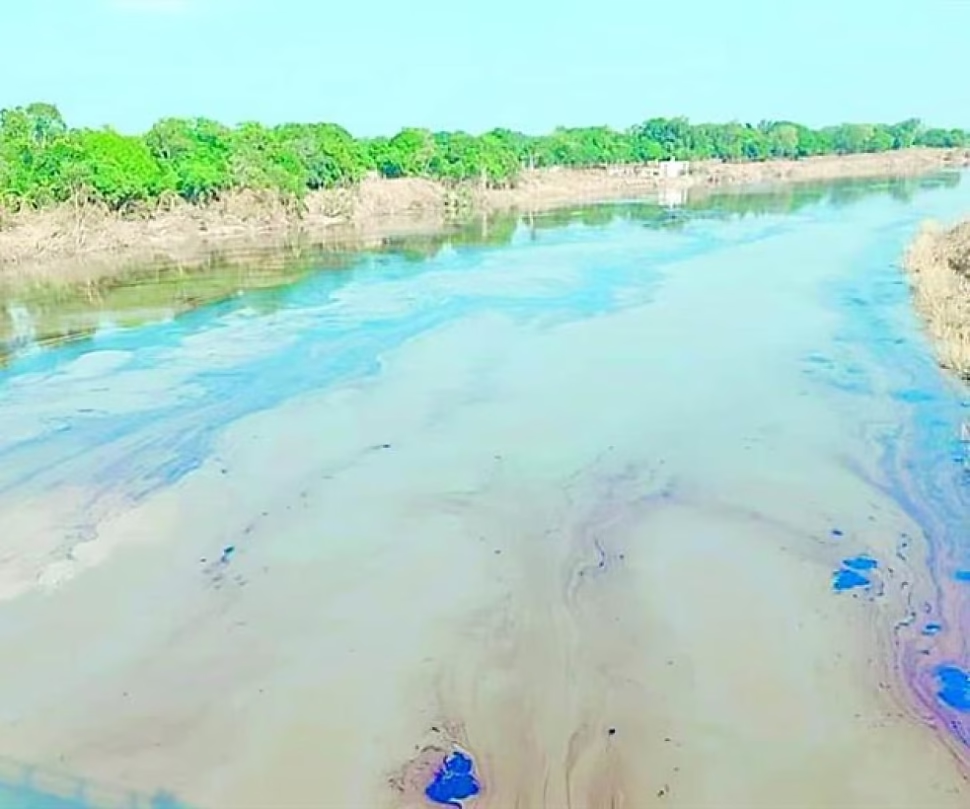
Pemex and its ecological ‘speedrun’: spill, express cleaning and return to work
It seems that at Pemex they took the concept of “express cleaning” too literally. The Mexican state oil company, in a move that reminds us of when you try to delete the history before your friends check your computer, announced this Wednesday that it has already reactivated the operations of an oil pipeline in the southeast of the country. All this after repairing the damage that, surprise, caused a hydrocarbon spill that spread along eight kilometers of the Pantepec River, in the state of Veracruz. The perfect scenario: torrential rains, a river that becomes a conveyor belt for crude oil and a company that acts with the urgency of a person who arrives at the bank one minute before it closes.
The jewel in the crown in this ecological nonsense is that Petróleos Mexicanos (or Pemex, for the folks) did not deign to offer an estimate of the total volume of the spill. Come on, not even close. But they did give us a clue with a partial spoiler flavor: as of Tuesday, they had recovered more than 180,000 liters of hydrocarbon, which is the equivalent of more than 1,132 barrels. To give you an idea, it’s as if all the coffees for life in an office full of millennials with anxiety had been dumped, but in an apocalyptic and toxic version.
The energy company, with a confidence that makes us question our own self-esteem, declared that the pipeline located between the municipalities of Poza Rica and Ixhuatlán de Madero, north of Veracruz, has already “resumed operations safely, in accordance with security protocols.” Because, clearly, the safest thing is to reactivate an oil pipeline that was recently giving away crude oil as if it were a fountain of chocolate in a fondue, but a nightmare.
The script of a disaster foretold (and with rain included)
What exactly happened? Well, the reactivation was agreed upon after repairing the damage to the structure. Details? Zero. Like when you ask “what happened?” after a drama and they only answer “nothing.” The fuel spill strategically coincided with severe flooding caused by torrential rains that affected different regions of Veracruz during the second week of October. A perfect combination of natural disaster and operational failure that sounds like the plot of a disaster movie that no one asked for.
The announcement that everything was returning to “normal” came just one day after Pemex confirmed – yes, after the fact – that the damage to the facility had caused the spill into the Pantepec River, near the municipality of Álamo. Regarding this mishap, the oil company released the classic corporate statement on Wednesday, saying that “it maintains intense cleaning, containment and environmental remediation work” in the area. Specific environmental damage? Exact volume of crude oil released into the ecosystem? Those are questions for adults, and apparently we’re not ready for that conversation.
The operation: when the river sounds, Pemex carries containers
The Pantepec River, which did not ask for prominence in this drama, is about 130 kilometers long. It is born in the mountains of the state of Hidalgo and descends towards the Coastal Plain of Veracruz to end, like a final trailer of the season, in the Gulf of Mexico in front of the municipality of Tuxpan. This waterway supplies water to many communities in the area, which suddenly found that their source of life was topping up with unsolicited hydrocarbons.
To handle the mess, Pemex reported that more than 80 land and river units operate in the area. The toolkit includes a specialized emergency vessel and five boats deployed for tracking, containment and safe access to critical areas. In addition, 48 oleophilic cords (which attract and absorb oily liquids as if they were magnets for disaster), 13 marine barriers and eleven backhoes are in action. Basically the ecological equivalent of trying to dry the ocean with a beach towel, but with heavy machinery.
René Téllez, director of Civil Protection of the municipality of Tuxpan, told The Associated Press that environmental authorities, Pemex and the Ministry of the Navy are working in the river to address the spill that was reported on October 16 and that, according to the company, was controlled three days later. Because in the world of Pemex, a long weekend is enough to control an ecological disaster of epic proportions. The aftermath? These seem to be the problem of the river and the communities that depend on it.
Are you as outraged as we are by this story of “we solve now, we never explain”? Share this note on your social networks and let’s make more people know the real price of “express reactivation”. And if you want to continue exploring more content about the environmental and energy nonsense of our time, be sure to check out our other publications.