From the wheelchair to space on a Jeff Bezos rocket

A paraplegic engineer fulfills her space dream with Blue Origin, challenging limits and redefining accessibility beyond the atmosphere.

From the wheelchair to space on a rocket by Jeff Bezos

Photo: AP Agency.

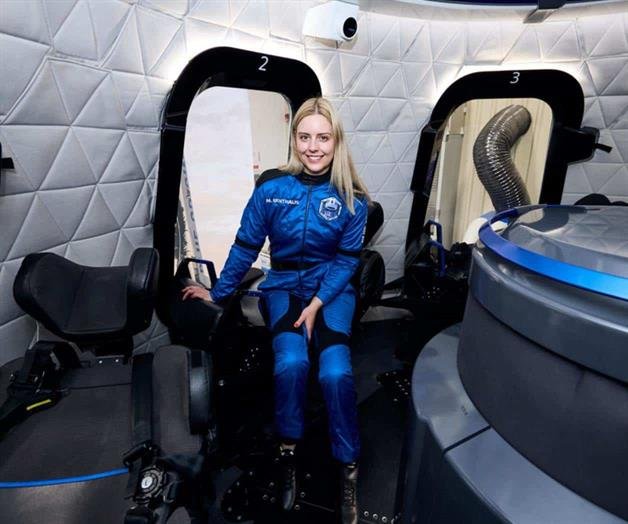
Imagine this: you spend seven years trapped in a wheelchair after a mountain bike accident. Your dream is to float in space, but of course, “there is no history of people with disabilities flying into space,” as you yourself acknowledge. And then what happens? A guy who worked at SpaceX calls you, offers you a ride on Jeff Bezos’ toy rocket, and poof! you become the first wheelchair user to leave the atmosphere. Life, sometimes, has a quite literal sense of humor.

RelatedJeff Bezos and Lauren Sánchez seal their love in a dream wedding in Venice

Michaela Benthaus, a 33-year-old German engineer, laughed “all the way up” during her Saturday suborbital flight with Blue Origin. The New Shepard capsule soared more than 65 miles above West Texas—because what better place to launch rockets than America’s backyard?—and she attempted to stand upside down in weightlessness. “It was the coolest experience,” he declared later. Of course, when you’ve been confined to a chair for seven years, three minutes floating like a balloon must taste like heaven.

Logistics (or how to put a wheelchair in a can)

The funniest thing—or perhaps the most hopeful—is that Blue Origin claims it only required “minor adjustments” to accommodate it. Because yes, the capsule was designed with accessibility in mind. His previous space tourists? People with limited mobility, nonagenarians… come on, the most exclusive and diverse social club in the solar system.

Minor adjustments included:

  • A patient transfer board to slide between the hatch and the seat (space slide anyone?).
  • A mat in the desert after landing for immediate access to your chair (because nothing ruins the moment more than having to crawl through the sand).
  • An elevator on the platform to go up the seven floors to the capsule (fortunately, Bezos didn’t make them take the stairs).

Benthaus had already tested weightlessness in parabolic flights and participated in simulated missions. But when Hans Koenigsmann—the former SpaceX executive who organized and sponsored this—called her last year, he thought it was “a misunderstanding.” Spoiler: it wasn’t. He accepted instantly. Who turns down a free trip to space paid for by a stranger? Only the very prudent.

The business of sleep (and opaque prices)

Here’s the good thing: ticket prices were not revealed. Of course not. Because when you’re the richest man on the planet—or one of them—and you want to send a paraplegic engineer into space for reasons that mix philanthropy, marketing, and whim, the last thing you want is for people to start doing the math. Koenigsmann paid. Blue Origin put the rocket. And everyone happy.

It is a private mission, without the participation of space agencies – although the ESA has a training program where Benthaus participates. Meanwhile, NASA cleared John McFall, a British amputee, for a future flight to the International Space Station. Hateful Comparisons: McFall uses prosthetics and could evacuate himself; Benthaus cannot walk and needed Koenigsmann and an engineer to carry her down “the short flight of stairs” after the flight. But hey, who needs independence when you’re weightless?

“You should never give up on your dreams, right?” Benthaus urged after landing.

Its goal now is to improve accessibility on Earth. Ironic, right? You have to get out into space to be taken seriously about improving the ramps down here. He says that inside “my space bubble” he receives positive comments, but outside it is not always so inclusive. What a surprise.

The flight lasted 10 minutes. Blue Origin’s total list of space travelers rose to 86 people—among executives and investors—because nothing says human advancement like taking millionaires to the edge of space. Bezos founded the company in 2000 and began manned flights in 2021; They are now using larger rockets from Florida and planning lunar modules.

Meanwhile, Michaela Benthaus floated upside down over Texas, contemplating our fragile blue planet from above, literally leaving behind her chair for a few glorious and weightless minutes, perhaps unintentionally demonstrating that the limits are where we decide to put them, even if it costs a fortune and outside help to reach them.


Did this story surprise you? Share it if you believe that dreams should have no limits or gravity. Explore more content about human limits!


How artificial intelligence transforms global security

Motorola Solutions is committed to hybrid models and agentic AI in the transformation of the sector.

Security industry: cloud migration and artificial intelligence

Security is undergoing a profound transformation. The cloud, generative artificial intelligence and video surveillance systems as decision tools are redefining the sector. This was stated by Pedro Simoes, global vice president of video security and analytics at Motorola Solutions.

“The cloud is a very strong trend, but it is not a solution for all sectors,” he explained. Prison facilities, airports and nuclear plants require hybrid models that combine local infrastructure with cloud services. Motorola Solutions is committed to unified platforms.

One of the key advances is agentic artificial intelligence. The company introduced Operator, a platform that integrates video, access controls and sensors in a single interface. The objective: reduce the time between detection and response. “It’s not just identifying. It’s being collaborative in decisions,” said Simoes.

The role of sensors in smart cities

Cameras no longer just record: they are sensors. “Today a camera produces data that can be used to optimize logistics, mobility or business decisions,” he added. Security information extends to multiple applications.

However, the growth of AI poses privacy challenges. Motorola Solutions developed “AI nutrition labels,” documents that detail capabilities and limitations of its models. “We are the first company in the sector to create and use this type of labels,” said Simoes.

Mexico and the 2026 World Cup

Mexico is experiencing a key moment for the 2026 FIFA World Cup. The arrival of millions of visitors is driving investments in technological infrastructure and security in airports, hotels and stadiums. Simoes confirmed collaboration with governments, without revealing details. “Safety is a priority; our responsibility is to develop technology that protects people and infrastructure.”

He recommended organizations think long term: “The decision should not be based only on current problems, but on the challenges of three or five years.” The combination of cloud, generative AI and unified platforms will define the next stage of the sector.

Continue reading

Strawberry Moon: the June full moon will arrive on the 29th

The Strawberry Moon will light up the night sky on June 29. Know its origin and other names.

The night sky will offer a notable astronomical event at the end of June. That month’s Full Moon, known as the Strawberry Moon, will reach its maximum splendor on Monday, June 29, according to the specialized portal Star Walk.

When and how to see it?

The full moon will occur exactly at 5:57 in the afternoon, central Mexico time. It will be the first full Moon after the summer solstice, which according to the same source will happen on Sunday, May 21. The satellite will be fully illuminated from June 28 to 30.

The origin of the name

Despite what its nickname suggests, the Moon does not take on a pinkish or reddish hue. The name “Strawberry Moon” comes from the native North American peoples, who named it that way because it coincided with the harvest season for this fruit in various regions of the continent.

In other cultures, this same full moon receives names such as:

  • Moon of Moras
  • Honeymoon
  • Rose Moon
  • Moon of Ripening Berries
  • Garden Moon
  • Green Corn Moon
  • Windy Moon
  • Birth Moon
  • Moon When the Buffalo Bellows

All of these nicknames are linked to natural phenomena typical of the same time of year.

Continue reading

The oldest plague: remains from 5,500 years ago in Siberia

Traces of plague from 5,500 years ago found in teeth of Siberian hunter-gatherers.

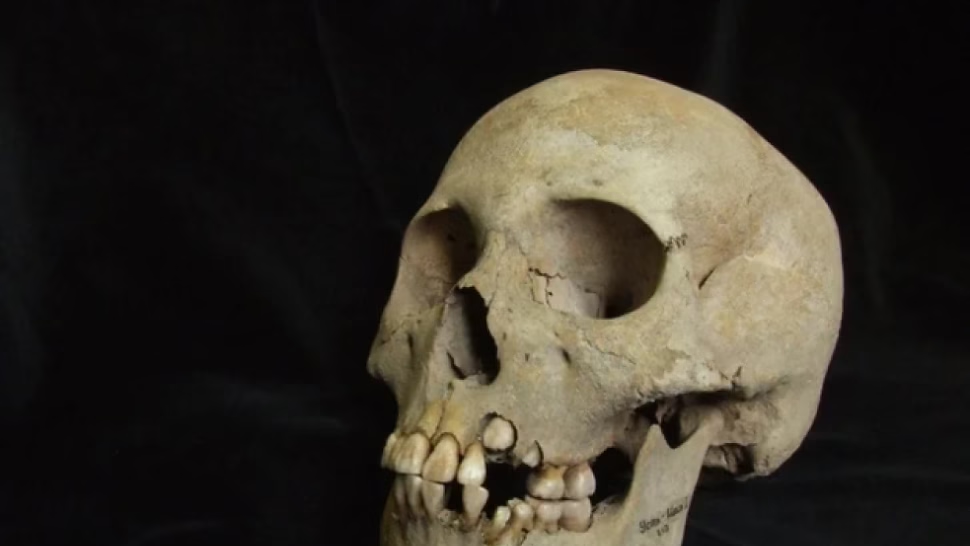
Scientists have identified the earliest evidence of plague known so far: traces of bacterial DNA in the teeth of hunter-gatherers buried near Lake Baikal in Siberia. Carbon dating indicates that the disease caused outbreaks about 5,500 years ago, about 200 years earlier than previously thought.

Finding in Siberia

A team led by geneticist Eske Willerslev of the University of Copenhagen analyzed remains from four cemeteries. They found traces of Yersinia pestis in the teeth of 18 individuals. The dating revealed two episodes of infection.

“To understand our own history, understanding the history of the plague is extremely important,” Willerslev said.

The prehistoric plague spread in stages. According to the authors, it was probably transmitted from marmots—native rodents—when people consumed their raw organs or handled infected skins. It also spread from person to person through coughing or sneezing.

Many of the deceased were children between 8 and 11 years old. Three girls were buried together; two were cousins. An aunt and her nephew were found in another mass grave. “There were people who buried the dead and who knew who they were. It’s a very human element,” said co-author Ruairidh Macleod, an expert in ancient DNA at the University of Oxford.

Implications of the study

The researchers note that children may be at greater risk due to still developing immune systems. The presence of multiple victims suggests that the prehistoric plague caused both isolated cases and outbreaks, said geneticist Aida Andrades Valtueña, from the Max Planck Institute for Evolutionary Anthropology, who was not involved in the study.

This ancient strain evolved long before the bubonic plague responsible for the medieval Black Death. However, there is evidence that earlier plagues were just as serious. The disease not only affected populous cities, but also small nomadic groups.

“Understanding the steps the bacteria took to become the deadly pathogen we know today can provide clues about how pathogens could emerge in the future,” wrote Andrades Valtueña.

The study was published Wednesday in the journal Nature.

Continue reading