Cold front unleashes chaos and isolation in the Hidalgo mountains

The fury of winter isolates communities and unleashes chaos in the Hidalgo mountains, with collapsed infrastructure and imminent risks.

Winter Unleashes its Fury in the Sierra

Like a titan of ice and water, the cold front number 16 has declared war on the land of Hidalgo, plunging the majestic Otomí-Tepehua region into a nightmare of epic proportions. This is not a simple meteorological phenomenon; It is a ruthless force sculpting a dangerous new landscape marked by apocalyptic collapses, infrastructure collapsing like houses of cards, roads turned into death traps and rivers rising with indomitable fury, all under the sinister shadow of a fading electricity, leaving communities in absolute darkness.

The Undersecretary of Civil Protection has launched a warning cry that echoes through the mountains, predicting a battle that will intensify. For the imposing regions of the Sierra Alta, the mysterious Huasteca and the rugged Sierra de Tenango, torrential precipitation is approaching that promises to worsen the terrestrial hell. And as if this were not enough, a silent and icy killer is advancing: a glacial drop in temperatures that could plunge the thermometer to -5 ° C, freezing all hope of an immediate respite.

RelatedTorrential rains leave 31 dead and submerge Poza Rica

A Region on the Edge of the Abyss

Risks are not simple warnings; They are prophecies of a tragedy unfolding in real time. The horizon is painted with devastating floods and treacherous puddles, while the roads transform into ribbons of slippery pavement where visibility is a luxury of the past, buffeted by gusts of wind that challenge any brave soul. The alert is maximum, a desperate call to the population to take refuge, to avoid venturing into the roads that are now rivers of mud and despair, and to never, under any circumstances, try to challenge the current of the rivers or flooded areas.

In the municipality of Tenango de Doriamonstrous landslides have fallen on the critical stretch of Los Ahilares, burying roads and, in a terrifying twist, causing the sinking of a bridge that was an umbilical connecting cord. Localities such as El Aguacate, Huasquilla, Cerro Chiquito, Piedras Negras and El Terreno are not only unstable; They live suspended in a limbo of grave danger, with the earth trembling under the feet of its inhabitants.

The tragedy extends its claws to Huehuetla, where a sentence of isolation has fallen on 20 communities. Since Thursday, they have been completely isolated, prisoners of geography, after the provisional crossing, their last thread of hope after the fall of the original bridge, has also collapsed, sealing their fate.

Infrastructure in Shatters and Communities in the Dark

The region’s road fabric is torn with relentless violence. In the demarcation of Huehuetla, the Huehuetla–Santa María Temascalapa highway has been fatally wounded, with partial damage extending from the height of Huasquilla to the domains of Tenango de Doria. Meanwhile, in San Bartolo Tutotepec, a colossal landslide has cut off the road to Huasquilla, and in Santa Inés, the slopes have vomited stones and earth in a landslide that recalls the fury of nature.

On the Xindho road, the road is dying, showing a structural weakening near the community of San Pedro that has forced the total closure of circulation. And in the darkness of the night, another crisis unfolds: massive blackouts have plunged Tenantitlán, El Seis, Progreso, La Campana and Chicamole into darkness, in the municipality of San Bartolo Tutotepec, leaving its inhabitants fighting not only against the cold and the isolation, but also against darkness.

The situation is critical and the world needs to know it! Share this urgent coverage on your social networks so that the voices of isolated communities are heard and explore more content related to the climate emergencies that are shaping our present.

CRT gives new deadline for registration of prepaid lines

Prepaid cell phone registration is extended: know the dates by digit

The Telecommunications Regulatory Commission (CRT) extended the deadline for prepaid cell phone users to link their line to the CURP. The new deadline is December 31 of this year, but not everyone has the same time: the calendar depends on the last digit of the phone number.

Calendar by digit

According to an official statement, the CRT assigned a specific period between August and December for each line. The objective is to organize the registration and improve the low participation registered until now. The telephone company will be in charge of making the connection once the user presents their documentation.

The process seeks to ensure that all prepaid lines are associated with the name and CURP of the owner. This, according to the CRT, will facilitate the identification of users and strengthen security in the use of telecommunications services. So far, the response has been insufficient, which led to the extension of the deadline.

Users should consult their telephone number to know the exact date on which they must complete the procedure. The CRT recommends not waiting until the last few days and going to your operator in advance.

Continue reading

Sheinbaum highlights record in clean energy and economic rebound

Sheinbaum reports historic growth in renewables and low inflation at 3.55%.

Economy and energy: the president’s announcements

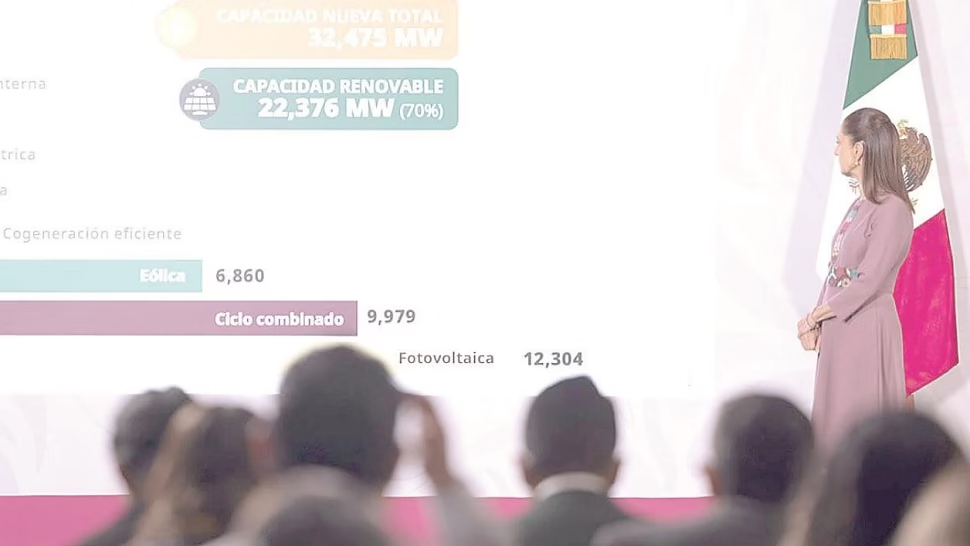
President Claudia Sheinbaum reported that, for the first time, Mexico has projects for 32 thousand megawatts of additional electrical capacity, of which 70% are renewable. “When we leave the government, natural gas consumption will decrease and energy generated by renewable resources will increase,” he stated.

Sheinbaum also highlighted economic growth. According to Inegi, the Global Indicator of Economic Activity (IGAE) rose 1.2% in April compared to March, the best advance since 2021. The annual rate reached 2.2%. The president attributed this to the boost in construction, especially the housing program.

Regarding inflation, the president pointed out that it fell to 3.55% annually in the first half of June, its lowest level since October 2025. This is due, she said, to agreements with gas stations to set maximum fuel prices and the Package Against Inflation and Scarcity (Pacic) to control the basic basket.

Energy transition with 32 thousand megawatts

The Secretary of Energy, Luz Elena González, explained that by 2030 32 thousand megawatts will be added; 22 thousand will be renewable. The goal is for at least 38% of generation to be clean to meet climate commitments. He assured that the CFE will maintain its majority participation, providing 61% of the electricity at the end of the six-year term.

The director of CFE, Emilia Calleja, explained the projects. In Baja California Sur, the Oasis System will combine solar energy, batteries and green hydrogen to supply Mulegé and 40 thousand homes. It includes a 72 megawatt plant, 20 megawatt storage and will produce 120 cubic meters of water per year, avoiding 94 thousand tons of CO2.

In Sonora, the “Rafael Galván” photovoltaic plant in Puerto Peñasco will reach one thousand megawatts of capacity and 246 megawatts of storage. It currently provides 400 megawatts. The investment exceeds 1.4 billion dollars. “They are environmental benefits that strengthen energy sovereignty,” concluded Secretary González.

Continue reading

Controversy over an interview with Monsiváis reaches the Senate and the Palace

The republication of a 1999 interview unleashes accusations between the Executive and legislators.

The republication of an old interview attributed to Carlos Monsiváis climbed to the center of the Mexican political debate this Wednesday. The issue was discussed both in the Senate and in President Claudia Sheinbaum’s morning conference.

The original text was written by journalist Edmundo Cázares in 1999 and recently republished by El Universal. It contains statements about the then head of Government Andrés Manuel López Obrador. Its veracity and context have been questioned, generating conflicting positions.

Sheinbaum describes the content as “grotesque”

During her conference, the president harshly criticized the publication. He described the content as “grotesque” and accused the medium of generating a controversy that distorts the tribute to the Mexican intellectual.

Reactions in the Senate

The issue also reached Congress. Senator Lilly Téllez read fragments of the text on the platform. In response, Gerardo Fernández Noroña rejected its use and maintained that it was a false publication with the intention of political attack.

The exchange reflects the polarization around the figure of López Obrador and the use of historical documents as partisan weapons.

Continue reading