A Country Split in Two: The Battle for the Roads
In a Mexico battered by the fury unleashed from the skies, a figure emerges as a beacon of hope in the midst of the devastation: 335 roads have been reconquered. But this victory, won with sweat and steel, is only part of an epic battle still being fought in the heart of the nation. Until this Sunday, October 19, the official report of the Government of the Republic reveals a heartbreaking reality: 329 routes remain captive to the earth and mud, cutting off the lives of entire communities in five states that groan under the weight of the waters. Hidalgo, Puebla, Querétaro, San Luis Potosí and Veracruz have become the scene of a human and logistical tragedy of Dantesque proportions.
And as the machinery struggles to make way, the human cost rises like a monument to pain. The figures, cold and implacable, freeze the soul: 76 souls lost forever, and an even more terrifying ghost lurks in the uncertainty: 31 unaccounted for people, whose names are a desperate echo in the fog of this catastrophe. Each issue is a universe of truncated dreams, a destroyed family, a life story interrupted by the indifference of nature.
The breakdown of martyrdom paints a map of mourning. Veracruz, the hardest hit entity, mourns 34 dead and cries out for 14 missing people. Hidalgo, with a wounded heart, counts his 22 dead and 12 loved ones whose whereabouts are unknown. Puebla has 19 irrevocable tragedies and 5 voids that scream for answers. Querétaro reports a life taken, while San Luis Potosí, in a sigh of relief in the midst of chaos, registers no human losses, although its territory lies fractured.
Hope Comes with Machinery and Words of Encouragement
In the midst of this apocalyptic landscape, a figure emerges who carries the hope of thousands on her shoulders: President Claudia Sheinbaum Pardo. His voice, transmitted like a message in a bottle through the incommunicated regions, announced a partial but significant triumph: the opening of the road in Huehuetla. It was not a triumphalist announcement, but the promise of a beginning. “The road is already partially open; little by little more machinery will arrive to accelerate the cleaning,” he declared, with the serenity of a general who knows the magnitude of the battle ahead.
His presence in Hidalgo alongside Governor Julio Menchaca was not a mere protocol photo; It was a scene loaded with monumental symbolism. Together, like two commanders on a modern war field, they walked across the wounded land. They monitored progress at Tianguistengo, but their mission went beyond logistics. It was a human mission. “We work in coordination with the state government. They are not alone“, were the words of Sheinbaum, an oath made before a people who look at the sky with fear and the earth with despair.
The journey took them to the depths of the Otomí-Tepehua region and the Sierra Alta de Hidalgo, where they listened, with the ears of their hearts, to the heartbreaking stories of a population that lost everything except faith. There, among rubble and hope, an unbreakable commitment was forged: to continue fighting to open paths that allow aid to be expedited. The Hidalgo government highlighted this pact, a beacon of unity in the storm. Menchaca, for his part, shared the essence of his mission: to talk with the families and supervise the work to “restore peace of mind for the families.” A tranquility that today seems like an unattainable luxury.
The Army of Reconstruction: Figures of a Colossal Management
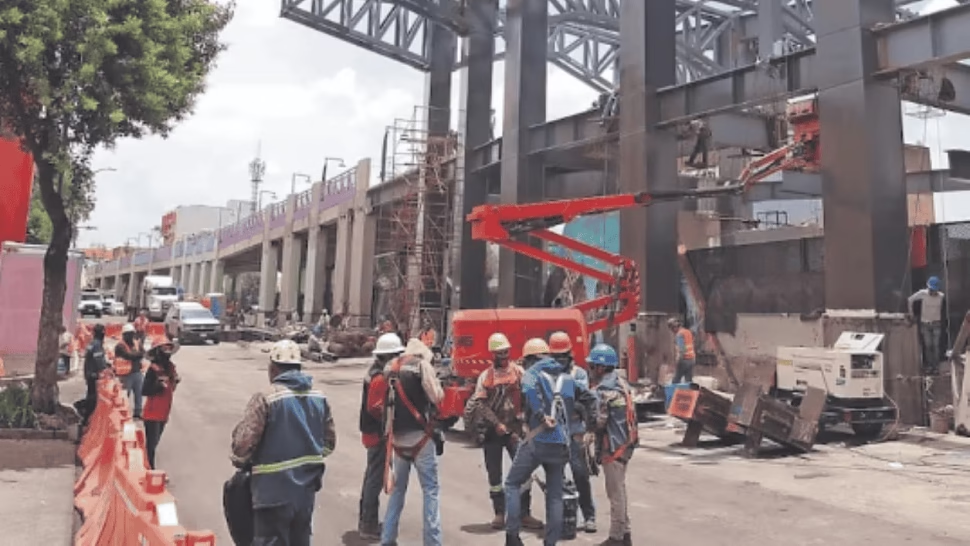
Behind this titanic effort lies the cold and necessary statistics of the operational response. A reconstruction army has been deployed over the mud, a force composed of 155 dedicated machines that roar against adversity, managed by 310 anonymous workers who have become heroes of this story. Their battlefield is 61 simultaneous work fronts, where each shovelful of earth removed is a step towards normality.
The state of the road network is a testimony of the unequal struggle. In addition to the completely cleared roads, there are 90 partially open roads, semi-clogged arteries that demand caution and hope. However, the shadow of the 88 completely closed roads looms as a reminder of how much remains to be done. Infrastructure does not escape drama; 28 bridges have been affected by the fury of the waters, of which 26 have already been thoroughly reviewed, evaluating the damage for their prompt rehabilitation.
This pharaonic deployment is not just a matter of opening routes; It is a race against the clock to bring food, medicine and comfort to those who feel abandoned on islands of despair. It is the materialization of the promise that no Mexican will be left behind. Every open road is a stronger beat for the hearts of these communities, a lifeline that tells them that the outside world has not forgotten them.
The narrative of this tragedy continues to be written with each passing hour. What began as a meteorological event has become a litmus test for national resilience, an examination of the State’s response capacity and the strength of the human spirit. The opening of roads is, in essence, the perfect metaphor for what is really at stake: reconnecting not only territories, but also lives, hopes and the very future of entire regions. The road to full recovery is long and steep, but every meter gained from the mud is an epic victory in the fight to be reborn from the waters.
This story of struggle and solidarity must be known by everyone. Help spread the word by sharing this story on your social networks and explore more content related to national emergency response. Together, we keep hope alive.