Forums on revocation of mandate advance amid accusations of simulation

Discussion over a key accountability mechanism is moving forward in Congress, but faces criticism for its possible lack of substance and transparency.

Analysis of the approval of forums for constitutional reform

In a political context marked by the debate on accountability mechanisms, the Commission on Constitutional Points of the Chamber of Deputies has taken a formal step towards the discussion of a substantial modification. By majority, the members endorsed the holding of four consultation forums aimed at expanding the analysis of the initiative that seeks to reform article 35 of the Political Constitution, specifically in relation to the revocation of mandate figure and the popular consultation. This procedure, however, was born under the shadow of a central claim: the accusation by the opposition groups that it is an exercise in political simulation, lacking clear rules and a genuine will to incorporate citizen voices in the legislative process.

The agreement was supported with 18 votes in favor from the parties Morena, PT and PVEM. Against, six votes were registered, cast by legislators from the PRI, PAN and Movimiento Ciudadano (MC). The initiative under scrutiny was presented by deputy Alfonso Ramírez Cuéllar and seeks to modify sections VIII and IX of the aforementioned constitutional article. It is crucial to understand that revocation of mandate is an instrument of direct democracy that allows citizens, under certain conditions, to decide whether or not an elected representative should conclude his or her position before the legal term. Therefore, any reform in the matter requires meticulous examination and plural debate, given its potential impact on the balance of powers and institutional stability.

RelatedForums on revocation of mandate fuel accusations of simulation

Procedural details and substantive criticism

The approved document, which originally contemplated two sessions and was modified in the debate to expand to four, suffers from a lack of critical specificity. It does not establish specific dates for holding the forums, vaguely stating that the first consultation with specialists would be on Monday, December 8 and leaving the second “with a date and time to be defined.” This ambiguity was the core of the objections. The PAN deputy, Nohemí Luna, argued precisely that it is not possible to accompany an agreement without transparent rules, stressing that open parliaments should not degenerate into mere political scenes where people are heard but not attended to. Their claim emphasizes that citizen participation deserves respect and substance, not action.

As for the structure of the sessions, the agreement stipulates a maximum duration of four hours per forum, segmented into two blocks of two hours each. Up to four speakers or specialists in the subject may participate in each of these blocks. This numerical limitation was another point of friction. The deputy of Citizen Movement, Iraís Reyes, warned that listening to a maximum of four experts per session is restrictive and not very inclusive, which could bias the debate and exclude valuable perspectives, contradicting the spirit of a deep and comprehensive analysis that a reform of this magnitude demands.

From an analytical perspective, this legislative episode reveals a fundamental tension in the democratic reform processes. On the one hand, there is a formal movement to discuss an instrument designed to strengthen citizen control over their rulers. On the other hand, the process itself is questioned due to flaws in its participatory design, generating distrust about whether the final objective is to enrich the legal framework or comply with a protocol procedure. The effectiveness and legitimacy of the revocation of mandate as an institution depend not only on its legal text, but on the perception of integrity and openness in the process that creates or modifies it. The lack of defined dates and limited spaces for exhibitors are, in this sense, variables that can affect the technical quality and political acceptance of the final result.

The way forward? Share this analysis on the mechanisms of participatory democracy on your social networks and explore more content on constitutional reforms and accountability on our site.
PRI accuses Morena of links to organized crime

The PRI leader launches serious accusations against Morena for alleged criminal ties.

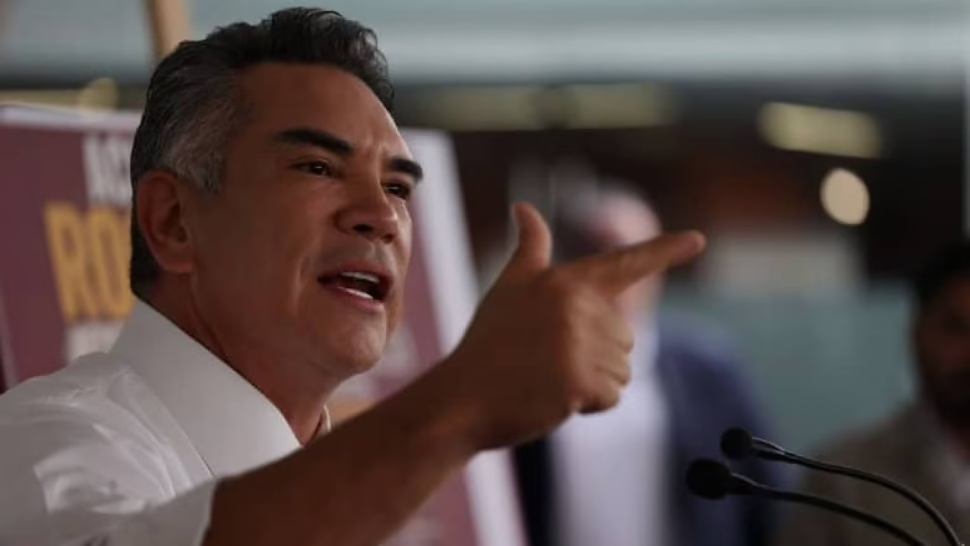
The national leadership of the PRI intensified its attack against Morena by pointing out alleged links of the ruling party with criminal groups and possible investigations in the United States.

Accusations of Alejandro Moreno

During the XLIII Plenary Meeting of COPPPAL, Alejandro Moreno stated that there are elements that could lead to international actions. The PRI leader maintained that Morena could be considered one:

“terrorist organization that finances organized crime”

He pointed out alleged irregularities in electoral processes in Sinaloa, Tamaulipas and Tabasco.

Moreno also mentioned journalistic versions of alleged investigations by US authorities against Morena politicians. He assured that some party actors would be providing information to agencies in that country, which, he said, anticipates new investigations.

The leader stated that for more than five years he has filed complaints in Mexico and before international organizations for alleged illegal acts by Morena officials, including cases of fiscal huachicol and possible links with organized crime. He assured that these complaints are beginning to have repercussions outside the country.

Continue reading

Citlalli Hernández denies apocryphal list about Morena’s process

The Morenista leader called not to spread false information about the internal process.

Morena’s internal process

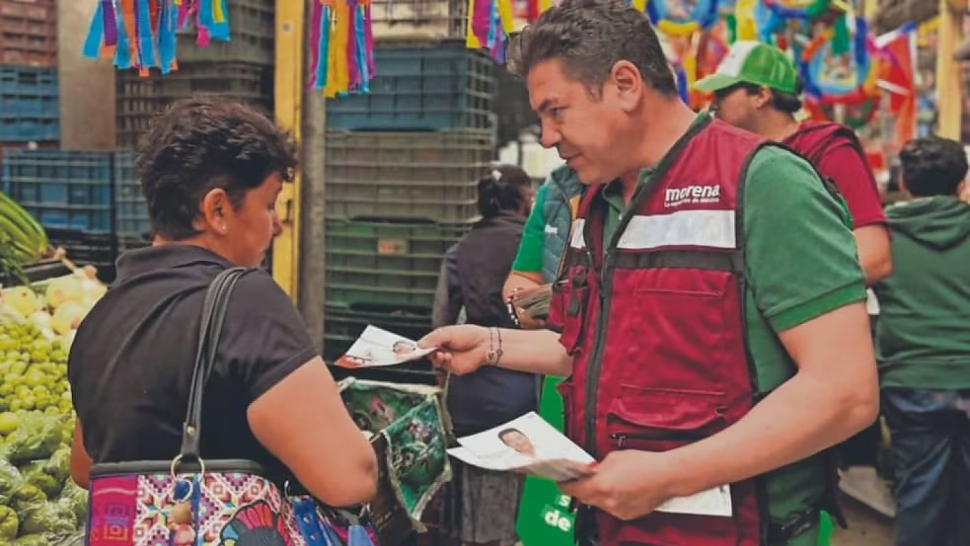
Citlalli Hernández Mora, president of the National Election Commission of Morena, denied the authenticity of a list that circulates on the definition of gender for the State Coordinations for the Defense of Transformation and National Sovereignty. He described the document as false and pointed out that it seeks to generate confusion in the internal process of the party.

Through a video broadcast on social networks, Hernández explained that the list dates back to the previous year and is invalid. He reiterated that all official information will be published exclusively through the party’s channels.

“I call on militancy and sympathizers not to share false information and to remain attentive to official statements,” he stated.

The leader indicated that the applicants will be the first to know the next stages of the process, which will then be made known in a transparent manner.

He highlighted that the movement led by President Claudia Sheinbaum seeks to strengthen new ways of doing politics, with dialogue, unity and respect for internal rules. Morena, he said, will continue to make decisions in accordance with its principles and in favor of the transformation project.

He announced that the National Elections Commission will review in the coming days the compliance with the requirements of the 277 candidates registered for the State Coordinations. In addition, a working table is maintained with the Labor Party and the Green Party to discuss the profiles before announcing the next stages.

Continue reading

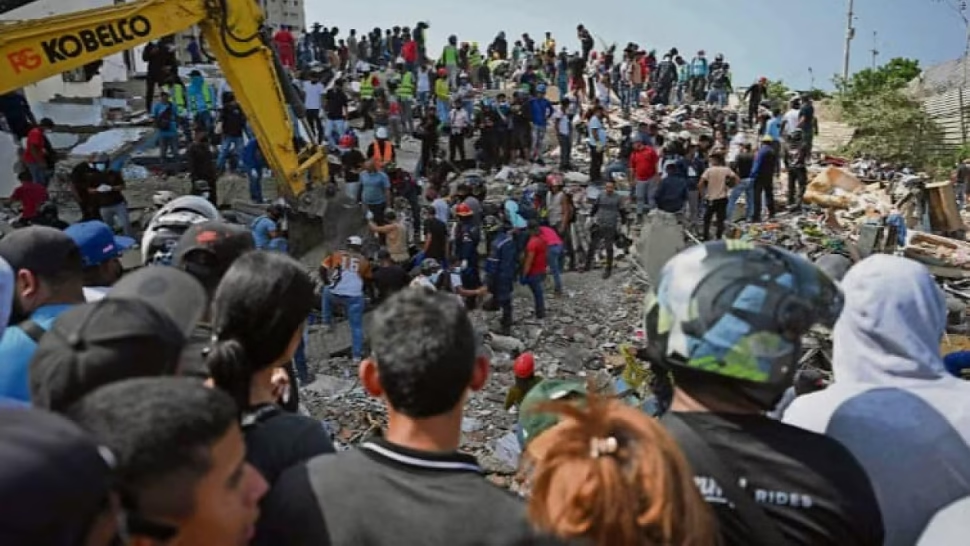
Mexican banks support those affected by earthquakes in Venezuela

Mexican banks activate support after earthquakes in Venezuela: donations and shipments without commission.

Various financial institutions in Mexico have implemented support measures to address the emergency caused by the recent earthquakes in Venezuela. The earthquakes left damage in several communities in the South American country.

Measures of financial institutions

BBVA México reported that, through its foundation, it made an initial donation of one million pesos to the Mexican Red Cross. In addition, it opened an account to receive contributions from the public. Resources will be channeled towards humanitarian aid work once the critical phase is over.

Banco Azteca announced the elimination of commissions on money transfers to Venezuela until July 10. The measure applies without an amount limit through platforms such as Western Union and MoneyGram, both in branches and in its mobile application.

Santander México announced an extraordinary donation to the Mexican Red Cross for the deployment of the USAR rescue group. This team, made up of specialists and canine pairs, is already in Venezuela supporting search and rescue efforts in collapsed structures.

Continue reading