An Experienced Voice Speaks Up for True Inclusion
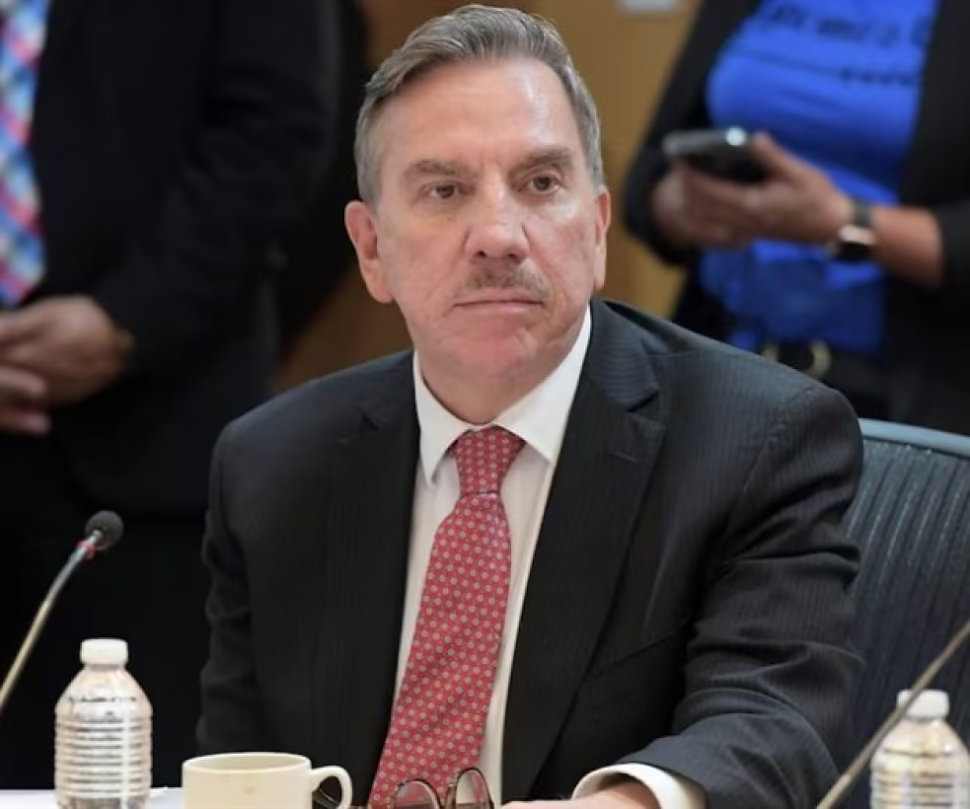
Justice is a lighthouse that should guide us towards a more equitable society for all, and today, a figure of great authority in the legal field invites us to reflect on a crucial step on this path. The retired minister of the Supreme Court of Justice of the Nation (SCJN), Javier Laynez Potisek, has expressed deep concern that resonates strongly. He described as “regressive” a recent resolution of the new Plenary Session that, in theory, seeks to protect the rights of people with disabilities. This assessment prompts us to analyze whether the decisions we make as a collective really build bridges or, inadvertently, raise new walls.
It is a powerful moment to remember that progress is not linear, and that each achievement must be guarded with determination. The essence of this discussion focuses on the social model of disability, a transformative paradigm that the High Court’s resolution of September 22 itself recognizes: disability is not an inherent characteristic of the person, but the result of the physical, attitudinal and social barriers that society erects. What an empowering vision! It places us, as a community, at the center of responsibility for creating a world accessible to all abilities.
From Recognition to Action: The Debate on Prior Consultation
With this basis of understanding, the new Plenary Session acted to correct harmful wording. They invalidated article 3 of Law 817 for people with disabilities of the State of Guerrero because its text presented disability as a condition, something that, the SCJN rightly pointed out, “reinforces stigmas and stereotypes“. This action is, without a doubt, a significant advance that celebrates the dignity of each individual. However, it is in the practical application where the debate that Laynez Potisek puts on the table arises.
The heart of the controversy beats around the right of consultation. The retired minister observes that the new Plenary Session is outlining a fundamental change in criteria. The new position proposes limiting the cases in which violations of this right can be reviewed ex officio by the Plenary. The argument is to give a “more leading role in the challenge” to people with disabilities. Sounds good, right? It seems empowering. But Laynez Potisek wisely warns us: this apparent power may, in reality, be a disproportionate burden.
Imagine for a moment having to constantly fight for a right that was precisely created to recognize the asymmetries you face. The position of the new Judiciary, from this perspective, is seen as regressive because, in the words of the former minister, “it imposes on people with disabilities the burden of defending for themselves a right that precisely recognizes the asymmetries that cross them“. It’s like asking someone to lift a heavy barrier with their own hands, when the collective purpose should be to remove that barrier forever.
Experience teaches us invaluable lessons. Laynez Potisek defends the “informal intervention” of the Court as an elementary principle of justice. “The practice of the Court declaring violations without waiting for the groups to assume that burden is based on an elementary principle: without unofficial intervention, inequality is reproduced,” he said. This proactive vision is a driver of change; It is the most powerful institution in the country extending its hand to preventively correct injustices, ensuring that equality is not just a concept, but a tangible reality.
For its part, the current SCJN maintains that its new criterion on prior consultation is balanced. They affirm that the right to consultation will now be analyzed when requested by the person challenging, without this meaning automatically annulling regulations that may favor the inclusion and well-being of this population group. They seek, in essence, a more case-by-case examination. This dialogue between two legitimate perspectives is the lifeblood of a vibrant democracy. It challenges us to find the exact point where individual empowerment and institutional protection meet to create truly robust and inclusive justice.
This moment is a call to collective conscience. It invites us to ask ourselves: how can we be more effective allies? How do we ensure that the judicial system not only proclaims rights, but also activates the most effective mechanisms to guarantee them? The transformation towards total inclusion requires critical and loving views like that of Minister Laynez Potisek, who encourage us not to settle and to continue building, together, a future where no one is left behind. Every step, every debate, every decision counts. Let’s keep moving forward!
Are you passionate about building a more just and inclusive society?Share this analysis on your social networks to amplify this crucial conversation and explore together more content that drives positive change.