Federal court rules Trump’s birthright citizenship order unconstitutional

A federal court rejects the controversial measure that sought to alter a historic constitutional right.

Court ruling blocks attempt to modify the 14th Amendment

A three-judge panel of the 9th Federal Court of Appeals ratified this Wednesday the unconstitutionality of former President Donald Trump’s executive order, which sought to eliminate birthright citizenship for children of undocumented or temporary migrants. The decision, by a 2-1 vote, upholds the previous blocking issued by a lower court in Seattle, thus strengthening the protection of this right enshrined in the Citizenship Clause of the 14th Amendment.

Legal context and key arguments

The dispute revolves around the interpretation of the phrase “subject to the jurisdiction of the United States” in the 14th Amendment. While the Justice Department under Trump argued that this excluded children of irregular migrants, the plaintiff states—Washington, Arizona, Illinois and Oregon—cited the precedent ofUnited States v. Wong Kim Ark(1898), where the Supreme Court established that the place of birth determines citizenship, regardless of the immigration status of the parents.

RelatedTrump challenges birthright citizenship in Supreme Court

Judges Michael Hawkins and Ronald Gould, appointed by Bill Clinton, emphasized that the national injunction was necessary to avoid “a patchwork of conflicting laws” between states. In contrast, Judge Patrick Bumatay, nominated by Trump, disagreed by questioning the states’ active standing, although he avoided ruling on the merits of the case.

Implications and next steps

This ruling brings the issue closer to potential review by the Supreme Court, which in recent years has limited the scope of national precautionary measures. However, the majority of the 9th Circuit determined that this case meets the permitted exceptions, given the interstate impact and the need for legal uniformity.

The decision temporarily preserves the status quo while litigation continues, but underscores judicial resistance to unilateral modifications of constitutional rights. Experts in immigration law highlight that, if Trump’s interpretation were successful, a class of “generational stateless people” would have been created, violating international human rights principles.

Are you interested in the impact of this ruling on immigration policies? Share this analysis on your social networks and explore more content on constitutional rights in our dedicated section.

Share this analysis on Twitter or Facebook to encourage informed debate. If you want to delve deeper into legal topics, visit our archive of historical cases of the Supreme Court.

Sheinbaum receives Felipe VI at the National Palace on June 25

Sheinbaum will meet with King Felipe VI amid previous diplomatic tensions.

Bilateral meeting at the National Palace

President Claudia Sheinbaum confirmed that next Thursday, June 25, she will meet with King Felipe VI of Spain. The event is scheduled for 4:00 p.m. at the National Palace, taking advantage of the monarch’s visit to Mexico for the 2026 World Cup. The following Friday, the king will attend the Spain-Uruguay match in Guadalajara.

The meeting occurs after years of diplomatic tensions. During the six-year term of Andrés Manuel López Obrador, the relationship cooled due to the demand for a public apology for the grievances of the Conquest. This generated distance with the Royal House and the Spanish government.

Approach signs

With the new government, efforts have been made to maintain institutional dialogue. Sheinbaum had already taken steps in that direction: at the end of April he carried out official activities in Barcelona and expressed his willingness to build a relationship based on mutual respect.

The meeting with Felipe VI reinforces that line. Both leaders will address issues of common interest, without a specific agenda having been leaked. The meeting is seen as a gesture of diplomatic normalization between both nations.

Continue reading

Vance reports progress in negotiations with Iran in Switzerland

Progress in dialogue between Washington and Tehran due to crisis in the Middle East.

Diplomatic advances in Switzerland

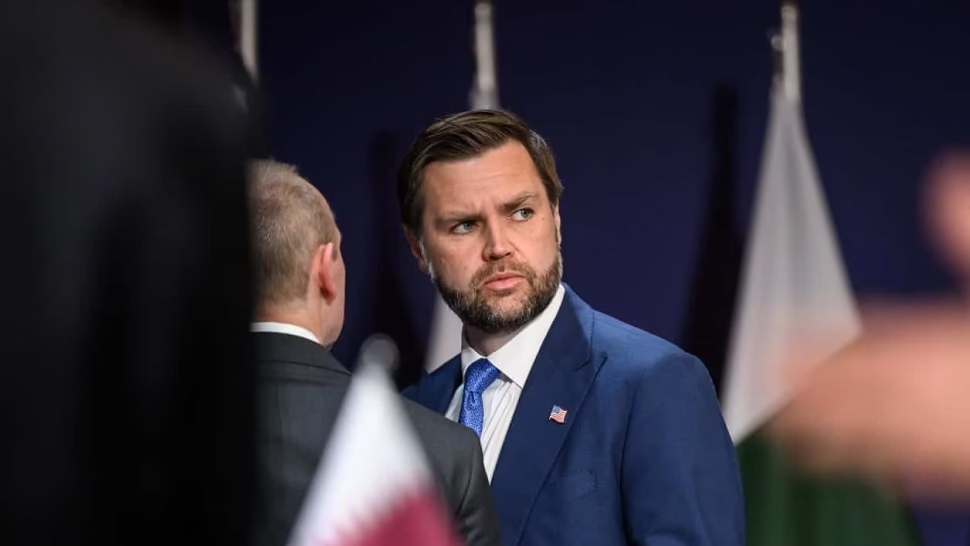
The Vice President of the United States, JD Vance, affirmed that the talks with Iranian representatives in the Bürgenstock complex, Switzerland, achieved relevant progress. According to Vance, the foundations were laid for an agreement that would reduce tensions in the Middle East.

During the meeting – which also included mediators from Pakistan and Qatar – two key issues were addressed: the reopening of the Strait of Hormuz and the conflict between Israel and Hezbollah in southern Lebanon.

The Strait of Hormuz, a strategic route for global oil transportation, had been closed by Iran after attacks by the United States and Israel. This skyrocketed international fuel prices. Although some ships have resumed transit, the main route still faces safety risks.

As part of the process, the US Treasury Department issued a temporary license allowing exceptions to sanctions related to Iranian oil. Technical talks will continue over the next 60 days.

The mediators indicated that there was progress in maintaining a ceasefire in Lebanon, but differences persist over the Iranian nuclear program and other key points of the agreement that Washington and Tehran seek to finalize.

Continue reading

Leo XIV criticizes the ease of financing wars and not hunger

The pontiff warned about the drop in financing for food assistance from 2022.

Call from the pontiff in the face of the food crisis

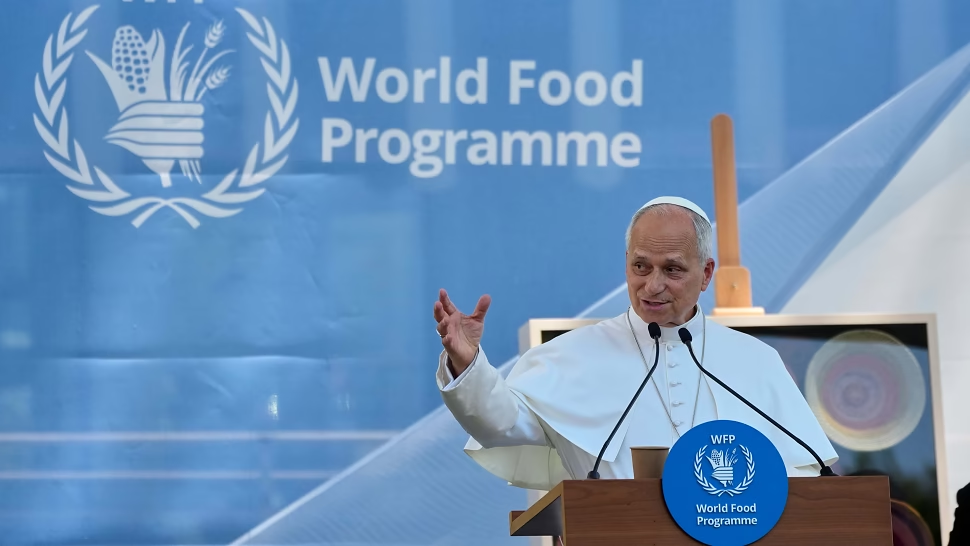
Pope Leo XIV urged governments to allocate more resources to combat hunger. During a meeting in Rome with the UN World Food Program (WFP), he pointed out that it is easier to finance armed conflicts than to guarantee food for millions of people in vulnerable situations.

The pontiff warned that political and administrative obstacles delay humanitarian aid. In contrast, military spending is advancing with fewer obstacles. This paradox reflects a serious inequality in global priorities.

Leo XIV indicated that funding for food assistance has decreased considerably since 2022. Although needs increased due to conflicts, climate crises and economic problems, funds did not grow at the same pace.

He highlighted that recent international contributions, such as the one announced by the United States for the WFP, will benefit millions of people. However, he stressed that there is still a significant gap to cover the necessary resources.

Before the UN body, the pope called on world leaders to place human dignity at the center of their decisions. Strengthening international cooperation is key to confronting hunger and inequality.

Continue reading