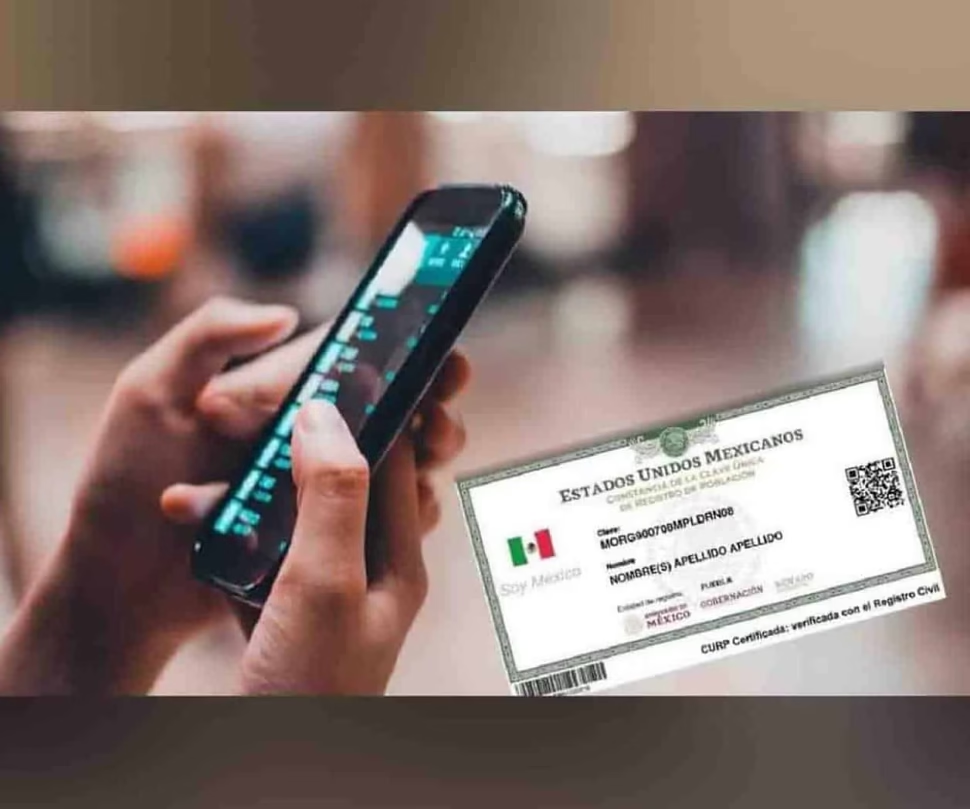
Extension of deadline to register cell phones: the risks of not doing so

The extension to register mobile lines exposes risks due to number reassignment; Experts recommend updating accounts.

The extension of the period to register mobile telephone lines provides a new opportunity for users to regularize their situation and avoid problems related to the reassignment of numbers, a common practice in telecommunications that can affect access to digital accounts.

According to the cybersecurity firm ESET, the main risk is not in the linking process, but when a user stops using a number that is still associated with banking services, emails, social networks or messaging applications.

RelatedThe five most dangerous Trojans for Android devices

Why is it important to register the number?

The Telecommunications Regulatory Commission (CRT) reports 63 million linked mobile lines, of which 40.2 million are prepaid and 22.8 million postpaid.

David González, computer security researcher at ESET, pointed out that mandatory registration does not represent a direct danger. “The real focus is on the possible reassignment of a number to another person, a common practice that can have implications if the number remains associated with digital accounts of the previous owner,” he explained.

Number reuse allows operators to optimize numbering resources. When a line is inactive for a certain amount of time, it can be recovered and assigned to a new user. That new owner could receive messages, verification codes or calls directed to the previous owner. Although it does not grant automatic access to accounts, it can cause difficulties in recovering access or updating data.

Recommendations to protect your accounts

“The scenario can lead to calls, messages and notifications addressed to the previous owner, exposing users and companies to operational risks,” González said.

ESET recommends keeping the line active, updating contact information when changing numbers and periodically reviewing which accounts are still linked to the cell phone. It also suggests using multi-factor authentication with specialized apps to reduce reliance on SMS messages as the sole verification mechanism.


Government defends forgiveness to Spain in indigenous law

The government defends pardoning Spain as a pillar of the new indigenous law to combat racism.

Forgiveness and multiculturalism: keys to the new indigenous law

Within the framework of the presentation of the General Law on the Rights of Indigenous and Afro-Mexican Peoples, the federal government insisted on the importance of historic forgiveness towards Spain. During the morning conference at the National Palace, King Felipe VI was recognized for his statements about the abuses during the Conquest.

“Forgiveness magnifies the people. The most important thing for Mexico is the identity that the recognition of the people represents,” stated official spokespersons.

The discussion focused on the need to overcome a Eurocentric vision. The authorities pointed out that without this change, racism and classism will continue to be promoted.

“If we do not recognize the vision of the great civilizations and the value that the people have given to the collective identity of Mexico, we will continue to promote racism and classism,” they warned.

After 300 years of colony and 200 years of independence, 20% of the Mexican population identifies as indigenous. The government called for recognizing this multiculturalism as part of the national identity.

The law seeks to guarantee rights and combat the structural discrimination that these communities still face.

Continue reading

Army and police, the institutions that generate the most trust in Mexico

The OECD reveals that Mexicans trust the armed forces and police more than the government.

Trust in institutions: Mexico’s ranking

The Organization for Economic Cooperation and Development (OECD) published a survey on the factors that determine trust in public institutions, carried out in 36 countries. In Mexico, the three institutions that generate the most trust are the armed forces, international organizations and the police.

The study details that the population trusts the Army and the police more than the Judiciary and the federal government. On the overall scale, the national civil service ranks fourth, followed by the regional civil service, the national government, the media, the Court and the Judiciary, state governments, local authorities, Congress and, lastly, political parties.

A particularity detected by the OECD in Mexico, Japan, Korea and the Slovak Republic: trust in legislators increases among the population with a lower educational level. On the other hand, citizens with university or postgraduate studies show less credibility towards their congress.

Main concerns

For Mexicans, crime or violence, inflation and corruption are the biggest concerns. They are followed by employment, health services, inequality, housing, climate change, national security and migration. At a global level, the OECD average places inflation as the main concern, then crime and inequality, while corruption is in ninth place.

Satisfaction with public services

Mexico surpassed the OECD satisfaction average in education: 66% compared to 60%. In health it tied with 54%. Additionally, 72% of Mexicans who recently completed an administrative procedure reported being satisfied, exceeding the 68% average for the organization.

“In the midst of economic, sociodemographic and technological transformations and with limited fiscal space, democratic governments face challenges in meeting people’s growing expectations and needs. A healthy level of trust in public institutions is essential to implement reforms,” ​​the OECD concluded, warning that government actions are limited by slow internal processes and difficulties in reaching consensus.

Continue reading

UNAM academic denounces violence by her husband, former director of Pemex

Nuclear engineer denounces attacks by her husband, former director of Pemex, and points out a network of silence.

Complaint for domestic violence

María Felicia Jiménez Lavie, a UNAM professor and nuclear engineer, made public her complaint for physical, economic and psychological attacks allegedly committed by her husband, Víctor Rodríguez Padilla, former director of Pemex. In an interview, he reported that the episodes of violence occurred on three occasions, the most recent being the most intense. A video spread on social networks shows Rodríguez Padilla hitting her and pushing her in the presence of a minor.

“This was the third episode, the strongest of all, but this as such was not recurring. This occurred only three times, the first being in 2022,” he declared.

Censorship after the complaint

Jiménez Lavie assured that, after publishing the evidence, she was subject to censorship to silence her. He stated that they canceled his account on

“Yes, I am afraid of him, of his influences, of all the people who support him in silence, because all this blocking my networks has not been done by him alone, he has done it with a support network,” he expressed.

The academic contradicted the Ministry of Energy, which stated that Rodríguez Padilla had not formally joined the INEEL. Jiménez Lavie pointed out that on June 3, the institute itself publicly welcomed him as general director. In the family sphere, although they are still married, they stopped living together in March; He accused the former official of exercising psychological violence against his eldest son and of neglecting the youngest son they have in common.

Support from the Women’s Secretariat

The Women’s Secretariat contacted the complainant to offer legal and psychological guidance, although it still does not have security measures. This Monday, through a letter addressed to journalist Azucena Uresti, Jiménez Lavie described his complaint as an act of courage to protect his children and called on the population to report any form of harassment or violence.

Continue reading