The SAT clarifies that its personnel will not carry weapons in daily functions

The organization clarifies its position regarding the controversial reform, highlighting that its staff will not use weapons in daily tasks.

The SAT reaffirms its commitment to security and transparency

Attention, community! Today we bring news that clarifies a crucial issue for everyone’s peace of mind. The Tax Administration Service (SAT) has issued a forceful statement: its administrative staffdoes not and will not carry weapons in their daily work. Why is it important? Because it shows that the institution prioritizes security from ethics and the legal framework. This is how you build trust!

Key details about the reform and its impact

In the midst of the debate over the reform to the Federal Firearms and Explosives Law, approved in April, the SAT distances itself from misinterpretations. The agency clarifies that the regulations do not authorize its employees to carry weapons to perform their duties. The reason? Only organizations with a collective license from the Secretariat of National Defense (Sedena) can use them in public security tasks, and the SAT only has permission for protection of facilities under the modality of private security. Precision that avoids confusion!

RelatedWeapons law reform expands permits and reinforces controls in Mexico

But there is more: the reform, promoted on “fast track” by the Senate, allows workers from public companies such as CFE, Pemex or Banxico to carry weapons if they prove necessary. However, the SAT emphasizes that its operational team does not fall into this category. An example of how institutions should communicate clearly!

What does this mean for society?

This clarification not only reinforces the transparency of the SAT, but also invites us to reflect on the balance between security and regulation. The reform includes provisions for ejidatarios and rural community members, who may possess low-caliber weapons in non-urban areas. Meanwhile, federal public security operational personnel will be able to use automatic weapons with strict supervision. Every regulation must seek to protect without violating rights!

The key message? Laws evolve, but institutions must act responsibly. The SAT demonstrates that its priority is to serve without resorting to measures that generate distrust. A step forward in the construction of a safer and more transparent Mexico!

Would you like to learn more about how public policies impact your life? Share this information and let’s continue talking about topics that shape our future. Together we can build a better informed society! #SecurityWithTransparency #SAT

🚀 Explore more content on legislation and social transformation on our networks. Share to reach more people!
Imports of Mexican cattle to the US resume

Following a health agreement, the US will reopen the port of Douglas, Arizona, for Mexican cattle.

President Claudia Sheinbaum reported that the United States will resume importing Mexican cattle starting the last week of August. The decision came after an official communication from the US Secretary of Agriculture, Brooke Rollins.

Reopening schedule

The reopening will begin at the border port of Agua Prieta, Sonora, linked to the Douglas crossing, Arizona. August 24 will be the first date of operation. Later, two additional points will be enabled in Chihuahua, subject to compliance with the Joint Action Plan against screwworm.

Sheinbaum instructed federal agencies to accelerate coordination with US authorities. He highlighted the work of the Secretary of Agriculture, Julio Berdegué, and the director of Senasica, Columba López, to strengthen health measures.

  • The animals will enter with complete inspections to verify that they do not show signs of the plague.
  • Later, the opening of the ports of Santa Teresa and Columbus, in New Mexico, will be evaluated.

The president described the news as positive for Mexican ranchers, who for months contained the spread of the screwworm. He appreciated Rollins’ willingness to maintain an institutional relationship.

Rollins, for his part, stated that the protection of the US livestock industry remains a priority and that the temporary closure of crossings was necessary to reduce risks. The reopening is possible thanks to binational collaboration.

Continue reading

More than eight million apocryphal cigarettes seized in Manzanillo

Joint operation in Manzanillo detected shipment of counterfeit cigarettes.

Operational in the port of Manzanillo

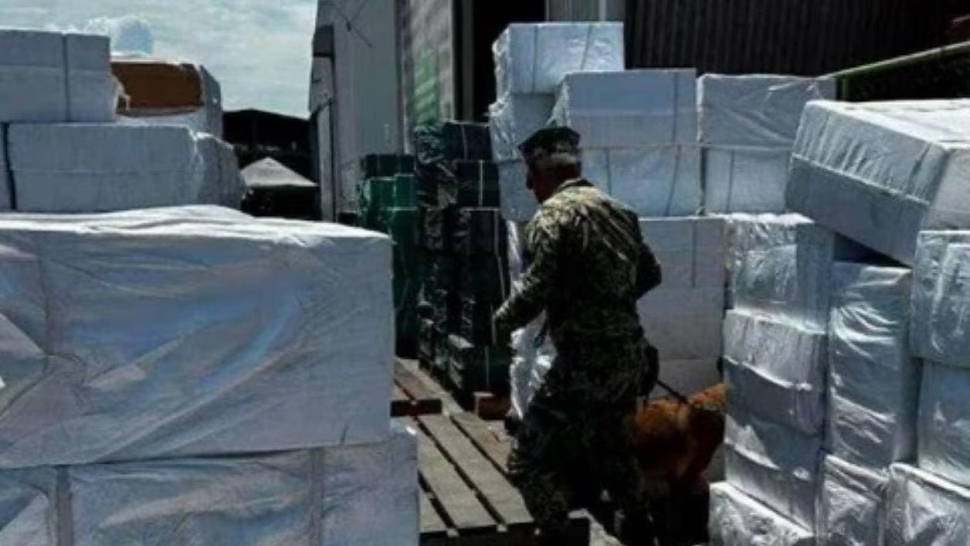
Federal authorities seized more than eight million allegedly apocryphal cigarettes in the port of Manzanillo, Colima. The operation was coordinated by agencies of the security cabinet and the National Customs Agency of Mexico (ANAM).

Personnel from the ANAM and the Administrative Unit of the Manzanillo Customs detected inconsistencies in an operation to import cigarettes from abroad. This led to a specialized review.

As a result of the inspections, the authorities located 8 million 436 presumably counterfeit cigarettes. The merchandise was insured with the support of the Secretary of the Navy (Semar).

The ANAM reported that this type of operations are part of the permanent mechanisms of operational intelligence, risk management and strategic analysis. The objective is to strengthen security in foreign trade operations and detect documentary irregularities or goods of illicit origin.

The comprehensive analysis of the operation made it possible to reinforce documentary traceability, operational review and validation of commercial profiles. The authorities maintain surveillance at entry points into the country to combat illegal trade.

Continue reading

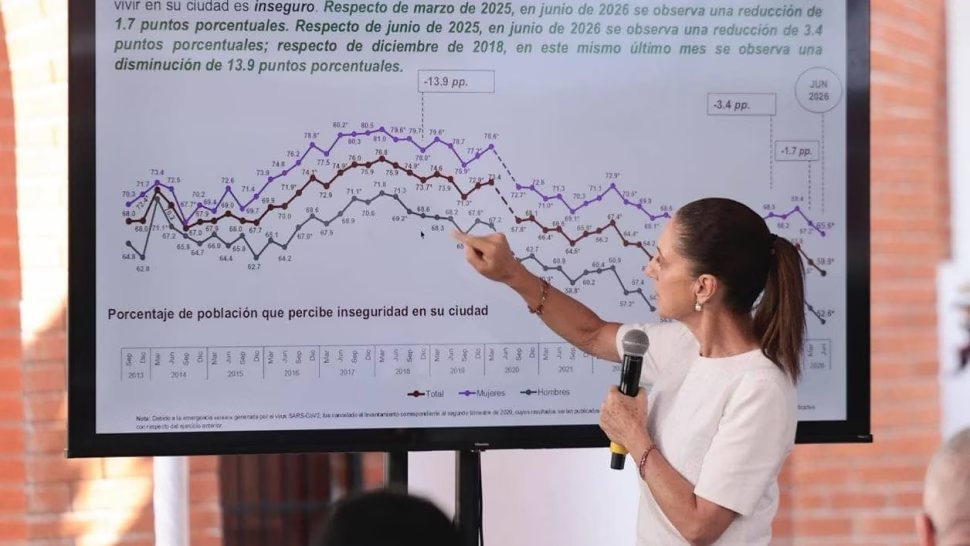
Perception of insecurity drops to 59.8%: Sheinbaum

Perception of insecurity in Mexico drops to 59.8%, the lowest figure since 2018.

ENSU results

President Claudia Sheinbaum reported that the perception of insecurity in urban areas fell to 59.8% in June 2026, according to the National Urban Public Security Survey (ENSU) of the INEGI. In December 2025 it was 63.8%, which represents six consecutive months of decline.

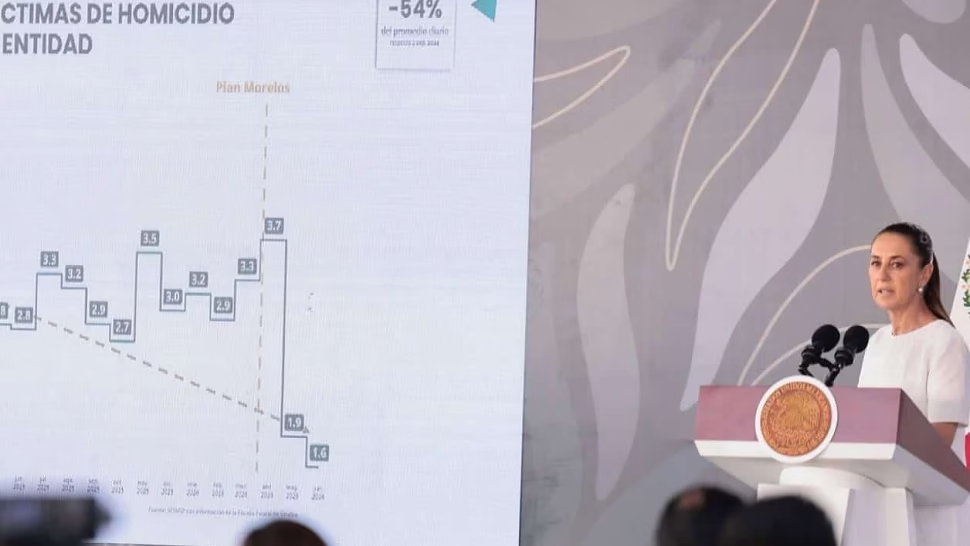
“The important thing here is that we are giving results in the security indicators and people are beginning to notice this decrease,” he said during the morning conference in Cuernavaca, Morelos.

Historical comparison

Sheinbaum recalled that in December 2018, under the government of Andrés Manuel López Obrador, the perception of insecurity was 73.7%. The previous lowest point was reached in September 2024 at 58.6%. The president attributed the improvement to the National Security Strategy.

The ENSU measures citizens’ feeling of insecurity in their environment. Recent data reflects a positive trend, although the challenge remains to maintain the reduction in crime. The authorities continue to implement actions to consolidate these results.

Continue reading