The Cuban model is crumbling in the midst of a general crisis

The Cuban health system, once a world model, faces an almost total collapse. The crisis extends to education, security and the economy.

The other side of socialist paradise

What was once an example for the WHO is today a shadow. In offices like Dr. Omitsa Valdés’, patients arrive with their own medicines and syringes. Basic exams are impossible due to lack of reagents.

Constant blackouts complete the picture of a health system on the brink of the abyss. But this is just the tip of the iceberg.

RelatedFloods threaten to reverse progress against poverty

When everything fails at once

Education also creaks. Universities temporarily closed, scholarships cut, schools without electricity. Public transportation is a memory on many streets.

The figures hurt: seven out of every ten Cubans live in extreme poverty. Salaries are not enough. Between 2022 and 2024, the population fell from 11 to 8.5 million.

Meanwhile, the machinery of control continues to function. Activists such as Kamil Zayas Pérez and Ernesto Ricardo Medina have been arrested for denouncing irregularities.

Neighbors like Yanet Rodríguez Sánchez live under constant surveillance. The police have limited resources for citizen security, but they always find patrols to repress dissidents.

Even tourism – that economic pillar – is faltering. In Varadero, half-empty hotels and businesses desperate for fuel. Airlines cancel flights, internal transportation is a lottery.

Gasoline is so scarce that it limits all economic activity. People survive on minimal rations and subsidized products that are never enough.

“Patients should bring their own medications and syringes”

“Seven out of ten Cubans live in extreme poverty”

The result is a toxic cocktail: health collapse + blackouts + repression + shortages = generalized hopelessness.

Endless lines for food, electricity that goes out without warning, growing insecurity and a future that gets darker every day. The government prioritizes control over solutions.

And so, while the official narratives speak of resistance and victories, more than garbage accumulates on the streets of Havana.
Navy ships arrive in Venezuela with humanitarian aid

Mexico delivers 388 tons of aid to Venezuela after earthquakes in June.

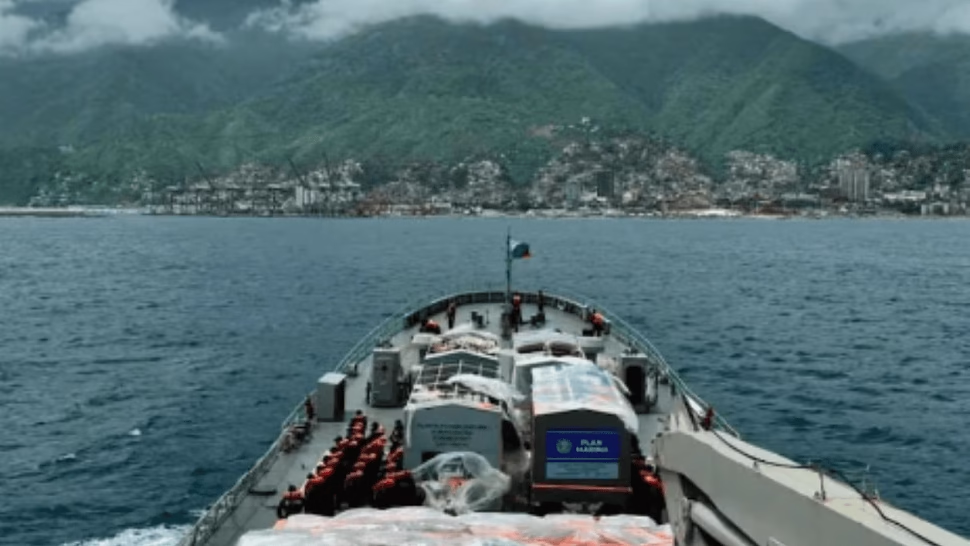
The ARM Isla Holbox and ARM Huasteco ships docked at the port of La Guaira, Venezuela, after eight days of navigation. The mission, ordered by President Claudia Sheinbaum, aims to deliver humanitarian assistance to the Venezuelan people affected by the earthquakes of June 24.

Load and capacity

The journey of 1,969 nautical miles (more than 3,600 kilometers) transported 388.4 tons of supplies. It includes food, bottled water, hygiene items, medicines and four water treatment plants capable of producing a thousand liters of purified water per hour each.

Personnel and coordination

One hundred elements of the Navy’s Emergency Response Brigades (BRE) will participate in the landing, installation and operation of the plants. They will also support the organization and distribution of aid, in coordination with Venezuelan authorities.

The Secretary of the Navy (Semar) indicated that, although the immediate care phase has already been overcome, recovery efforts continue to restore essential services. The help sent seeks to strengthen that stage.

This operation was possible thanks to the joint work between Semar, the Foreign Ministry, institutions, companies, foundations and civil organizations. The federal government reiterated its commitment to international solidarity and the construction of a more resilient region in the face of natural disasters.

Continue reading

Venezuela raises the death toll from the June earthquakes to 4,561

Official figure amounts to 4,561 deaths after the June earthquakes in Venezuela.

The Venezuelan authorities updated this Monday the death toll after the two earthquakes on June 24. The new report, released by Jorge Rodríguez, president of the National Assembly, indicates that 4,561 fatalities have been recorded. The number of injured has remained at 16,740 for a week.

Disaster data

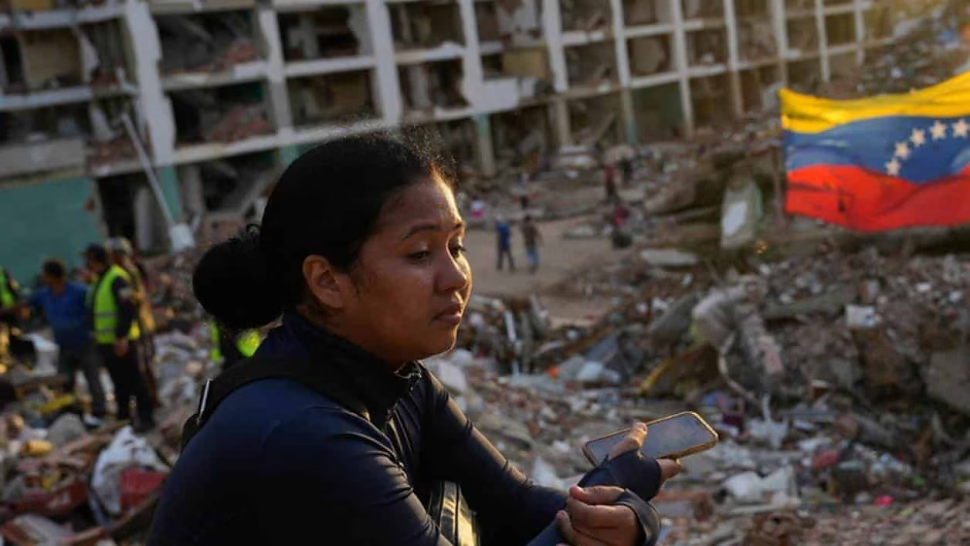
Most of the deaths occurred in the coastal state of La Guaira, 20 kilometers north of Caracas. After the 7.2 and 7.5 magnitude earthquakes, which occurred 39 seconds apart, 1,254 aftershocks have been recorded, according to the United States Geological Survey. They were the strongest earthquakes in the country in more than a century.

The report details that 856 buildings were damaged and 190 completely collapsed. More than 1,600 additional structures — bridges, roads — were also affected. The government estimates that tens of thousands of people lost their homes. Currently, more than 20 thousand remain in 107 temporary shelters installed in Caracas, La Guaira and the state of Miranda.

Continue reading

Lindsey Graham, Trump ally, dies at 71

Senator Lindsey Graham died at age 71 from an aortic dissection. Trump expressed his regret.

A loss in Congress

Republican Senator Lindsey Graham, a close ally of President Donald Trump, died Saturday night after a brief and sudden illness. He was 71 years old. His office confirmed the news in a statement posted on social media.

“The family appreciates the prayers and asks for privacy at this difficult time,” the text stated. No further details were immediately given.

Hours later, a second statement revealed the preliminary cause: an aortic dissection resulting from arteriosclerotic cardiovascular disease, according to the District of Columbia Medical Examiner. This is a rupture of the aorta due to hardening of the arteries.

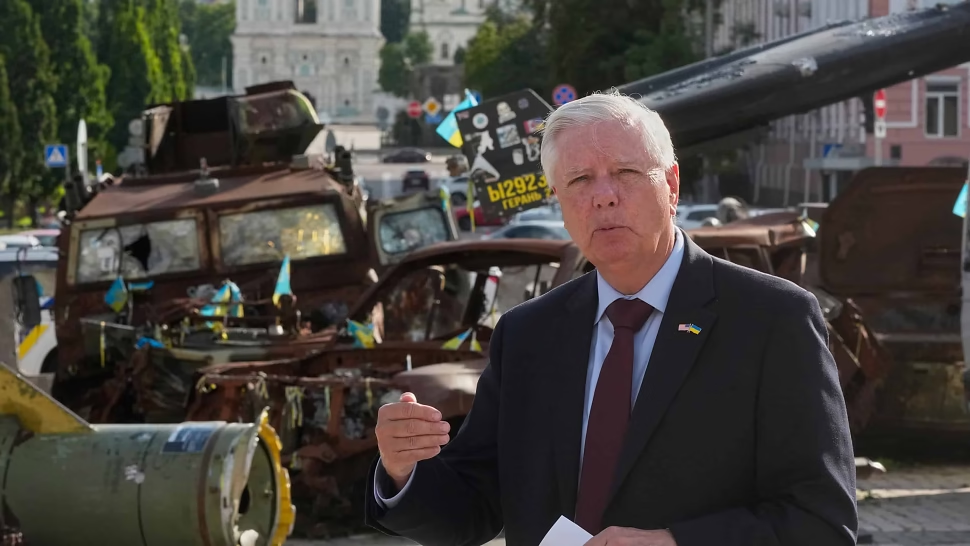
Trump, who spoke frequently with Graham, told NBC’s “Meet the Press” that the senator called him on Saturday after returning from a trip to Ukraine. “It sounded a little tired, but perfect,” he said. The president ordered flags to fly at half-mast until next Saturday.

Graham, a former Air Force attorney, served three decades in Congress. He was a foreign policy hawk and advised Trump on issues such as Iran and Russia. On Friday he had announced an agreement to advance sanctions against Russia. As chairman of the Senate Budget Committee, he was key in Trump’s second term, when Republicans pushed laws with a slim 53-47 majority in the House.

Continue reading