Venezuela raises the death toll from the June earthquakes to 4,561

Official figure amounts to 4,561 deaths after the June earthquakes in Venezuela.

The Venezuelan authorities updated this Monday the death toll after the two earthquakes on June 24. The new report, released by Jorge Rodríguez, president of the National Assembly, indicates that 4,561 fatalities have been recorded. The number of injured has remained at 16,740 for a week.

Disaster data

Most of the deaths occurred in the coastal state of La Guaira, 20 kilometers north of Caracas. After the 7.2 and 7.5 magnitude earthquakes, which occurred 39 seconds apart, 1,254 aftershocks have been recorded, according to the United States Geological Survey. They were the strongest earthquakes in the country in more than a century.

RelatedEarthquakes in Venezuela: more than 900 dead and 51 thousand missing

The report details that 856 buildings were damaged and 190 completely collapsed. More than 1,600 additional structures — bridges, roads — were also affected. The government estimates that tens of thousands of people lost their homes. Currently, more than 20 thousand remain in 107 temporary shelters installed in Caracas, La Guaira and the state of Miranda.

Navy ships arrive in Venezuela with humanitarian aid

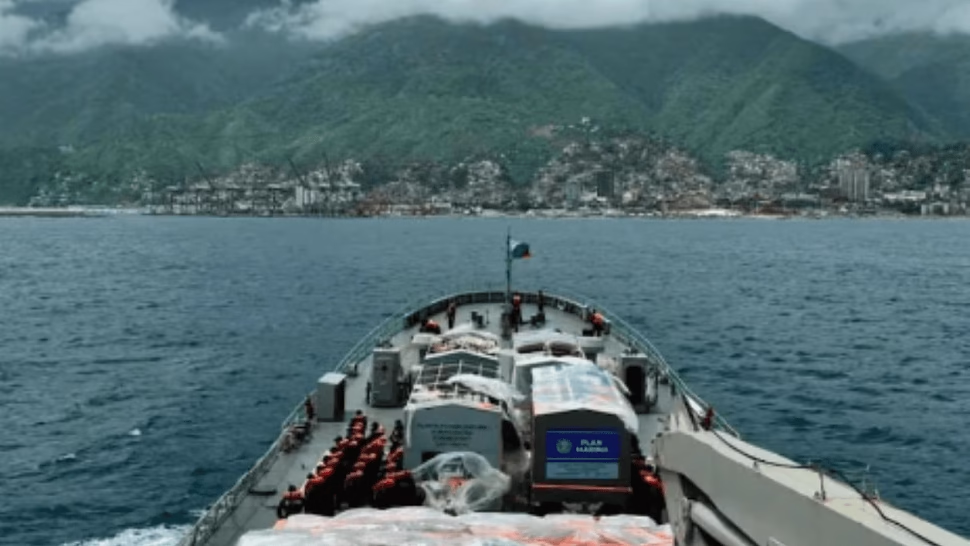
Mexico delivers 388 tons of aid to Venezuela after earthquakes in June.

The ARM Isla Holbox and ARM Huasteco ships docked at the port of La Guaira, Venezuela, after eight days of navigation. The mission, ordered by President Claudia Sheinbaum, aims to deliver humanitarian assistance to the Venezuelan people affected by the earthquakes of June 24.

Load and capacity

The journey of 1,969 nautical miles (more than 3,600 kilometers) transported 388.4 tons of supplies. It includes food, bottled water, hygiene items, medicines and four water treatment plants capable of producing a thousand liters of purified water per hour each.

Personnel and coordination

One hundred elements of the Navy’s Emergency Response Brigades (BRE) will participate in the landing, installation and operation of the plants. They will also support the organization and distribution of aid, in coordination with Venezuelan authorities.

The Secretary of the Navy (Semar) indicated that, although the immediate care phase has already been overcome, recovery efforts continue to restore essential services. The help sent seeks to strengthen that stage.

This operation was possible thanks to the joint work between Semar, the Foreign Ministry, institutions, companies, foundations and civil organizations. The federal government reiterated its commitment to international solidarity and the construction of a more resilient region in the face of natural disasters.

Continue reading

Lindsey Graham, Trump ally, dies at 71

Senator Lindsey Graham died at age 71 from an aortic dissection. Trump expressed his regret.

A loss in Congress

Republican Senator Lindsey Graham, a close ally of President Donald Trump, died Saturday night after a brief and sudden illness. He was 71 years old. His office confirmed the news in a statement posted on social media.

“The family appreciates the prayers and asks for privacy at this difficult time,” the text stated. No further details were immediately given.

Hours later, a second statement revealed the preliminary cause: an aortic dissection resulting from arteriosclerotic cardiovascular disease, according to the District of Columbia Medical Examiner. This is a rupture of the aorta due to hardening of the arteries.

Trump, who spoke frequently with Graham, told NBC’s “Meet the Press” that the senator called him on Saturday after returning from a trip to Ukraine. “It sounded a little tired, but perfect,” he said. The president ordered flags to fly at half-mast until next Saturday.

Graham, a former Air Force attorney, served three decades in Congress. He was a foreign policy hawk and advised Trump on issues such as Iran and Russia. On Friday he had announced an agreement to advance sanctions against Russia. As chairman of the Senate Budget Committee, he was key in Trump’s second term, when Republicans pushed laws with a slim 53-47 majority in the House.

Continue reading

US bombs Iran in response to attack in Strait of Hormuz

Air retaliation after Iranian attack on a ship in the Strait of Hormuz.

New escalation in the Strait of Hormuz

The United States launched multiple airstrikes against Iran on Sunday, in response to an Iranian action against a container ship in the Strait of Hormuz. The initial attack set the boat on fire and left one crew member missing.

Tehran responded with offensives against Bahrain, Kuwait, Qatar, Jordan and Oman. The latter nation, located on the other side of the strait, faces Iranian pressure to cooperate in managing maritime traffic.

The US military said it seeks to “degrade” Iran’s ability to attack commercial ships that transit freely through the waterway. The statement came after a third round of attacks, which lasted until early Monday morning.

Iranian state media confirmed explosions at several points. The first American wave, on Sunday morning, was a direct retaliation for the Iranian attack on the container ship the day before. In response, Iran attacked Gulf Arab countries, intensifying a cycle of violence that jeopardizes negotiations between Tehran and Washington to end the conflict.

Military objectives and reactions

Hours later, the United States attacked again. The governor of the island of Qeshm, near the strait, reported fewer than a dozen shells fired at military targets, with no casualties, according to the state agency IRNA. Explosions were also heard in Bandar Abbas and Hajiabad.

A U.S. official, speaking on condition of anonymity, said some attacks targeted missile systems, air defense and vessels of the paramilitary Revolutionary Guard.

US Central Command said it hit about 140 targets, including missile and drone launch sites, ammunition depots and communications equipment.

Negotiations on the brink of collapse

Iran and the United States are almost halfway through the 60-day period of their interim agreement, designed to reach a definitive cessation of hostilities. The strait, a key route for global oil and gas supplies, has become a point of friction that threatens to break down talks.

“A return to large-scale hostilities would have catastrophic consequences,” said UN Secretary-General António Guterres, according to a statement.

Iran maintains that the strait is closed; The United States denies it. The tension continues to increase.

Continue reading