A ring of fire at the end of the world
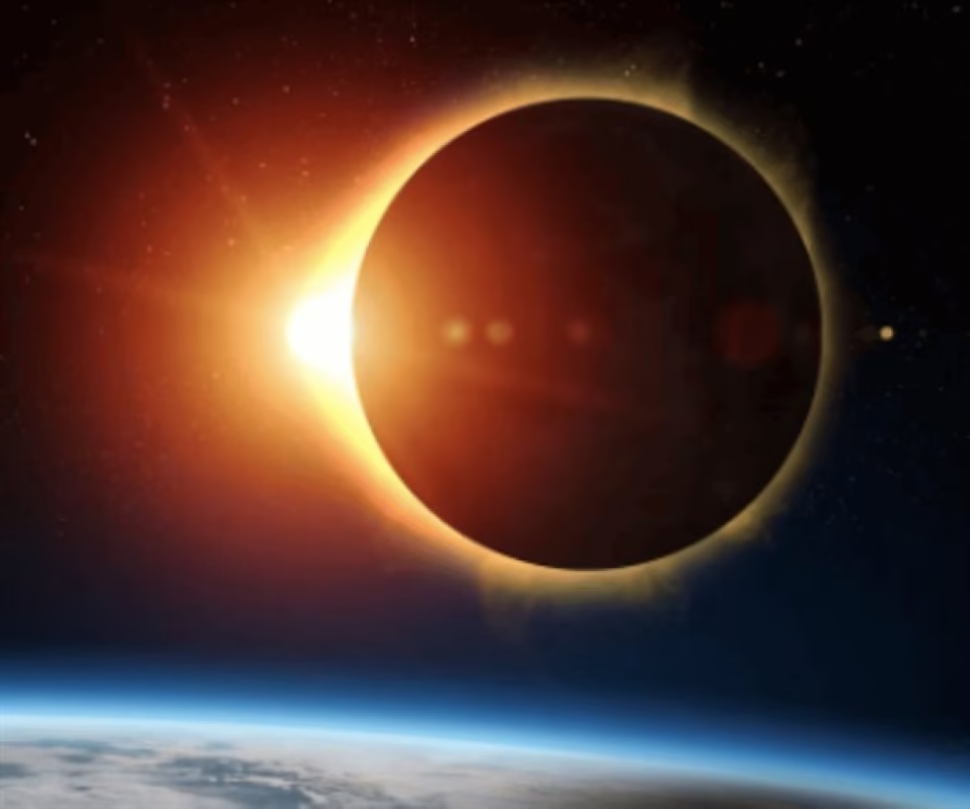
The astronomical year starts strong. On February 17, 2026, the Moon will pass in front of the Sun, creating one of the most impressive spectacles: an annular solar eclipse.
The particularity? That famous “ring of fire” will form because our satellite will be at its furthest point from Earth.
Where it will be seen (and where it will not be)
Here comes the key fact, and it is a little frustrating for many. According to NASA calculations, the path of the complete eclipse passes almost exclusively through remote areas of Antarctica.
“The trajectory of annularity is concentrated almost exclusively in remote regions of Antarctica,” the data confirm.
This means that only scientific expeditions and personnel at polar bases will see it in person. For the rest of the planet, it will be a digital event.
In the extreme south of Chile, Argentina and parts of South Africa a partial eclipse can be seen, but of low magnitude. For Mexico and North America, it will not be directly visible.
The solution: live broadcasts
All is not lost. Technology comes to the rescue so that no one misses out. Platforms such as Time and Date will offer complete coverage with mobile telescopes and interactive maps in real time.
NASA’s official YouTube channel also often features broadcasts with commentary from astrophysicists, which is a unique educational opportunity.
“The use of these digital tools is essential,” says the American Astronomical Society, recalling that observing this type of eclipse always requires specialized solar filters.
Viewing it online is not only safe for your eyes, but it also allows you to appreciate details of the solar corona that are normally only captured by professional equipment.
Why it matters for science
Beyond the visual spectacle, these events are pure gold for researchers. They allow us to study sudden changes in our atmosphere, specifically in the ionosphere, when sunlight briefly disappears.
Although the ring’s peak moment lasts only minutes, the data collected is vital to sharpening our understanding of celestial mechanics.
Practical Tip: If you plan to connect to a broadcast, do so a few minutes before 12:07 GMT (expected peak time) to ensure a good connection and not miss anything.
This event marks the beginning of a year 2026 full of important astronomical phenomena. One more reason to look at the sky, even if this time it’s through a screen.