They denounce manipulation in the FGR tender and labor abuses

Employees accuse manipulation of a state contracting process and systematic violations of their rights, while the authorities remain inactive.

Analysis of the accusations regarding the tender for cleaning services

A group of workers in the cleaning sector has submitted a formal request to the Secretary of Public Service, specifically to the Undersecretary of Anti-Corruption and Good Government, for an exhaustive audit to be carried out of the contracting process identified with the code LA-49-830-049000975-N-3-2026. This procedure, intended to award the cleaning and maintenance service in the facilities of the Attorney General of the Republic (FGR), is under scrutiny for alleged procedural anomalies. The central complaint lies in the fact that the call was postponed on three different occasions, a maneuver that, according to the complainants, had the ultimate objective of unduly favoring the company Shiny Place S.A. de C.V. to retain the concession.

The investigation reveals that this is not an isolated incident. The employees maintain that, throughout the last fiscal year, the contracting firm has accumulated multiple accusations for contractual breaches and questionable administrative practices. The most recurrent and serious pattern is the lack of punctuality in the disbursement of payrolls, systematically violating the terms agreed in the employment contracts. This situation has generated a climate of extreme financial instability for hundreds of families that depend on these salaries.

RelatedIMSS and SNTSS agree to salary increase and new labor benefits

Pattern of labor violations and institutional inaction

The conflict has transcended the administrative sphere to materialize in collective protest actions. Episodes such as the demonstration recorded in April of this year in front of the headquarters of the National Guard are a direct consequence of this accumulated unrest. The testimonies collected, such as that of Carlos, an employee who preferred to maintain partial anonymity, describe a hostile work environment: “It is always the same with this company (Shiny Place); they are late in payments and when one complains, they threaten to fire us and not give us a single peso of what we have already worked.” This statement highlights the asymmetry of power and the culture of intimidation that prevents the defense of basic rights.

The analysis of Shiny Place’s business practices shows a strategy to reduce operating costs that borders on illegality. The deliberate omission to register the entire workforce with the Mexican Social Security Institute (IMSS) has been documented, depriving workers of access to health services, financial disability benefits and a retirement fund. This regulatory evasion, added to the denial of other legal benefits, constitutes a double violation: against the dignity of the worker and against the public treasury. The Secretary of Labor and Social Welfare (STPS), the governing body in the matter, has maintained a position of apparent non-intervention, which has allowed the perpetuation of this scheme to the detriment of thousands of employees.

The logical conclusion drawn by those affected is that there is a correlation between the alleged manipulation of the bidding process and the company’s history. They trust that the Anti-Corruption and Good Government Secretariat will exercise its powers to review and, where appropriate, revoke the awarding ruling in favor of Shiny Place, considering that it is flawed from its origin and rewards a company with reprehensible work performance. The resolution of this case will set a crucial precedent on accountability in public procurement and the effective protection of the rights of workers subcontracted by the State.

Do you consider that transparency in public tenders is essential to combat corruption?Share this analysis on your social networks to make visible the importance of accountability and explore more content related to investigations on public ethics and labor rights on our platform.
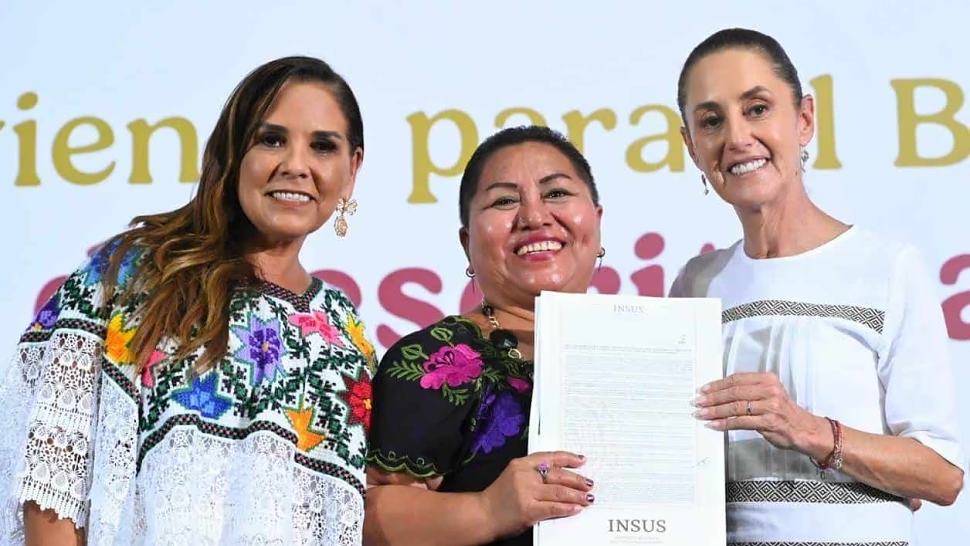

Sheinbaum announces comprehensive plan against sargassum in Quintana Roo

Federal government launches plan against sargassum with support from the Navy and Tourism in Quintana Roo.

Plan against sargassum in Quintana Roo

President Claudia Sheinbaum announced a comprehensive plan to clean the beaches of Quintana Roo of sargassum. It will start in 15 days and will be coordinated by the Secretariats of the Navy and Tourism.

“We went on a helicopter tour, the Navy lent us a helicopter, we went with the Secretary of the Navy to all the beaches, from Tulum to Puerto Morelos, to see the sargassum problem,” he declared from Playa del Carmen.

Sheinbaum explained that more boats will be purchased to capture sargassum at sea, a more effective method, and efforts will be made to recycle it to prevent it from affecting the beaches. The announcement occurred after delivering deeds to families in the Colosio neighborhood, as part of the Housing for Wellbeing program.

More actions in the entity

The president recalled that the six-year goal is to build 1.8 million homes, of which 57 thousand are contemplated in Quintana Roo. In addition, almost 5 million unpayable credits from Infonavit and Fovissste will be forgiven and restructured.

On the same tour, Sheinbaum presented the Tulum Renace Plan, which includes free entry to the Jaguar Park and new rates for the archaeological zone: 80 pesos for nationals and 265 for foreigners, according to the DOF.

The Secretary of Agrarian Development, Edna Elena Vega, reported that 504 documents of legal certainty were delivered in the Colosio neighborhood, totaling 2,397 deeds throughout the country. Governor Mara Lezama thanked the federal subsidy of 8 million pesos for the deeds.

Sebastiana Pérez, beneficiary of the program, expressed her gratitude for the legal certainty of her assets.

Continue reading

PRI deputy proposes extending paternity leave to 15 days

Initiative seeks to equalize parental rights and promote family co-responsibility.

PRI deputy Emilio Suárez Licona presented an initiative to extend paternity leave from five to 15 paid work days. The reform proposes to modify article 132 of the Federal Labor Law.

The proposal establishes that employers must grant paternity leave for the birth or adoption of a child. The objective is to strengthen the participation of parents in family care.

“Current legislation creates inequality by granting only five days of leave to fathers, while mothers have 84 days of maternity leave,” said the legislator.

Suárez Licona stated that the initiative seeks to guarantee more time for the comprehensive care and development of families. He recalled that the Supreme Court of Justice of the Nation has established criteria to advance in the approval of parental leave under the principle of the best interests of the child.

The deputy highlighted that countries such as Spain, Sweden and Norway have expanded paternity rights with models of greater family equality. In Mexico, the use of these licenses remains limited, so the reform aims to promote greater parental participation.

Continue reading

Ariadna Montiel responds to Maru Campos: “He has no moral authority”

Morena and the governor of Chihuahua clash over accusations of foreign interference and links to crime.

The national leader of Morena, Ariadna Montiel Reyes, responded to criticism from the governor of Chihuahua, María Eugenia Campos Galván, who accused the ruling party of using the Baja California case to clean up its image. The conflict escalated after the broadcast of audios about the governor of Baja California, Marina del Pilar Ávila Olmeda, and her possible link with FBI agents.

Crossed signs

Campos Galván published a video on social networks where he stated that the National Palace attempted to involve Chihuahua to divert attention. He demanded that the federal government “break the pact with crime” and said that the defense of the homeland must be above partisan interests.

In response, Montiel assured that Campos “does not have the moral authority” to talk about sovereignty. He accused her of having allowed the intervention of foreign agencies in security during her administration, mentioning joint operations with US authorities in Chihuahua.

Tension between parties

The Morenista leader maintained that the governor should not give lessons on national security. The exchange occurs in a context of disputes between Morena and opposition state governments over security issues and links with foreign forces. So far, there are no additional official statements.

Continue reading